
Revision summary
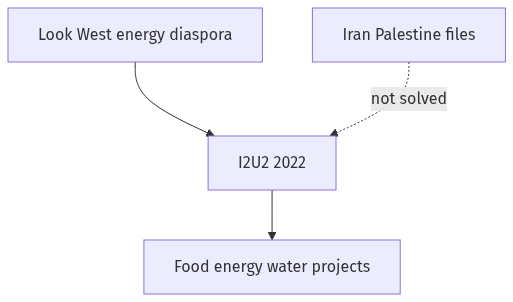
Look West treats the Gulf and Israel as central to energy, labour, and investment. I2U2 is India, Israel, UAE, and the United States in a 2022 project grouping. Food parks and clean energy are the public work, not a mutual-defence treaty. Abraham Accords politics made the table easier. Iran and Palestine remain outside its scope and still constrain India’s full West Asia map.
Model answer
Copper italics in this answer — like this — are the key facts. Each one is unpacked in the Facts & figures rail.
Introduction
I2U2 groups India, Israel, the United Arab Emirates, and the United States. It is the so-called West Asia Quad. Look West, or Think West, is India’s effort to treat the Gulf and Israel as seriously as Act East treats ASEAN. I2U2 is a project arm of that turn, not a NATO in the Gulf.
Body
Look West
- Energy imports, Indian workers in the Gulf, remittances, and later defence and investment with the UAE, Saudi Arabia, and Israel made West Asia a core interest, not a transit zone.
- The Abraham Accords reduced the cost of India dealing openly with Israel and Gulf States at the same table.
- Chabahar and Iran remained a parallel, harder file, which is why Look West is a set, not a single alliance.
What I2U2 does
- Announced in 2022, it has worked on food parks, hybrid energy, and water and space-related cooperation rather than on a joint army.
- It uses US technology, Gulf capital, Israeli innovation, and Indian scale and food demand.
- For India it is economic statecraft and status among West Asian partners, consistent with multi-alignment.
What it is not
- It is not a substitute for NAM or for Global South diplomacy. Several NAM States oppose Israeli policy. India separates I2U2 projects from UN votes that still use older language.
- It does not resolve Palestine, Yemen, or Iran. Tehran reads the geometry as unfriendly, which feeds the 7(c) challenge.
- It cannot police the Strait of Hormuz by itself. US and local militaries still dominate hard security.
Fit with theory
- Keohane’s clubs: a small regime for specific goods. Mitrany’s function: food and energy tasks first.
- Mearsheimer’s map: the United States knitting partners on China’s western approaches and on Iran. India participates where projects serve growth.
Flow diagram
Conclusion
I2U2 is a functional West Asian club that fits India’s Look West bet on Gulf capital, Israeli technology, and US partnership. It extends multi-alignment into projects. It does not replace Iran policy, Palestinian diplomacy, or Indian labour protection in the Gulf.
Quick related
Students also ask
-
Peaceful co-existence remains the cornerstone of India's foreign policy. Comment.
Next question on this syllabus topic (2022 · Q5(a)). View answer →
-
Is I2U2 the same as the Indo-Pacific Quad?
No. Membership and tasks differ. The nickname West Asia Quad is journalistic. There is no merged military command.
-
Does I2U2 end India’s Iran ties?
It complicates them. Chabahar still exists as a separate bet. India has not chosen a single West Asian camp.
Same topic · past papers
UPSC has asked this before
These previous-year questions sit on the same topic. Open one to practise the earlier ask.
-
2024 · Q7(a) · PSIR GS 2 · 20 marks
Discuss the future of SAARC in the light of India's increased focus on other regional groupings like ASEAN and BIMSTEC.
More from this topic
Q8(b) · UPSC Mains 2026 · PSIR GS 2 · 15 marks · Solution
India has recognised that West Asia is not a single contest, but a tangle of rivalries, bargains and anxieties. Comment
Recent developments in Indian Foreign policy
This 15-mark model answer for UPSC CSE Mains examines India's evolved diplomacy in West Asia, transitioning from a monolithic view to navigating complex regional rivalries, strategic bargains, and security anxieties. It highlights India's de-hyphenated engagement with Israel, Iran, and the Arab Gulf, robust energy diplomacy, diaspora protection, and minilateral frameworks like I2U2. The conclusion anchors this pragmatic realism within India's strategic autonomy and Act West policy.
Q5(b) · UPSC Mains 2026 · PSIR GS 2 · 10 marks · Solution
What strategic options can India exercise as a response to the tensions between Pakistan and Afghanistan?
Recent developments in Indian Foreign policy
India faces a complex security landscape due to Durand Line tensions and cross-border terrorism between Pakistan and Afghanistan. Strategic options include proactive diplomatic engagement with the Taliban regime to secure developmental investments, intelligence-sharing and capacity-building with regional partners like Iran and Central Asian Republics, and maintaining a strict posture on counter-terrorism. By leveraging multilateral platforms such as the Shanghai Cooperation Organisation and reinforcing soft-power outreach through humanitarian aid, New Delhi can safeguard its core security interests. Simultaneously, India must balance its defensive posture with strategic autonomy, ensuring regional stability without direct military entanglement in the Pashtun belt.
Q5(c) · UPSC Mains 2025 · PSIR GS 2 · 10 marks · Solution
For India, a multipolar world order would also mean a multipolar Asia. Comment.
Recent developments in Indian Foreign policy
A multipolar world is several great-power centres; it is hollow for India if Asia is Sino-centric. India’s threats, trade and waters are Asian, so Asian power-sharing is the real test of the slogan. Japan, ASEAN centrality, Korea, Australia and India beside China and the U.S. are the intended map. Quad and FOIP are instruments of pluralism, not a finished concert. The claim is right as strategy and still aspirational as fact.