
Revision summary
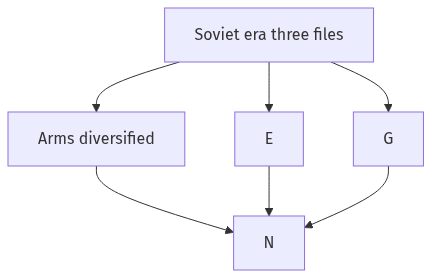
The old model was Soviet and Russian arms, a small economy, and anti-unipolar geopolitics. India now diversifies weapons; Russia is no longer the future monopoly supplier. After 2022, oil dominates trade and brings sanctions risk. Russia’s closeness to China weakens its value as India’s Asia balancer. The three names remain; the balanced three-pillar picture does not.
Model answer
Copper italics in this answer — like this — are the key facts. Each one is unpacked in the Facts & figures rail.
Introduction
For decades India–Russia ties were described through defence supply, a thin but strategic economy, and a geopolitical fit against a common map of China and the West. The statement is partly right: the old balance among those three has broken. It is too strong if it means the relationship has no remaining structure.
Body
Arms
- The Soviet Union and then Russia were the main source of Indian combat aircraft, tanks, submarines, and later the S-400 system.
- That pillar is weaker. India now buys from France, the United States, Israel, and domestic lines. Spare-part risk after 2022 and CAATSA pressure on customers of Russian systems accelerated diversification.
- Joint projects such as BrahMos still exist. New big-ticket dependence is no longer the whole of Indian modernisation.
- Arms remain a pillar in the inventory of the services. They are no longer the future-monopoly pillar they were in the 1970s–1990s.
Economy
- Pre-2022 trade was small next to India–China or India–US trade. Energy, diamonds, and fertilisers mattered more than a full production partnership.
- After 2022, discounted Russian oil made energy a suddenly large economic fact. That is a new economic pillar, not the old industrial-cooperation dream.
- Payment systems, shipping insurance, and Western secondary-sanctions risk make this energy trade politically costly and operationally awkward.
- Investment, connectivity through INSTC, and the rupee-rouble experiments have not matched the oil spike.
Geopolitics
- Shared interest in a multipolar order, a UN Security Council relationship, and caution about a unipolar United States still exist.
- The China–Russia closeness after 2022 is the shock. A partner that is also Beijing’s close strategic partner is a less simple geopolitical asset for New Delhi after Galwan.
- Russia remains useful on Afghanistan-era intelligence memory, Central Asia, and as a veto-wielding P5 member that India does not want as an enemy.
- Mearsheimer’s great-power map now places Russia as a declining European war State more than as India’s Asia balancer.
Comment
- The three headings still name the files. Their relative weights have changed: oil up, new arms down, geopolitics more contradictory.
- Keohane’s view of lingering regimes fits the residual defence and nuclear-technical cooperation. Cox’s view of a shifting world order fits Russia’s turn toward China.
- The fair comment is that the classic equal three-pillar model is outdated. A thinner, energy-heavy, politically constrained partnership remains.
Flow diagram
Conclusion
Arms, economy, and geopolitics still describe India–Russia files, but they are not three equal pillars. Diversified arms, oil-heavy trade, and a Russia–China bind have rebuilt the relationship on a narrower and more awkward base.
Quick related
Students also ask
-
Critically examine the rise of People's Republic of China (PRC) as a great power and its implications on Asian Political order
Next question on this syllabus topic (2022 · Q3(a)). View answer →
-
Has India ended defence ties with Russia?
No. Legacy platforms and some joint projects continue. New diversification is the change, not a zero inventory.
-
Is cheap oil enough to replace the old geopolitics?
It is a large commercial fact. It does not restore Russia as a simple balancer of China.
Same topic · past papers
UPSC has asked this before
These previous-year questions sit on the same topic. Open one to practise the earlier ask.
-
2026 · Q4(b) · PSIR GS 2 · 15 marks
How did the Council of Mutual Economic Assistance (CMEA) reflect geo-political division of the world during the cold war?
More from this topic
Q7(c) · UPSC Mains 2026 · PSIR GS 2 · 15 marks · Solution
India has adopted multi-alignment to fulfill its core values and interests in international relations. Discuss
Changing International Political Order
• Shifted from passive non-alignment to active multi-alignment to navigate a multipolar world. • Preserves strategic autonomy by building overlapping partnerships without joining exclusive blocs. • Drives economic security through diversified energy, trade corridors, and critical technologies. • Promotes a pluralistic, reformed global order rooted in civilizational independence. • Engages simultaneously in diverse platforms like the Quad, BRICS, SCO, and I2U2. • Balances major-power rivalries (US-China, Russia-West) while championing the Global South.
Q4(b) · UPSC Mains 2026 · PSIR GS 2 · 15 marks · Solution
How did the Council of Mutual Economic Assistance (CMEA) reflect geo-political division of the world during the cold war?
Changing International Political Order
The Council of Mutual Economic Assistance (CMEA), established in 1949, served as the Soviet bloc's institutional counterpart to the US-led Marshall Plan, institutionalizing the geo-political division of the global economy during the Cold War. It reflected bipolarity by binding Eastern European satellite states and extra-European socialist economies like Cuba and Vietnam into a centralized, Moscow-directed trade network. While intended to foster socialist internationalism and economic cooperation, it cemented the Eastern Bloc's separation from capitalist markets and reflected asymmetrical Soviet dominance. The organization ultimately highlighted the structural limitations of command economies and disintegrated alongside the Soviet collapse in 1991.
Q8(a) · UPSC Mains 2025 · PSIR GS 2 · 20 marks · Solution
India's reluctance to perceive any 'existential threat' inevitably made the multilateral path to nuclear security a 'default option' until it decided to cross nuclear Rubicon in 1998. Identify and analyze some of the major reasons behind this shift in India's position on the nuclear question
Changing International Political Order
India’s early nuclear path mixed scientific capacity with moral multilateralism and a recessed 1974 PNE. NPT hierarchy, NSG sanctions and CTBT’s closing window turned the default into a cage. China’s arsenal and Pakistan’s weapons-plus-proxy mix supplied the security case for 1998. Vajpayee’s government supplied the political will; status mixed with deterrence. 1998 was admission that survival could no longer be outsourced to a disarming great-power club.