
Revision summary
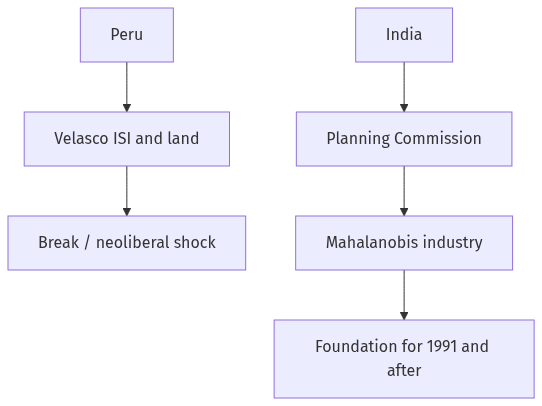
Peru’s mid-century development mixed export oligarchy with a radical military-planning interlude under Velasco, then crisis and neoliberal reversal. Indian early planning under the Planning Commission and the Mahalanobis strategy built public industry, technical education, and a durable idea of state-led structural change. India’s process was parliamentary and federally argued; Peru’s surge was corporatist and more easily dismantled. Critiques of the Hindu rate of growth and of controls do not cancel the foundational industrial and administrative capacity. The comparison shows that planning founds future development when institutions outlast a single regime, which India did more than Peru.
Model answer
Copper italics in this answer — like this — are the key facts. Each one is unpacked in the Facts & figures rail.
Introduction
Peru and India both tried, in the mid-twentieth century, to use the state to break a primary-export trap and to industrialise. Peru’s path ran through an oligarchic export economy, a burst of military developmentalism under Juan Velasco Alvarado, and then a crisis that opened onto Fujimori’s neoliberal shock. India’s early planning under Nehru, Mahalanobis, and the Planning Commission was more durable, more democratic, and more foundational for the mixed economy that followed — including the later turn to markets.
Body
The Peruvian experience
Peru’s classic political economy was coastal export (guano, then sugar, cotton, minerals) and an Andean hinterland of incomplete agrarian citizenship. Civilian governments flirted with import-substitution and with a National Planning Institute. The decisive developmental surge was the Revolutionary Government of the Armed Forces (1968–75). Velasco nationalised oil and parts of mining, legislated agrarian reform against the coastal latifundia, and built state enterprises. Planning was nationalist and corporatist, closer to a military project of CEPAL-style structuralism than to a parliamentary five-year debate.
- The limits were severe: top-down reform, later debt, and 1990s dismantling. Peruvian planning is a discontinuous developmental state — interrupted ISI without a lasting democratic coalition.
Early Indian planning as foundation
India’s Planning Commission (1950) and the Second Plan’s Mahalanobis heavy-industry strategy built steel, machines, IITs, and a public-sector elite. Critics of controls and the Hindu rate of growth do not erase that industrial and food-policy base. Unlike Velasco’s Peru, Indian plans were debated in Parliament and the NDC. 1991 liberalised from a mixed economy, not from an export oligarchy alone.
The comparative lesson
Planning without democratic depth can be reversed in a decade. India’s early phase laid physical and institutional rails that later markets and welfare still use. The foundation was a sovereign developmental state that survived leadership change — Peru’s mirror of discontinuity.
Flow diagram
Conclusion
Peru planned sharply under a military developmental regime and then unplanned under crisis and neoliberal shock. India planned early, imperfectly, and continuously enough to found an industrial and administrative base. The early Indian phase matters because later development, including the market turn, still stands on that base — a foundation Peru’s interrupted ISI did not equally leave.
Quick related
Students also ask
-
Illustrate with examples how regional parties in India have played a crucial role in drawing the historically disadvantaged groups into the mainstream political system
Next question on this syllabus topic (2025 · Q8(c)). View answer →
-
Why compare India with Peru rather than with the USSR?
Because both were mixed, postcolonial or post-oligarchic economies using ISI and land reform, not Soviet command systems; the contrast is democratic continuity versus military interruption.
-
Did early Indian planning cause later growth?
It did not cause the 2000s boom by itself. It supplied steel, skills, public banks, and a national market on which later growth and welfare could be built.
Same topic · past papers
UPSC has asked this before
These previous-year questions sit on the same topic. Open one to practise the earlier ask.
-
2021 · Q4(c) · PSIR GS 1 · 15 marks
"Free and fair deliberation is key to the foundation of democracy." Explain -
2021 · Q4(a) · PSIR GS 1 · 20 marks
Do you think that the Buddhist traditions have lent greater ethical foundation to the ancient Indian political thought? Give your arguments
More from this topic
Q8(c) · UPSC Mains 2026 · PSIR GS 1 · 15 marks · Solution
"The lack of political will in preventing environmental degradation is one of the major challenges that India is experiencing." Comment
Political Theory
This 15-mark PSIR answer evaluates India's environmental degradation through the lens of political will, balancing developmental imperatives with ecological imperatives. It examines how electoral cycles, populist short-termism, and growth-first paradigms often sideline ecological security. Key thinkers like Ramachandra Guha and political economy frameworks are integrated to explain the structural inertia. The response provides Indian illustrations ranging from developmental clearances to air pollution crises. It concludes with a policy-forward outlook anchored in constitutional provisions like Article 48A and 51A(g).
Q8(a) · UPSC Mains 2026 · PSIR GS 1 · 20 marks · Solution
Discuss the causes and consequences of inter-State water disputes in India
Political Theory
This answer examines the structural causes and multi-dimensional consequences of inter-State water disputes in India. It highlights federal friction, climate variability, and legal-institutional gaps as primary causes. The consequences span socio-economic losses, inter-regional animosity, and challenges to federal integrity. The response incorporates institutional frameworks like the Inter-State Water Disputes Act and concludes with cooperative water federalism as the way forward.
Q7(c) · UPSC Mains 2026 · PSIR GS 1 · 15 marks · Solution
Map the different types of ethnic conflicts that have emerged in 21st century India
Political Theory
This 15-marker maps the typology of ethnic conflicts in 21st-century India, distinguishing between indigenous-immigrant clashes, tribal identity assertions, and sub-nationalist movements. It examines the structural roots of these conflicts in uneven development, resource competition, and cultural anxiety. The answer integrates theoretical insights on identity politics with concrete Indian case studies across the Northeast and mainland. It concludes with a policy-oriented view emphasizing federal accommodation, democratic dialogue, and inclusive development.