
Revision summary
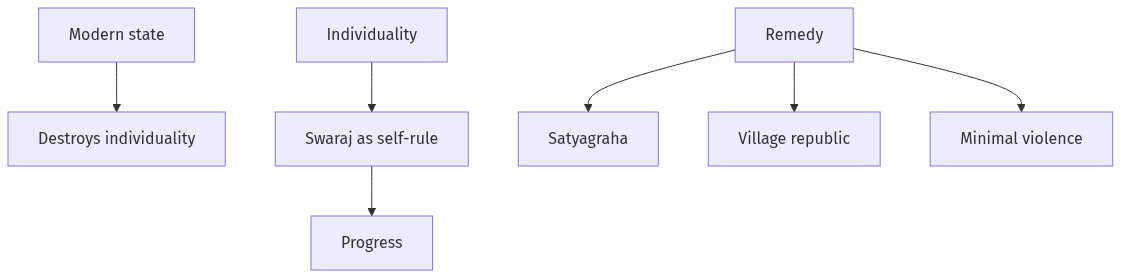
Gandhi treats individuality as moral self-rule, the root of progress, not as market isolation. The modern state, allied to industrial civilisation, takes over conscience and livelihood and turns persons into administered subjects. Hind Swaraj and the ideal of enlightened anarchy prefer a transformed, decentralised order to a powerful machine of good. Satyagraha, ahimsa, spinning, and panchayats are methods for growing individuals who can resist unjust law. Ambedkar’s caution that the state may still be needed against caste must qualify any simple anti-statism drawn from the quotation.
Model answer
Copper italics in this answer — like this — are the key facts. Each one is unpacked in the Facts & figures rail.
Introduction
Mahatma Gandhi wrote that the state does the greatest harm to mankind by destroying individuality, which lies at the root of all progress. The sentence is not an anarchist postcard. It is a moral theory of freedom. Individuality here is swaraj: self-rule of the person, without which collective swaraj is only a change of masters.
Body
What individuality means for Gandhi
Gandhi’s person is a moral agent who must answer for means as well as ends. Ruskin, Thoreau, and Tolstoy stand behind this. The individual experiments with truth. Progress is the growth of that capacity, not the growth of railways, armaments, or a census of subjects. When the modern state — with its police, professions, and “civilisation” that Hind Swaraj (1909) indicts — takes over conscience, hygiene, and livelihood, the person becomes a cog. Hobbes’s mortal god is, for Gandhi, a spiritual disaster even when it is efficient.
Individuality is not Mill’s aesthetic eccentricity alone, and it is not possessive individualism. It is the courage to say no to unjust law, and the discipline to purify oneself before demanding that the world change. That is why fasting, spinning, and jail-going are political methods. They produce individuals who cannot be fully administered.
How the state destroys it
A centralised state claims a monopoly of violence and of welfare. It professionalises politics. It conscripts. It may even do good — plague control, famine codes — while teaching dependence. Gandhi feared Western industrial civilisation as a partner of this state: wants multiply, character thins, and the village republic dies. He therefore preferred enlightened anarchy as an ideal, and a minimally violent, highly decentralised order as a practical approximation: panchayats, trusteeship, bread labour.
He was not blind to order. Some state remains among imperfect people. The hierarchy of values is the point: when the state becomes the principal agent of progress, it has already destroyed the root of progress.
Political implication
- Satyagraha is individuality in public: suffering binds the state without matching its force. Ahimsa keeps the opponent’s individuality intact. Ambedkar warned that saintly anti-statism can leave caste untouched. That criticism must sit here. Gandhi still names a pathology: the moral person absorbed into party, plan, and police.
Flow diagram
Conclusion
Gandhi’s charge is that the modern state kills the moral individual on whom progress depends. Swaraj is self-rule before it is a constitution. The remedy is decentralisation, satyagraha, and a severe limit on what the state may do in the name of the people. The warning remains, even where a constitutional state is still needed to protect those whom village custom would crush.
Quick related
Students also ask
-
Explain how the slogan 'the personal is political' addresses the issue of women's oppression and discrimination?
Next question on this syllabus topic (2025 · Q3(c)). View answer →
-
Was Gandhi an anarchist?
He named enlightened anarchy as the ideal and feared the state, yet he worked with and toward political institutions. The practical programme is radical decentralisation, not a cult of chaos.
-
How does this differ from Mill’s individuality?
Mill defends experiments in living under a liberal state. Gandhi suspects that very state and ties individuality to self-limitation, non-violence, and village swaraj.
Same topic · past papers
UPSC has asked this before
These previous-year questions sit on the same topic. Open one to practise the earlier ask.
-
2026 · Q3(c) · PSIR GS 1 · 15 marks
Discuss Gandhi's approach to property in relation to trusteeship
More from this topic
Q8(c) · UPSC Mains 2026 · PSIR GS 1 · 15 marks · Solution
"The lack of political will in preventing environmental degradation is one of the major challenges that India is experiencing." Comment
Political Theory
This 15-mark PSIR answer evaluates India's environmental degradation through the lens of political will, balancing developmental imperatives with ecological imperatives. It examines how electoral cycles, populist short-termism, and growth-first paradigms often sideline ecological security. Key thinkers like Ramachandra Guha and political economy frameworks are integrated to explain the structural inertia. The response provides Indian illustrations ranging from developmental clearances to air pollution crises. It concludes with a policy-forward outlook anchored in constitutional provisions like Article 48A and 51A(g).
Q8(a) · UPSC Mains 2026 · PSIR GS 1 · 20 marks · Solution
Discuss the causes and consequences of inter-State water disputes in India
Political Theory
This answer examines the structural causes and multi-dimensional consequences of inter-State water disputes in India. It highlights federal friction, climate variability, and legal-institutional gaps as primary causes. The consequences span socio-economic losses, inter-regional animosity, and challenges to federal integrity. The response incorporates institutional frameworks like the Inter-State Water Disputes Act and concludes with cooperative water federalism as the way forward.
Q7(c) · UPSC Mains 2026 · PSIR GS 1 · 15 marks · Solution
Map the different types of ethnic conflicts that have emerged in 21st century India
Political Theory
This 15-marker maps the typology of ethnic conflicts in 21st-century India, distinguishing between indigenous-immigrant clashes, tribal identity assertions, and sub-nationalist movements. It examines the structural roots of these conflicts in uneven development, resource competition, and cultural anxiety. The answer integrates theoretical insights on identity politics with concrete Indian case studies across the Northeast and mainland. It concludes with a policy-oriented view emphasizing federal accommodation, democratic dialogue, and inclusive development.