
Revision summary
The slogan comes from second-wave feminism, famously associated with Carol Hanisch, and treats private injuries as effects of public power. Liberal theory’s public–private split hid unpaid work, domestic violence, and sexual subordination as personal matters. Millett, Pateman, and MacKinnon analysed patriarchy, the sexual contract, and male-standpoint law as political structures. Once named, those structures can be met by rights, statutes, and a thicker idea of citizenship, as Indian feminist legal struggles show. The slogan must still make room for intimacy, and for caste and class differences among women, or it becomes another false universal.
Model answer
Copper italics in this answer — like this — are the key facts. Each one is unpacked in the Facts & figures rail.
Introduction
‘The personal is political’ is the compact of second-wave feminism. It says that women’s oppression is not a string of private misfortunes. It is organised through households, sexuality, law, and the state. Carol Hanisch’s 1969 essay gave the phrase its famous form. The theoretical work of Kate Millett, Shulamith Firestone, Carole Pateman, and Catharine MacKinnon shows why the slogan is a theory of power, not a mood.
Body
What the slogan refuses
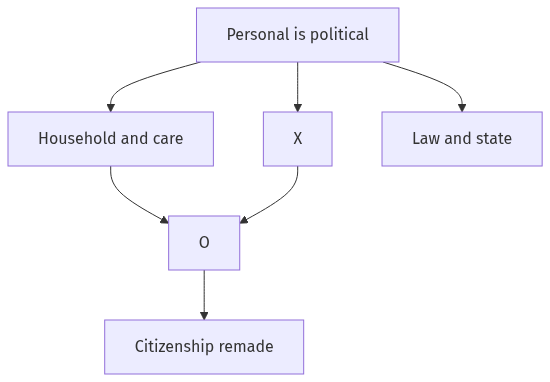
Liberal political theory, from Locke onward, split a public of rights and citizenship from a private of family and property. The family was natural, pre-political, or a haven. Discrimination in wages or votes could be named as public injustice. Beating, unpaid care, marital rape, and the silencing of domestic labour were treated as personal, cultural, or unfortunate. The slogan refuses that map. If the state licenses marriage, inheritance, and male headship, the household is already political.
Kate Millett treated patriarchy as power. Pateman’s sexual contract argued that the social contract presupposed men’s access to women’s bodies. MacKinnon analysed male-standpoint law. The site of injury is intimate; the cause is structural.
How it addresses oppression
Oppression is not only denial of the vote. It is unpaid care, control of fertility, and violence that keeps women out of public space. Consciousness-raising made isolated pain a public pattern, which law can then meet: domestic violence statutes, Vishaka, maternity rights. Nivedita Menon shows the slogan must travel across caste, or it becomes a privileged personal.
If everything is political, intimacy dies. Liberal feminists still want a reformed public–private split; socialist feminists add that culture without capitalism is an incomplete diagnosis. The diagnostic force remains: adding women to an unchanged public while leaving the household as a state of nature does not end discrimination.
Flow diagram
Conclusion
The personal is political because the private is already organised by public power. Naming family, sexuality, and care as political addresses oppression that equal voting rights left untouched. The task is to democratise those sites without abolishing intimacy, and without forgetting caste and class inside the category ‘woman’.
Quick related
Students also ask
-
The decision to conduct Population Census-2027 has reopened the debate on consultation in India. Discuss its various aspects
Next question on this syllabus topic (2025 · Q8(a)). View answer →
-
Does the slogan mean the state should run the family?
It means the family is already shaped by the state and by male power. Reform can be rights against violence and for care, not necessarily a police of intimacy.
-
How does this differ from first-wave suffrage feminism?
Suffrage demanded the vote as public equality. The second wave argued that without politicising the household, the vote would leave the deeper structure of patriarchy standing.
More from this topic
Q8(c) · UPSC Mains 2026 · PSIR GS 1 · 15 marks · Solution
"The lack of political will in preventing environmental degradation is one of the major challenges that India is experiencing." Comment
Political Theory
This 15-mark PSIR answer evaluates India's environmental degradation through the lens of political will, balancing developmental imperatives with ecological imperatives. It examines how electoral cycles, populist short-termism, and growth-first paradigms often sideline ecological security. Key thinkers like Ramachandra Guha and political economy frameworks are integrated to explain the structural inertia. The response provides Indian illustrations ranging from developmental clearances to air pollution crises. It concludes with a policy-forward outlook anchored in constitutional provisions like Article 48A and 51A(g).
Q8(a) · UPSC Mains 2026 · PSIR GS 1 · 20 marks · Solution
Discuss the causes and consequences of inter-State water disputes in India
Political Theory
This answer examines the structural causes and multi-dimensional consequences of inter-State water disputes in India. It highlights federal friction, climate variability, and legal-institutional gaps as primary causes. The consequences span socio-economic losses, inter-regional animosity, and challenges to federal integrity. The response incorporates institutional frameworks like the Inter-State Water Disputes Act and concludes with cooperative water federalism as the way forward.
Q7(c) · UPSC Mains 2026 · PSIR GS 1 · 15 marks · Solution
Map the different types of ethnic conflicts that have emerged in 21st century India
Political Theory
This 15-marker maps the typology of ethnic conflicts in 21st-century India, distinguishing between indigenous-immigrant clashes, tribal identity assertions, and sub-nationalist movements. It examines the structural roots of these conflicts in uneven development, resource competition, and cultural anxiety. The answer integrates theoretical insights on identity politics with concrete Indian case studies across the Northeast and mainland. It concludes with a policy-oriented view emphasizing federal accommodation, democratic dialogue, and inclusive development.