
Revision summary
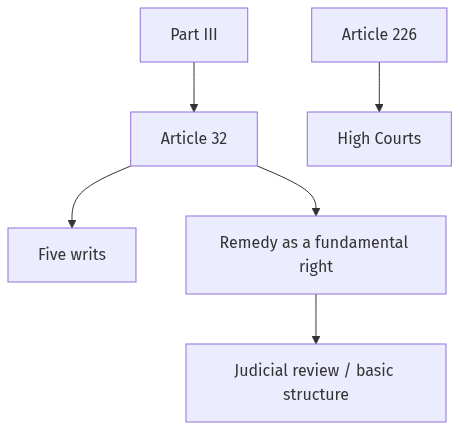
Part III’s distinctive legal remedy is Article 32: the right to move the Supreme Court to enforce Fundamental Rights. The Court may issue habeas corpus, mandamus, prohibition, quo warranto, and certiorari. Ambedkar called Article 32 the heart of the Constitution because rights need remedies. Article 226 gives High Courts a broader writ power in practice. Kesavananda treats judicial review as a basic-structure essential, which protects the remedial core of Part III.
Model answer
Copper italics in this answer — like this — are the key facts. Each one is unpacked in the Facts & figures rail.
Introduction
Part III of the Constitution of India does not only list liberties. It supplies legal remedies so that those liberties can be enforced against the state. Ambedkar called Article 32 the heart and soul of the Constitution because a right without a remedy is not a legal right.
Body
Article 32 and the writs
Article 32 gives the right to move the Supreme Court for enforcement of Fundamental Rights. The Court may issue habeas corpus, mandamus, prohibition, quo warranto, and certiorari. Habeas corpus tests illegal detention. Mandamus commands a public duty. Prohibition and certiorari control inferior courts and tribunals. Quo warranto tests usurpation of public office. This right to constitutional remedies is itself a fundamental right. Parliament cannot take it away in ordinary fashion; Kesavananda later protected judicial review as part of basic structure.
Related remedial structure
Article 226 gives High Courts a wider writ jurisdiction, including for purposes other than Part III, which makes the High Court the first practical forum for many citizens. During Emergency, the suspension of remedies showed what the rights are worth without courts. Public interest litigation later widened standing, so that remedies could reach those who could not personally approach the Court. The legal remedies in Part III are therefore Article 32 at the centre, the five writs as tools, and a judicially developed practice of access.
Flow diagram
Conclusion
Legal remedies in Part III are the right to approach the Supreme Court under Article 32, the writs that follow, and the status of that right as itself fundamental. Article 226 and later public interest practice complete the working system. Without these, the rest of Part III would be a declaration.
Quick related
Students also ask
-
Relevance of the Legislative Council.
Next question on this syllabus topic (2024 · Q5(d)). View answer →
-
Can Parliament abolish Article 32?
Ordinary amendment cannot empty judicial review of meaning. Basic-structure doctrine treats the power of courts to enforce rights as essential.
-
Are Directive Principles enforceable by these writs?
Directive Principles are not generally justiciable as rights. Courts may use them to interpret Part III, as Minerva Mills insisted on harmony, but Article 32 enforces Fundamental Rights.
Same topic · past papers
UPSC has asked this before
These previous-year questions sit on the same topic. Open one to practise the earlier ask.
More from this topic
Q8(b) · UPSC Mains 2026 · PSIR GS 1 · 15 marks · Solution
Critically comment on the shifts in the functioning of the Indian Parliament in the last two decades
Indian Nationalism
This 15-mark answer analyses the transformation of the Indian Parliament over the past two decades, moving from a deliberative forum to an arena of executive assertion. It highlights declining debate hours, bypassing of Department-Related Standing Committees (DRSCs), and the rise of ordinance-making and bypassing of bicameral consensus through Money Bills. The critique incorporates Morris-Jones and Pratap Bhanu Mehta's insights on the hollowing out of institutions. The conclusion argues for systemic institutional reforms to restore Parliament's core constitutional role as a deliberative check on executive power.
Q7(a) · UPSC Mains 2025 · PSIR GS 1 · 20 marks · Solution
Enunciate the impediments to women's participation in local governance in the process of political decentralisation
Indian Nationalism
The 73rd and 74th Amendments reserved local seats for women, which is a structural opening, not yet equal participation. Sarpanch-pati proxy rule, unpaid care, and a male bureaucracy remain the everyday patriarchal impediments. Caste and class decide which women can act; Dalit women office-holders face additional violence and veto. Thin devolution of money and staff makes many local offices ceremonial, so participation has no policy content. Parties and seat rotation often transfer the reserved ticket to a household rather than building a woman’s public career.
Q7(b) · UPSC Mains 2025 · PSIR GS 1 · 20 marks · Solution
Caste remains a vital axis for political mobilisation in India. How would the caste census address the aspirations of people? Discuss
Indian Nationalism
Caste remains a mobilisation axis because it still structures dignity, land, and access to the state, as Kothari, Mandal, and bahujan politics show. Parties already count jatis; the demand is that the official Census should too, beyond SC and ST. Aspirations include fairer reservation design, targeting of welfare, and recognition after the unpublished 2011 SECC caste data. Risks include reification of identity and a pure percentage war that forgets class, gender, and Ambedkar’s horizon of annihilation. A democratic census would publish usable aggregates while protecting persons and keeping constitutional individual rights at the centre.