
Revision summary
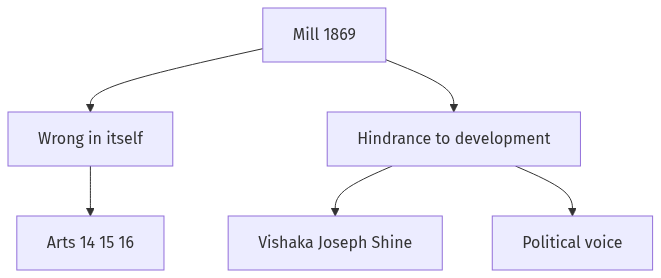
Mill held that legal subordination of women is unjust as a right and damaging to human development. The liberty principle puts the burden on those who would legally confine a sex. Indian Articles 14, 15, and 16 reject sex as a caste of public law. Vishaka, Shayara Bano, and Joseph Shine removed specific legal subordinations. Personal law and household inequality show that development is still hindered where legal rank remains.
Model answer
Copper italics in this answer — like this — are the key facts. Each one is unpacked in the Facts & figures rail.
Introduction
J. S. Mill in The Subjection of Women (1869) argued that the legal inferiority of women is unjust as a matter of right and harmful as a matter of social progress. The comment must take both clauses: wrong in itself, and a hindrance to development.
Body
Wrong in itself
- Mill applied the liberty principle of On Liberty: the burden of proof lies on those who would restrict a person, not on the person who would act.
- Legal subordination in marriage, property, custody, and public office treated women as a class under men, which Mill said no custom could justify once the argument was opened.
- The claim is deontological in force even though Mill is a utilitarian: some legal relations are unjust before one counts national output.
- Rawls later required equal basic liberties for all persons; sex as a legal rank fails that test.
- Ambedkar and the Constituent Assembly wrote Articles 14, 15, and 16 so that the state may not maintain sex as a caste of law, while Article 15(3) allows special provisions for women.
Hindrance to human development
- Mill’s development is the unfolding of capacities through freedom of thought, occupation, and association.
- Half the population legally confined wastes talent and corrupts the men who hold the privilege, which is a utilitarian and a moral-psychological claim.
- Education, property, and the vote were the instruments he named; later labour law, equal pay under Article 39(d), and political reservation in Articles 243D and 243T extend the same logic.
- Joseph Shine v. Union of India (2018) struck down the adultery offence as a denial of women’s equal status; Shayara Bano v. Union of India (2017) set aside instant triple talaq as arbitrary.
- Vishaka v. State of Rajasthan (1997) treated workplace sexual harassment as a constitutional injury pending a statute, which is development as the removal of a legal and social bar.
Limits of Mill and of the comment
- Mill still wrote inside a household picture that later feminists, and Carole Pateman, showed was itself a political contract of male sex-right.
- Legal equality does not by itself end unpaid care or violence; Sandel’s unencumbered self is not the whole of gendered life, yet Mill’s legal point remains the first public step.
- Personal law pluralism under Articles 25 to 30 continues to produce sex-unequal civil status in some domains, which is exactly the subordination Mill named.
- The 106th Amendment’s future reservation for women in legislatures is a delayed institutional reply to the second clause, development through voice.
Flow diagram
Conclusion
- Mill’s sentence stands: legal sex-subordination is unjust in itself and it blocks the development of women and of society. Articles 14 to 16, Vishaka, Shayara Bano, and Joseph Shine are the Indian legal working-out. Remaining personal-law and household inequalities show that the hindrance is not fully removed.
Quick related
Students also ask
-
Systems Approach.
Next question on this syllabus topic (2022 · Q1(a)). View answer →
-
Was Mill only a utilitarian in this essay?
He uses utility of development, but the first clause is a claim of justice: the legal relation is wrong in itself.
-
Does Article 15(3) contradict Mill?
No. Special provisions to correct historic legal and social bars are a means to the equal liberty Mill demanded, not a new subordination of men as a caste.
Same topic · past papers
UPSC has asked this before
These previous-year questions sit on the same topic. Open one to practise the earlier ask.
-
2022 · Q5(b) · PSIR GS 1 · 10 marks
The Preamble of the Indian Constitution reflects itself as a 'social contract'. Elucidate.
More from this topic
Q8(c) · UPSC Mains 2026 · PSIR GS 1 · 15 marks · Solution
"The lack of political will in preventing environmental degradation is one of the major challenges that India is experiencing." Comment
Political Theory
This 15-mark PSIR answer evaluates India's environmental degradation through the lens of political will, balancing developmental imperatives with ecological imperatives. It examines how electoral cycles, populist short-termism, and growth-first paradigms often sideline ecological security. Key thinkers like Ramachandra Guha and political economy frameworks are integrated to explain the structural inertia. The response provides Indian illustrations ranging from developmental clearances to air pollution crises. It concludes with a policy-forward outlook anchored in constitutional provisions like Article 48A and 51A(g).
Q8(a) · UPSC Mains 2026 · PSIR GS 1 · 20 marks · Solution
Discuss the causes and consequences of inter-State water disputes in India
Political Theory
This answer examines the structural causes and multi-dimensional consequences of inter-State water disputes in India. It highlights federal friction, climate variability, and legal-institutional gaps as primary causes. The consequences span socio-economic losses, inter-regional animosity, and challenges to federal integrity. The response incorporates institutional frameworks like the Inter-State Water Disputes Act and concludes with cooperative water federalism as the way forward.
Q7(c) · UPSC Mains 2026 · PSIR GS 1 · 15 marks · Solution
Map the different types of ethnic conflicts that have emerged in 21st century India
Political Theory
This 15-marker maps the typology of ethnic conflicts in 21st-century India, distinguishing between indigenous-immigrant clashes, tribal identity assertions, and sub-nationalist movements. It examines the structural roots of these conflicts in uneven development, resource competition, and cultural anxiety. The answer integrates theoretical insights on identity politics with concrete Indian case studies across the Northeast and mainland. It concludes with a policy-oriented view emphasizing federal accommodation, democratic dialogue, and inclusive development.