
Revision summary
Post-behaviouralism is Easton’s 1969 turn from technique-first behaviouralism to a science of public problems. The Credo of Relevance puts substance before technique and accepts professional responsibility for the use of knowledge. Action science means inquiry organised to change problems, joining data to explicit values. The turn corrects value-neutrality as evasion; it fails if it drops method for slogans. Indian policy and rights research is action science when it evaluates institutions, not only when it reports attitudes.
Model answer
Copper italics in this answer — like this — are the key facts. Each one is unpacked in the Facts & figures rail.
Introduction
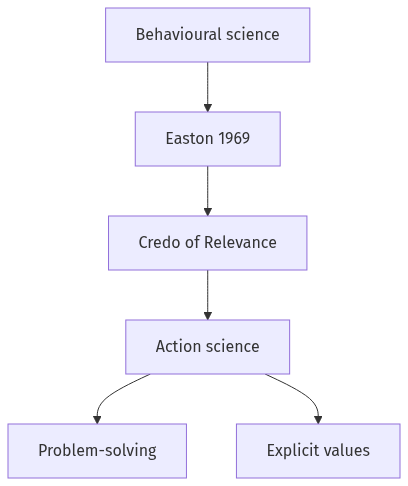
Post-behaviouralism is David Easton’s 1969 correction of the behavioural revolution. The Credo of Relevance says that political science must speak to the urgent problems of the time and must become an applied, problem-solving science of action, not only a value-neutral catalogue of regularities.
Body
From behaviouralism to the credo
- Behaviouralism, which Easton had promoted, sought observable attitudes, systems of demand and support, and cumulative theory.
- Robert Dahl’s decision studies and Almond and Verba’s civic culture were products of that programme.
- By 1969, war, racial conflict, and urban crisis in the United States made a purely technical science look evasive.
- Easton’s American Political Science Association address stated a credo: substance must precede technique; the needs of the day must set the agenda; science should not hide behind facts when the facts are of suffering.
- Relevance meant that the profession accepts responsibility for the use of knowledge.
Action science
- Action science, in this setting, is inquiry organised to change a public problem, not only to describe it.
- It joins empirical tools to explicit values: peace, racial equality, poverty, and later environment and gender.
- The analyst is not a spectator. She designs institutions, evaluates policy, and accepts that intervention is part of the knowledge process.
- This is closer to Marx’s thesis on changing the world, and to policy analysis, than to a laboratory model of detached observation.
- Foucault would later warn that sciences of action also govern; Easton’s credo still assumed that relevant science could serve human ends.
Analysis of the advocacy
- The credo correctly ended the pretence that Easton’s own systems theory had no value premises.
- It risked turning the discipline into short-term advocacy without the very methods that make action competent.
- A balanced post-behaviouralism therefore keeps measurement and comparison, and then asks, with Rawls, which action is just, and with Mill, which action leaves liberty standing.
- Indian political science that studies implementation of Parts III and IV, panchayats, and welfare statutes is action science in Easton’s sense when it evaluates and proposes, not only when it counts votes.
- The credo does not abolish theory. It forbids a theory that will not meet the world in which allocation, in Easton’s own definition, already happens.
Flow diagram
Conclusion
- The Credo of Relevance made post-behavioural political science an action science: empirically informed, value-explicit, and responsible for public problems. Easton corrected his own behavioural programme. The analysis holds if action remains disciplined by method and by a public theory of justice, not if relevance becomes only a slogan.
Quick related
Students also ask
-
"The legal subordination of one sex to another is wrong in itself, and now one of the chief hindrances to human development." (J. S. Mill). Comment
Next question on this syllabus topic (2023 · Q4(b)). View answer →
-
Did post-behaviouralism reject data?
No. It rejected the claim that technique and value-neutrality come before the problems of the time.
-
Is action science the same as activism?
It is disciplined intervention and evaluation. Activism without method is not what Easton’s credo asked the profession to become.
Same topic · past papers
UPSC has asked this before
These previous-year questions sit on the same topic. Open one to practise the earlier ask.
-
2021 · Q2(b) · PSIR GS 1 · 15 marks
Examine the importance of behavioural approach in political theory. What led to its decline?
More from this topic
Q8(c) · UPSC Mains 2026 · PSIR GS 1 · 15 marks · Solution
"The lack of political will in preventing environmental degradation is one of the major challenges that India is experiencing." Comment
Political Theory
This 15-mark PSIR answer evaluates India's environmental degradation through the lens of political will, balancing developmental imperatives with ecological imperatives. It examines how electoral cycles, populist short-termism, and growth-first paradigms often sideline ecological security. Key thinkers like Ramachandra Guha and political economy frameworks are integrated to explain the structural inertia. The response provides Indian illustrations ranging from developmental clearances to air pollution crises. It concludes with a policy-forward outlook anchored in constitutional provisions like Article 48A and 51A(g).
Q8(a) · UPSC Mains 2026 · PSIR GS 1 · 20 marks · Solution
Discuss the causes and consequences of inter-State water disputes in India
Political Theory
This answer examines the structural causes and multi-dimensional consequences of inter-State water disputes in India. It highlights federal friction, climate variability, and legal-institutional gaps as primary causes. The consequences span socio-economic losses, inter-regional animosity, and challenges to federal integrity. The response incorporates institutional frameworks like the Inter-State Water Disputes Act and concludes with cooperative water federalism as the way forward.
Q7(c) · UPSC Mains 2026 · PSIR GS 1 · 15 marks · Solution
Map the different types of ethnic conflicts that have emerged in 21st century India
Political Theory
This 15-marker maps the typology of ethnic conflicts in 21st-century India, distinguishing between indigenous-immigrant clashes, tribal identity assertions, and sub-nationalist movements. It examines the structural roots of these conflicts in uneven development, resource competition, and cultural anxiety. The answer integrates theoretical insights on identity politics with concrete Indian case studies across the Northeast and mainland. It concludes with a policy-oriented view emphasizing federal accommodation, democratic dialogue, and inclusive development.