
Revision summary
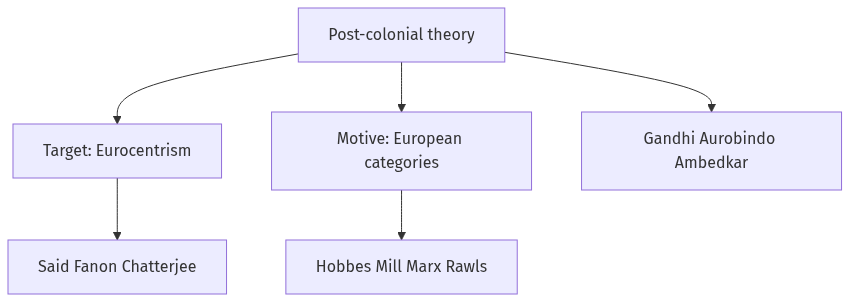
Eurocentrism treats European political experience as the universal measure. Post-colonial theory attacks that measure through Said, Fanon, and Chatterjee, and through recovery of Gandhi, Aurobindo, and Ambedkar. The same theory is motivated by European problems of the state, nation, and rights that empire made inescapable. Chakrabarty’s formula is that Europe is indispensable and inadequate. The discussion is of that double relation, not of a simple rejection of all European thought.
Model answer
Copper italics in this answer — like this — are the key facts. Each one is unpacked in the Facts & figures rail.
Introduction
Post-colonial political theory studies how empire organised knowledge, the state, and the self. Eurocentrism is its target because European experience was treated as the universal measure of the political. Eurocentrism is also a motive force because the theory still works by answering, reversing, and using European categories.
Body
Eurocentrism as target
- Eurocentrism is the practice of taking European state, reason, and progress as the standard, and treating other histories as lack or delay.
- Edward Said’s Orientalism showed that academic and literary knowledge of the East was a form of power, which meets Foucault’s power-knowledge thesis in an imperial setting.
- Frantz Fanon analysed colonial violence and the colonised mind; political theory that ignored that scene was incomplete.
- Partha Chatterjee argued that anti-colonial nationalism often copied the modular European nation and then claimed difference in the inner domain of culture.
- Indian materials that the decline-of-political-theory literature ignored — Gandhi’s Hind Swaraj, Aurobindo’s swaraj, Ambedkar’s constitutionalism — are recovered as theory, not as local colour.
Eurocentrism as motive force
- The questions of sovereignty, rights, the state, and civil society remain Hobbes, Locke, Mill, Marx, and Rawls questions even when the answer is no.
- Dipesh Chakrabarty’s provincializing Europe states the bind: Europe is indispensable and inadequate.
- Post-colonial writers use historicist time, the nation, and the archive that empire built, even while they criticise them.
- Subaltern studies sought a subject outside elite nationalism and still used Gramscian and Marxist tools.
- Motive force here means that without the European canon as antagonist and resource, the field would not have its present shape.
A balanced discussion
- If post-colonial theory only inverts Europe, it remains Europe-centred in a negative form.
- If it ignores rights, Dahl’s contestation, and Ambedkar’s law, it can romanticise community in the way Sandel and Walzer warn against when community is uncriticised.
- The productive path is to treat Indian, African, and Caribbean political thought as argument in its own right, and still to use European tools where they explain the colonial state that actually existed.
- Eurocentrism is therefore both what the theory attacks and what continues to organise its problems.
Flow diagram
Conclusion
Post-colonial political theory targets Eurocentrism as a false universal. It is also moved by European categories of state, nation, and rights that it must answer. Said, Fanon, Chatterjee, and Chakrabarty show that double relation. Gandhi, Aurobindo, and Ambedkar are the non-European arguments that the field must actually read.
Quick related
Students also ask
-
Examine the liberal theory of State in contemporary politics
Next question on this syllabus topic (2022 · Q3(a)). View answer →
-
Does post-colonial theory mean rejecting Mill and Rawls?
It means refusing their silent universality. It still uses liberty and justice as claims against colonial and post-colonial states.
-
Why is Eurocentrism a motive force, not only a target?
Because the colonial state was built in European legal forms, and because the theory defines itself by answering that canon.
More from this topic
Q1(b) · UPSC Mains 2026 · PSIR GS 1 · 10 marks · Solution
Post-colonial theory of State.
Theories of the State
The post-colonial theory of the state examines how state structures inherited from colonial powers operate in newly independent societies. Unlike Western liberal states, the post-colonial state is characterized by relative autonomy, overdevelopment of the bureaucratic-military apparatus, and interventionist socio-economic roles. Thinkers like Hamza Alavi and Partha Chatterjee highlight how the state mediates between multiple ruling classes while managing agrarian and industrial transitions. In India, this is visible in the state acting as a relative autonomous actor balancing regional, bourgeois, and agrarian interests. The framework provides crucial insights into state power, civil society weakness, and democratic consolidation in the Global South.
Q2(a) · UPSC Mains 2025 · PSIR GS 1 · 20 marks · Solution
What is the Marxist and liberal approach towards the state? On what grounds the theoretical differences between them are premised? Explain
Theories of the State
The liberal approach treats the state as limited public power justified by consent to protect rights, with law and separated offices as its form. Locke, Montesquieu, Mill, Rawls, and even Hayek share that the individual has claims the state must not devour. The Marxist approach treats the modern state as organised class power, from the Manifesto through Lenin’s smash-and-wither thesis. Gramsci and Poulantzas add hegemony and relative autonomy without dropping the class explanation. The theoretical difference rests on anthropology, property, history, and the meaning of emancipation, not only on liking or disliking a particular government.
Q1(b) · UPSC Mains 2024 · PSIR GS 1 · 10 marks · Solution
Pluralist theory of State.
Theories of the State
Pluralist theory treats the democratic state as an arena of competing organised groups rather than as a single-class or closed-elite machine. Bentley and Truman described politics as group process; Dahl called competitive democracy a polyarchy of multiple minorities. Resources of influence are dispersed, so who governs can vary by issue. Bachrach and Baratz, Lukes, Gramsci, and Lindblom show agenda control, manufactured wants, hegemony, and the privileged position of business. The theory explains open contest in polyarchies; it does not exhaust structural power.