
Revision summary
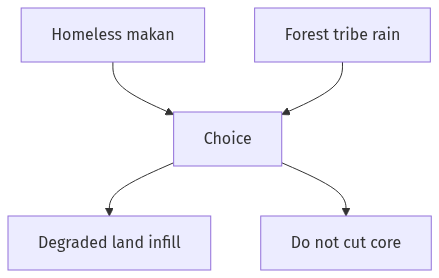
DPSPs demand both housing for the weak and protection of the environment. Clearing a biodiverse forest can unhouse tribals while housing someone else. The ethical first search is vacant plots, infill and degraded land, with FRA consent if forest is touched at all. A photo colony in a core habitat fails public-trust and land-ethic tests. The poor who live from the forest count as the poor, not as an obstacle.
Model answer
Copper italics in this answer — like this — are the key facts. Each one is unpacked in the Facts & figures rail.
Introduction
The Constitution asks the State to care about roti, kapda and makan. A district wants to cut a living forest to house the homeless. The same forest holds rain, tribes, medicine and soil. This is not ‘trees versus poor people’. It is which poor, which land, and whether the State did the easier violence.
Body
(a) Can deforestation be ethically justified for housing?
Not as a first resort, and not in this dense old patch. Shelter is a real duty (Article 21 with DPSPs on livelihood). A living forest that holds rain, tribes and soil is also a duty (Article 48A, public trust, FRA). Ethics of lesser harm can justify some tree loss on already degraded land after an honest search. It cannot justify the easiest green core so that a colony photograph is ready this financial year. If the only story is “the poor cannot eat biodiversity”, the speaker has erased the poor who already eat from that forest. So: no ethical blank cheque for this proposal; a narrow maybe only after brown-land failure is proved in public.
(b) Socio-economic, administrative and ethical challenges
Socio-economic: urban homeless need makan; forest users need produce and identity; a cleared slope can dry a town and raise future disaster costs. Administrative: EIA theatre, forged gram sabhas, target-driven housing missions, weak land records, and a contractor who arrives before the botanist. Ethical: which poor; consent versus consultation; present voters versus unborn; means (a grove as a shortcut) versus ends (dignity). Leopold’s land ethic and Gandhi’s talisman collide unless the officer counts the tribal face as the poorest face too.
(c) Substantial alternatives
Publish a vacant-land audit of government plots, infill, unused staff colonies and rental housing. Build vertical on brownfield. Repair existing public buildings first. If forest is touched at all: edge only, gram sabha consent, no-go core, real compensatory ecology (not distant eucalyptus), and livelihood shares for displaced users. PMAY and rental policy should precede a chainsaw. That package protects environmental integrity and human dignity together.
A civil servant who only quotes makan has forgotten that the grove is also kapda — shade — for the people who already live there.
Flow diagram
Conclusion
Shelter is a constitutional care. A dense old forest is not the first place to keep that promise. Audit degraded land, get consent, and do not manufacture a new displaced tribe in the name of housing.
Quick related
Students also ask
-
Case study. Subash is Secretary, PWD in the State Government. He is a senior officer, known for his competence, integrity and dedication to work. He enjoys the trust and confidence of Minister Incharge of PWD and Programme Implementation. As a part of his job profile, he is responsible for policy formulation, execution of projects relating to infrastructure initiatives in the State. Besides, he oversees the technical and administrative aspects relating to planning, designing and construction etc. Subash's Minister is an important Minister in the state and significant growth in urban infrastructure development and road network has been registered during his tenure. He is very keen for launching of ambitious road construction project in the near future. Subash is in regular touch with the Minister and is working various modalities of road construction project. Regular meetings, interactions and presentations are made by him to the Minister before a formal public announcement of the project is made by the Minister. Subash's only son Vikas is in real estate business. His son from his own sources is aware that a mega road project is on the anvil and announcement in this regard is expected anytime. He is very keen to know from his father the exact location of the upcoming project. He knows that there would be quantum jump in the prices of land at the proposed location. Buying land at this stage at cheaper prices would pay him rich dividends. He is pleading with him (his father) day in and day out to share him location of the proposed project. He assured him that he would handle the matter discreetly as it would not attract any adverse notice as he in the normal course, keeps on buying land as a part of his business. He feels pressurised because of constant pleadings by his son. Another significant aspect of the matter pertained to the extra/undue interest in the above project by the Minister PWD. His nephew was also having big infrastructure project company. In fact, the Minister has also introduced his nephew to him and indicated to him to take care of his nephew's business interest in the forthcoming project. The Minister encouraged him to act fast in the matter as early announcement and execution of mega road project would enhance his status in the party and public life. In the above backdrop, Subash is in a fix as to the future course of action. (a) Discuss the ethical issues involved in the case. (b) Critically examine the options available to Subash in the above situation. (c) Which of the above would be most appropriate and why?
Next question on this syllabus topic (2025 · Q9). View answer →
-
Does ethics freeze all urban housing?
No. It freezes the lazy choice of a green core when brown land exists.
-
What if the only land is forest?
Then prove it in a public audit, take the least harm slice, and compensate with real ecology and livelihood, not a distant eucalyptus plot.
Same topic · past papers
UPSC has asked this before
These previous-year questions sit on the same topic. Open one to practise the earlier ask.
-
2018 · Q12 · GS IV · 20 marks
Case study. As a senior officer in the Ministry, you have access to important policy decisions and upcoming big announcements such as road construction projects before they are notified in the public domain. The Ministry is about to announce a mega road project for which the drawings are already in place. Sufficient care was taken by the planners to make use of the government land with the minimum land acquisition from private parties. The compensation rate for private parties was also finalized as per government rules. Care was also taken to minimize deforestation. Once the project is announced, it is expected that there will be a huge spurt in real estate prices in and around that area. Meanwhile, the Minister concerned insists that you realign the road in such a way that it comes closer to his 20 acres farmhouse. He also suggests that he would facilitate the purchase of a big plot of land in your wife's name at the prevailing rate which is very nominal, in and around the proposed mega road project. He also tries to convince you by saying that there is no harm in it as he is buying the land legally. He even promises to supplement your savings in case you do not have sufficient funds to buy the land. However, by the act of realignment, a lot of agricultural lands have to be acquired, thereby causing a considerable financial burden on the government, and also the displacement of the farmers. As if this is not enough, it will involve cutting down of a large number of trees denuding the area of its green cover. Faced with this situation, what will you do? Critically examine various conflicts of interest and explain what your responsibilities are as a public servant. (250 words). -
2015 · Q11 · GS IV · 20 marks
Case study. You are heading a district administration in a particular department. Your senior officer calls you from the State Headquarters and tells you that a plot in Rampur village is to have a building constructed on it for a school. A visit is scheduled during which he will visit the site along with the chief engineer and the senior architect. He wants you to check out all the papers relating to it and to ensure that the visit is properly arranged. You examine the file which relates to the period before you joined the department. The land was acquired from the local Panchayat at a nominal cost and the papers show that clearance certificates are available from the two of the three authorities who have to certify the site's suitability. There is no certification by the architect available on file. You decide to visit Rampur to ensure that all is in order as stated on file. When you visit Rampur, you find that the plot under reference is part of Thakurgarh Fort and that the walls, ramparts, etc., are running across it. The fort is well away from the main village, therefore a school here will be a serious inconvenience for the children. However, the area near the village has potential to expand into a larger residential area. The development charges on the existing plot, at the fort, will be very high and the question of heritage site has not been addressed. Moreover, the Sarpanch, at the time of acquisition of the land, was a relative of your predecessor. The whole transaction appears to have been done with some vested interest. (a) List the likely vested interests of the concerned parties. (b) Some of the options for action available to you are listed below. Discuss the merits and demerits of each of the options: You can await the visit of the superior officer and let him take a decision. You can seek his advice in writing or on phone. You can consult your predecessor/colleagues, etc., and then decide what to do. You can find out if any alternate plot can be got in exchange and then send a comprehensive written report. Can you suggest any other option with proper justification?
More from this topic
Q12 · UPSC Mains 2026 · GS IV · 20 marks · Solution
Case study. Ajit has been recently promoted as the Head of the Department of Weapon Sales (DWS) in the Ministry of Defence Production (MDP). His charter of duties includes international sales of weapons produced domestically by MDP. In two recent wars, MDP weapons have performed admirably, resulting in many countries showing interest in buying them, particularly long-range artillery and missiles. Country A and country B have asked for these weapons. However, production constraints restrict DWS to accept only one purchase order. Country A is a developing nation with a sound technology base. MDP is planning R&D collaboration with it for the next generation of weapons. It is not part of any security alliance and needs weapons for protection from a troublesome neighbour. It seeks a large acquisition on a long-term loan. Country B is also a developing nation. Military strength is its priority, with the military budget often ingressing into allocations for human resources and infrastructure development. It is in security alliance with a superpower who has a large military base there and periodically allots it financial grants. It is a member of an economic bloc with which the government is currently negotiating a free trade agreement. It is not a signatory of NPT but possesses smaller nuclear weapons and delivery systems. It supports some guerrilla forces abroad. It has sought a smaller acquisition and is prepared to make some advance payment. It is currently negotiating arms purchases from another nation too. Ajit discussed this case with his counterparts in the related departments. Therein, the significant economic benefits, employment generation and stronger diplomatic relations arising from this sale were highlighted. It was also emphasized that refusing the deal could result in country B purchasing weapons from some other supplier. Ajit was aware that in arms sales, due diligence at each stage was pivotal to ensure conformity to national policy and international treaties. (a) Discuss the options available to Ajit. Which option should he select and why? (b) How can Ajit balance nation's economic and strategic interests with ethical considerations?
Ethics Case Studies
This case study examines ethical dilemma in defense exports, balancing economic gains, strategic partnerships, and non-proliferation norms. Ajit must choose between Country A for R&D collaboration and self-reliance, or Country B for immediate financial gains and FTA leverage. The recommended course prioritizes long-term strategic security, technological synergy, and international humanitarian norms over short-term mercantile interests.
Q11 · UPSC Mains 2026 · GS IV · 20 marks · Solution
Case study. Rajapuram is a border district. Jhara and Biru, its two major communities are in continual conflict with each other. The social fabric is fractured and demands mending. Ethnic tensions between the two communities have erupted into violence resulting in a large number of deaths. The stated causes are conflicting land claims, uneven resource allocation and inadequate political representation in government bodies. Separate relief camps had to be created for the two communities. The situation is volatile and appears to be getting out of control. Rajan has been appointed the District Magistrate (DM) of Rajapuram and tasked to quickly get the situation under control. His immediate tasks include restoring administrative authority, reopening the highway and initiating peace talks. On taking over his appointment, Rajan realized that the inter-community rivalry had even seeped into the local administration and police. With functional neutrality being the immediate casualty, it had made both communities distrustful of the government. The neighbouring country could utilize the opportunity to spur insurgent activity and further aggravate the situation. Rajan favoured a controlled approach starting with opening the highway to restore food and medical supplies. He toyed with the idea of requisitioning CRPF units to help restore administrative control. (a) Discuss the ethical issues that need to be addressed in this case. (b) What are the options open to Rajan? Which option would ensure protection of his non-partisan image without compromising ethics?
Ethics Case Studies
This GS4 case study examines the ethical dilemmas faced by a District Magistrate in managing an ethnic conflict in a sensitive border district. It analyses the ethical issues involving neutrality, human life, security, and institutional trust. It evaluates options ranging from purely coercive measures to inclusive peace-building. The recommended approach balances administrative firmness with transparent, unbiased stakeholder engagement to uphold public service values.
Q10 · UPSC Mains 2026 · GS IV · 20 marks · Solution
Case study. Vikas is a government officer with over a decade of service in public administration. He has recently moved as the District Collector (DC) of Nainipura, a remote hilly district bordering a forest. Due to Nainipura's low levels of economic development, one of his major duties is to ensure proper functioning of the public distribution system (PDS) amongst the economically weaker sections (EWS). During his on-site visits, Vikas was apprised of a typical administrative challenge in operating the PDS. To prevent leakages, all distributors were required to carry out real-time biometric identification of the beneficiaries, whose fingerprints were tallied with identity card records. This was creating problems as the operating system sometimes rejected fingerprint matching in the cases of growing children, manual labourers and senior citizens. The problem was further compounded in periods of low WIFI connectivity. The distributors, in such cases, resorted to personal discretion when they could identify the recipient. Vikas had to address this problem on priority. Strictly adhering to 'government regulations' would ensure fiscal probity but would greatly trouble the proposed beneficiary, i.e., EWS. It may even impinge on their fundamental right to life as per Article 21 of the Constitution. Conversely, leaving the resolution solely to the discretion of the distributors could lead to misuse and leakages. (a) What are the options open to Vikas? How should he balance fiscal probity with empathy towards the designated beneficiaries? (b) Discuss the ethics of using technology as a gatekeeper for welfare schemes.
Ethics Case Studies
• Balance strict digital rules with human empathy to prevent vulnerable citizens from losing entitled rations due to technical failures. • Avoid extreme approaches like rigid enforcement (causing exclusion) or unchecked discretion (causing leakage and corruption). • Implement practical offline workarounds like manual registers, paper slips, or OTPs backed by periodic audits. • Treat procedural norms and technology as tools for human welfare rather than rigid ends in themselves. • Recognize that digital gatekeeping creates ethical tensions between fiscal efficiency and the exclusion of genuine beneficiaries. • Guard against technology violating human dignity by forcing vulnerable groups to repeatedly prove their identity against system errors. • Ensure administrative accountability so systemic technological failures are not unfairly blamed on the citizens.