
Revision summary
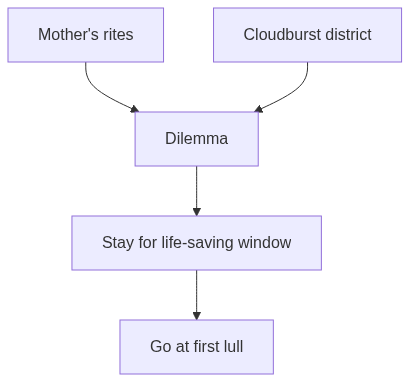
Vijay’s options are to leave at once, stay then go, stay through the peak, attempt a short hop, or freeze. The dilemma is filial duty versus the unique public role of a Deputy Commissioner in a still-killing disaster. Leaving at once risks command failure; using a relief helicopter for a funeral would be wrong. The best path is to stay through the life-saving window, delegate rites with the sister and a priest, and travel at the first true lull. Grief is not denied; it is sequenced after the right to life of those still in the open.
Model answer
Copper italics in this answer — like this — are the key facts. Each one is unpacked in the Facts & figures rail.
Introduction
Vijay is the Deputy Commissioner of a hill district that a cloudburst has broken. Roads and phones are down. More than two hundred people are dead and thousands are hurt. His mother in Kerala has died, and the family asks him to come for the last rites. He has no other close relative in India. This is not a trick. It is the oldest civil-service wound: the State’s hour and the mother’s hour falling on the same night.
Body
(a) Options available to Vijay
First, he can leave at once for Kerala, handing the district to the Additional District Magistrate and the Superintendent of Police, and hope the helicopter and camps run without him. Second, he can stay until the acute phase eases — roads partly open, the next rain pulse handled — and then go for rites, asking his sister to delay ceremonies if faith and law allow, or to perform them with a priest on video as many families did in the pandemic. Third, he can stay through the whole relief peak and accept that he may miss the funeral, requesting a cousin, a trusted neighbour, or the sister on a later flight to complete rituals, and performing his own shraddha when the district can spare him. Fourth, he can try a very short absence of a day if a special flight exists and if the Chief Secretary formally places a full charge, which in a cut-off hill district is often a fantasy. Fifth, he can collapse into indecision, which is also a choice, and a bad one.
(b) Ethical dilemmas
The dilemmas are filial piety versus public trusteeship; unique positional duty (only one DC is the crisis coordinator) versus replaceable son (rites can be done by kin and priest); personal grief versus the grief of five thousand injured; religious time (last rites soon) versus hydrological time (the next cloudburst). There is also integrity of emotion: pretending he does not hurt is false; abandoning the camps to prove he is a good son may be another falsehood. Confucius honoured the parent; the Constitution honours the right to life of the living who still need a boat. Both claims are real. That is why it is a dilemma, not a slogan.
(c) Critical evaluation of the options
Leaving at once honours the mother and may save Vijay from a lifetime of guilt. It risks command failure in a theatre where the DC’s name is the State. In a remote district, the ADM may be junior; helicopters need a single political-administrative face. The public will not parse his grief; they will see an empty chair.
Staying forever without any rite can look heroic and can break a person, and Hindu (or any) custom is not a toy. A middle path — stay while the rain is killing, delegate rites with a recorded blessing, go as soon as a named officer holds the night — respects both if it is honest, not a slow escape.
A one-day hop is ethically pretty and logistically cruel if it means a helicopter taken off a medical run. Using relief aviation for a funeral would be a scandal of means.
(d) Most appropriate option
The most appropriate course is to remain in the district through the life-saving window, formally vest operational charge in the next competent officer for defined hours, ask the sister and a priest to perform the rites with Vijay present on a satellite call if a link exists, and travel to Kerala at the first genuine lull, with the Chief Secretary informed so that the State owns the choice. This is Gandhi’s talisman (the face of the injured in the camp) plus honour to the parent delayed, not denied. It is role morality: the DC is not an ordinary son while the district is an open wound. When the wound closes, he must go home and weep. An officer who never weeps is not stronger. An officer who leaves a drowning block to prove a ritual clock is not more moral. He is absent.
Flow diagram
Conclusion
Vijay should hold the district while people are still being pulled from the slope, share the rites at a distance if he must, and go to Kerala as soon as a real lull and a named deputy exist. Duty to the living poor and honour to his mother can both be told in that order, not as a cancellation of either.
Quick related
Students also ask
-
Case study. In line with the Directive Principles of State Policy enshrined in the Indian Constitution, the government has a constitutional obligation to ensure basic needs - "Roti, Kapda aur Makan (Food, Clothes and Shelter)" - for the under-privileged. Pursuing this mandate, the district administration proposed clearing a portion of forest land to develop housing for the homeless and economically weaker sections of the society. The proposed land, however, is an ecologically sensitive zone densely populated with age-old trees, medicinal plants and vital biodiversity. Besides, these forests help to regulate micro-climate and rainfalls; provide habitat for wildlife, support soil fertility and prevent land/soil erosion and sustain livelihoods of tribal and nomadic communities. Inspite of the ecological and social costs, the administration argues in favour of the said proposal by highlighting that this very initiative would provide housing to human rights as a critical welfare priority. Besides it, it fulfils the government's duty to uplift and empower the poor through inclusive housing development. Further, these forest areas have become unsafe due to wild-animal threats and recurring human-wild life conflicts. Lastly, clearing forest-zones may help to curb anti-social elements allegedly using these areas as hideouts, thereby enhancing law and order. (a) Can deforestation be ethically justified in the pursuit of social welfare objectives like, housing for the homeless? (b) What are the socio-economic, administrative and ethical challenges in balancing environmental conservation with human development? (c) What substantial alternatives or policy interventions can be proposed to ensure that both environmental integrity and human dignity are protected?
Next question on this syllabus topic (2025 · Q8). View answer →
-
Is missing a parent’s funeral always unethical?
No. In a unique life-saving command it can be a tragic right. It remains a debt to be paid as soon as the command can be handed over.
-
Should the State force him to stay?
The Chief Secretary should support the stay with a named deputy and later leave. Coercion without support is another cruelty.
Same topic · past papers
UPSC has asked this before
These previous-year questions sit on the same topic. Open one to practise the earlier ask.
-
2025 · Q12 · GS IV · 20 marks
Case study. Ashok is Divisional Commissioner of one of the border districts of the North East State. A few years back, Military has taken over the neighbouring country after overthrowing the elected civil government. Civil war situation is prevailing in the country especially in last two years. However, internal situation further deteriorated due to rebel groups taking over control of certain populated areas near own border. Due to intense fight between military and rebel groups, civilian casualties has increased manifold in recent past. In the meantime, in one night Ashok got information from the local police guarding the border check post that there are about 200-250 people mainly women and children trying to cross over to our side of the border. There are also about 10 soldiers with their weapons in military uniform part of this group who wants to cross over. Women and Children are also crying and begging for help. A few of them are injured and bleeding profusely need immediate medical care. Ashok tried to contact Home Secretary of the State but failed to do so due to poor connectivity mainly due to inclement weather. (a) What are the options available with Ashok to cope with the situation?(b) What are the ethical and legal dilemmas being faced by Ashok?(c) Which of the options, do you think would be more appropriate for Ashok to adopt and why?(d) In the present situation, what are the extra precautionary measures to be taken by the Border Guarding Police in dealing with soldiers in uniform? -
2020 · Q9 · GS IV · 20 marks
Case study. Rampura, a remote district inhabited by a tribal population, is marked by extreme backwardness and abject poverty. Agriculture is the mainstay of the local population, though it is primarily subsistence due to the very small land holdings. There is insignificant industrial or mining activity. Even the targeted welfare programs have inadequately benefited the tribal population. In this restrictive scenario, the youth has begun to migrate to other states to supplement the family income. Plight of minor girls is that their parents are persuaded by labour contractors to send them to work in the Bt Cotton farms of a nearby state. The soft fingers of the minor girls are well suited for plucking the cotton. The inadequate living and working conditions in these farms have caused serious health issues for the minor girls. NGOs in the districts of domicile and the cotton farms appear to be compromised and have not effectively espoused the twin issues of child labour and development of the area. You are appointed as the District Collector of Rampura. Identify the ethical issues involved. Which specific steps will you initiate to ameliorate the conditions of minor girls of your district and to improve the over-all economic scenario in the district?
More from this topic
Q12 · UPSC Mains 2026 · GS IV · 20 marks · Solution
Case study. Ajit has been recently promoted as the Head of the Department of Weapon Sales (DWS) in the Ministry of Defence Production (MDP). His charter of duties includes international sales of weapons produced domestically by MDP. In two recent wars, MDP weapons have performed admirably, resulting in many countries showing interest in buying them, particularly long-range artillery and missiles. Country A and country B have asked for these weapons. However, production constraints restrict DWS to accept only one purchase order. Country A is a developing nation with a sound technology base. MDP is planning R&D collaboration with it for the next generation of weapons. It is not part of any security alliance and needs weapons for protection from a troublesome neighbour. It seeks a large acquisition on a long-term loan. Country B is also a developing nation. Military strength is its priority, with the military budget often ingressing into allocations for human resources and infrastructure development. It is in security alliance with a superpower who has a large military base there and periodically allots it financial grants. It is a member of an economic bloc with which the government is currently negotiating a free trade agreement. It is not a signatory of NPT but possesses smaller nuclear weapons and delivery systems. It supports some guerrilla forces abroad. It has sought a smaller acquisition and is prepared to make some advance payment. It is currently negotiating arms purchases from another nation too. Ajit discussed this case with his counterparts in the related departments. Therein, the significant economic benefits, employment generation and stronger diplomatic relations arising from this sale were highlighted. It was also emphasized that refusing the deal could result in country B purchasing weapons from some other supplier. Ajit was aware that in arms sales, due diligence at each stage was pivotal to ensure conformity to national policy and international treaties. (a) Discuss the options available to Ajit. Which option should he select and why? (b) How can Ajit balance nation's economic and strategic interests with ethical considerations?
Ethics Case Studies
This case study examines ethical dilemma in defense exports, balancing economic gains, strategic partnerships, and non-proliferation norms. Ajit must choose between Country A for R&D collaboration and self-reliance, or Country B for immediate financial gains and FTA leverage. The recommended course prioritizes long-term strategic security, technological synergy, and international humanitarian norms over short-term mercantile interests.
Q11 · UPSC Mains 2026 · GS IV · 20 marks · Solution
Case study. Rajapuram is a border district. Jhara and Biru, its two major communities are in continual conflict with each other. The social fabric is fractured and demands mending. Ethnic tensions between the two communities have erupted into violence resulting in a large number of deaths. The stated causes are conflicting land claims, uneven resource allocation and inadequate political representation in government bodies. Separate relief camps had to be created for the two communities. The situation is volatile and appears to be getting out of control. Rajan has been appointed the District Magistrate (DM) of Rajapuram and tasked to quickly get the situation under control. His immediate tasks include restoring administrative authority, reopening the highway and initiating peace talks. On taking over his appointment, Rajan realized that the inter-community rivalry had even seeped into the local administration and police. With functional neutrality being the immediate casualty, it had made both communities distrustful of the government. The neighbouring country could utilize the opportunity to spur insurgent activity and further aggravate the situation. Rajan favoured a controlled approach starting with opening the highway to restore food and medical supplies. He toyed with the idea of requisitioning CRPF units to help restore administrative control. (a) Discuss the ethical issues that need to be addressed in this case. (b) What are the options open to Rajan? Which option would ensure protection of his non-partisan image without compromising ethics?
Ethics Case Studies
This GS4 case study examines the ethical dilemmas faced by a District Magistrate in managing an ethnic conflict in a sensitive border district. It analyses the ethical issues involving neutrality, human life, security, and institutional trust. It evaluates options ranging from purely coercive measures to inclusive peace-building. The recommended approach balances administrative firmness with transparent, unbiased stakeholder engagement to uphold public service values.
Q10 · UPSC Mains 2026 · GS IV · 20 marks · Solution
Case study. Vikas is a government officer with over a decade of service in public administration. He has recently moved as the District Collector (DC) of Nainipura, a remote hilly district bordering a forest. Due to Nainipura's low levels of economic development, one of his major duties is to ensure proper functioning of the public distribution system (PDS) amongst the economically weaker sections (EWS). During his on-site visits, Vikas was apprised of a typical administrative challenge in operating the PDS. To prevent leakages, all distributors were required to carry out real-time biometric identification of the beneficiaries, whose fingerprints were tallied with identity card records. This was creating problems as the operating system sometimes rejected fingerprint matching in the cases of growing children, manual labourers and senior citizens. The problem was further compounded in periods of low WIFI connectivity. The distributors, in such cases, resorted to personal discretion when they could identify the recipient. Vikas had to address this problem on priority. Strictly adhering to 'government regulations' would ensure fiscal probity but would greatly trouble the proposed beneficiary, i.e., EWS. It may even impinge on their fundamental right to life as per Article 21 of the Constitution. Conversely, leaving the resolution solely to the discretion of the distributors could lead to misuse and leakages. (a) What are the options open to Vikas? How should he balance fiscal probity with empathy towards the designated beneficiaries? (b) Discuss the ethics of using technology as a gatekeeper for welfare schemes.
Ethics Case Studies
• Balance strict digital rules with human empathy to prevent vulnerable citizens from losing entitled rations due to technical failures. • Avoid extreme approaches like rigid enforcement (causing exclusion) or unchecked discretion (causing leakage and corruption). • Implement practical offline workarounds like manual registers, paper slips, or OTPs backed by periodic audits. • Treat procedural norms and technology as tools for human welfare rather than rigid ends in themselves. • Recognize that digital gatekeeping creates ethical tensions between fiscal efficiency and the exclusion of genuine beneficiaries. • Guard against technology violating human dignity by forcing vulnerable groups to repeatedly prove their identity against system errors. • Ensure administrative accountability so systemic technological failures are not unfairly blamed on the citizens.