Q9 · UPSC Civil Services Mains 2025 · GS IV · 20 marks · 2 min read

← Q8 Q10 →

Case study. Subash is Secretary, PWD in the State Government. He is a senior officer, known for his competence, integrity and dedication to work. He enjoys the trust and confidence of Minister Incharge of PWD and Programme Implementation. As a part of his job profile, he is responsible for policy formulation, execution of projects relating to infrastructure initiatives in the State. Besides, he oversees the technical and administrative aspects relating to planning, designing and construction etc. Subash's Minister is an important Minister in the state and significant growth in urban infrastructure development and road network has been registered during his tenure. He is very keen for launching of ambitious road construction project in the near future. Subash is in regular touch with the Minister and is working various modalities of road construction project. Regular meetings, interactions and presentations are made by him to the Minister before a formal public announcement of the project is made by the Minister. Subash's only son Vikas is in real estate business. His son from his own sources is aware that a mega road project is on the anvil and announcement in this regard is expected anytime. He is very keen to know from his father the exact location of the upcoming project. He knows that there would be quantum jump in the prices of land at the proposed location. Buying land at this stage at cheaper prices would pay him rich dividends. He is pleading with him (his father) day in and day out to share him location of the proposed project. He assured him that he would handle the matter discreetly as it would not attract any adverse notice as he in the normal course, keeps on buying land as a part of his business. He feels pressurised because of constant pleadings by his son. Another significant aspect of the matter pertained to the extra/undue interest in the above project by the Minister PWD. His nephew was also having big infrastructure project company. In fact, the Minister has also introduced his nephew to him and indicated to him to take care of his nephew's business interest in the forthcoming project. The Minister encouraged him to act fast in the matter as early announcement and execution of mega road project would enhance his status in the party and public life. In the above backdrop, Subash is in a fix as to the future course of action. (a) Discuss the ethical issues involved in the case. (b) Critically examine the options available to Subash in the above situation. (c) Which of the above would be most appropriate and why?

Topic: Ethics Case Studies. Syllabus: Case Studies on above issues. Same official PYQ from year-wise 2025 and Ethics Case Studies.

Revision summary

The ethical issues are conflict of interest, insider land information and a minister’s plea for a nephew. Leaking the alignment would let the son steal a public price jump. Favouring the nephew would be cronyism. Subash should refuse both, warn his son, recuse from related tenders, and record the minister’s request to the Chief Secretary. Discretion that hides a family trade is not professionalism.

Model answer

Introduction

Subash is a trusted PWD Secretary. His son wants the secret alignment of a coming road so that he can buy land cheap. The Minister wants care for a nephew’s infrastructure firm. This is a textbook of conflict of interest, insider information, and political pressure. Competence without probity is how a good officer becomes a family broker.

Body

(a) Ethical issues

  • Conflict of interest: Subash’s private family wealth is tied to a public secret. Misuse of official information (a Conduct Rules and, at the extreme, a criminal line) if he speaks the alignment. Fairness: other citizens cannot buy that land. Independence: the Minister’s nephew is a second conflictcrony access. Integrity versus loyalty: loyalty to a minister is constitutional, not personal. Emotional pressure from a son is still not a defence. Appearance of bias even if he later “does it discreetly” — justice must be seen.

(b) Options

He can leak to the son and favour the nephew. He can leak to the son and resist the nephew. He can tell neither and record the minister’s request in a confidential file to the Chief Secretary. He can recuse from the alignment decision and from tender committees. He can ask for a transfer. He can warn the son in writing that any bid using inside knowledge will be reported. He can become a whistle if a tender is already being tailored.

(c) Most appropriate

  • The right bundle is: do not share the location with the son; tell the son, once, firmly, that the request is unethical and possibly illegal; treat the nephew as any other bidder under transparency of DPR and tender; reduce to writing the minister’s “take care” remark and seek written orders if the minister insists on a name; recuse from evaluation if the nephew bids; inform the Chief Secretary so the State, not Subash’s memory, holds the risk. If the minister punishes him, that is the cost of integrity, which Vivekananda would still call strength.

Kautilya listed temptations of office. The son’s plea is the softest and worst, because love launders a crime. The most appropriate option is silence on the map, sunlight on the tender, and a file that can go to a court.

Flow diagram
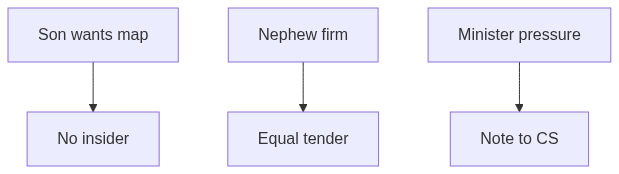
flowchart TD
  SON[Son wants map] --> NO[No insider]
  NEP[Nephew firm] --> EQ[Equal tender]
  MIN[Minister pressure] --> FIL[Note to CS]

Conclusion

Subash must not feed his son the alignment and must not tailor the project for the minister’s nephew. He should recuse where family or the nephew appears, record pressure, and keep the tender open. Love and loyalty are not licences to loot a road.

Quick related

Students also ask

PYQ trend

When UPSC asked this

Related PYQs from other years, newest first. Open a question to read it.

  1. 2025 · Q7 · GS IV · 20 marks

    Case study. Vijay was Deputy Commissioner of remote district of Hilly Northern State of the country for the last two years. In the month of August heavy rains lashed the complete state followed by cloud burst in the upper reaches of the said district. The damage was very heavy in the complete state especially in the affected district. The complete road network and telecommunication were disrupted and the buildings were damaged extensively. People's houses have been destroyed and they were forced to stay in open. More than 200 people have been killed and about 5000 were badly injured. The Civil Administration under Vijay got activated and started conducting rescue and relief operations. Temporary shelter camps and hospitals were established to provide shelter and medical facilities to the homeless and injured people. Helicopter services were pressed in, for evacuating sick and old people from remote areas. Vijay got a message from his hometown in Kerala that his mother was seriously sick. After two days Vijay received the unfortunate message that his mother has expired. Vijay has no close relative except one elder sister who was US citizen and staying there for last several years. In the meantime, the situation in the affected district deteriorated further due to resumption of heavy rains after a gap of five days. At the same time, continuous messages were coming on his mobile from his hometown to reach at the earliest for performing last rites of his mother. (a) What are the options available with Vijay?(b) What are the ethical dilemma being faced by Vijay?(c) Critically evaluate and examine each of these options identified by Vijay.(d) Which of the options, do you think, would be most appropriate for Vijay to adopt and why?

    View answer →

  2. 2025 · Q8 · GS IV · 20 marks

    Case study. In line with the Directive Principles of State Policy enshrined in the Indian Constitution, the government has a constitutional obligation to ensure basic needs - "Roti, Kapda aur Makan (Food, Clothes and Shelter)" - for the under-privileged. Pursuing this mandate, the district administration proposed clearing a portion of forest land to develop housing for the homeless and economically weaker sections of the society. The proposed land, however, is an ecologically sensitive zone densely populated with age-old trees, medicinal plants and vital biodiversity. Besides, these forests help to regulate micro-climate and rainfalls; provide habitat for wildlife, support soil fertility and prevent land/soil erosion and sustain livelihoods of tribal and nomadic communities. Inspite of the ecological and social costs, the administration argues in favour of the said proposal by highlighting that this very initiative would provide housing to human rights as a critical welfare priority. Besides it, it fulfils the government's duty to uplift and empower the poor through inclusive housing development. Further, these forest areas have become unsafe due to wild-animal threats and recurring human-wild life conflicts. Lastly, clearing forest-zones may help to curb anti-social elements allegedly using these areas as hideouts, thereby enhancing law and order. (a) Can deforestation be ethically justified in the pursuit of social welfare objectives like, housing for the homeless? (b) What are the socio-economic, administrative and ethical challenges in balancing environmental conservation with human development? (c) What substantial alternatives or policy interventions can be proposed to ensure that both environmental integrity and human dignity are protected?

    View answer →

  3. 2025 · Q10 · GS IV · 20 marks

    Case study. Rajesh is a Group A officer with nine years of service. He is posted as Administrative Officer in an Oil Public Sector undertaking. As an Administrative Officer he is responsible for managing and coordinating various administrative tasks to ensure smooth functioning of office. He also manages office supplies, equipment etc. Rajesh is now sufficient senior and is expecting his next promotion in JAG (Junior Administrative Grade) in the next one or two years. He knows that promotion is based on examination of ACRs/Performance Appraisal of last few years (5 years or so) of an officer by a DPC (Departmental Promotion Committee) and an officer lacking requisite grading of ACRs may not be found fit for promotion. Consequences of losing promotion may entail financial and reputational loss and set-back for career progression. Though he also puts his best efforts in official discharge of his duties, yet he is unsure of assessment by his superior officer. He is now putting extra efforts so that he gets thumping report at the end of financial year. As Administrative Officer, Rajesh is regularly interacting with his immediate boss, who is his reporting officer for writing his ACR. One day he calls Rajesh and wants him to buy computer-related stationery on priority from a particular vendor. Rajesh instructs his office to initiate action for procuring these items. During the day, the dealing Assistant brings an estimate of Rupees Thirty Five Lakhs covering all stationery items from the same vendor. It is noticed that as per delegated financial powers, as provided in the GFR (General Financial Rules) as applicable in that Organisation, expenditure for office items exceeding Rupees Thirty Lakhs requires sanction of the next higher authority (boss in the present case). Rajesh knows that immediate superior would expect all these purchases should be done at his level and may not appreciate such lack of initiative on his part. During discussions with office, he learns that common practice of splitting of expenditure (where large order is divided into a series of smaller ones) is followed to avoid obtaining sanction from higher authority. This practice is against the rules and may come to the adverse notice of Audit. Rajesh is perturbed. He is unsure of taking decision in the matter. (a) What are the options available with Rajesh in the above situation?(b) What are the ethical issues involved in this case?(c) Which would be the most appropriate option for Rajesh and why?

    View answer →

  4. 2025 · Q11 · GS IV · 20 marks

    Case study. Mahatma Gandhi National Rural Employment Guarantee Program, MGNREGA was earlier known as National Rural Employment Scheme, NREGA. It is an Indian Social Welfare Program that aimed at fulfilling the 'Right to Work' provisions made in the Constitution. MGNREGA was launched in 2006 under Rural Employment Sector by the Ministry of Rural Development. Main objective of the program is to give legal guarantee of wage employment to the adult members of rural households who are willing to do unskilled manual labour work subject to a maximum of 100 days per year for every household. Every rural household has the right to register under the scheme, job card is issued to the registered, Job Card holder can seek employment; State Government shall pay 25% of minimum wage for the first 30 days as compensatory daily unemployment allowance to the families and of wage for remaining period of the year. MGNREGA work was undertaken by various Gram Panchayats. You have been appointed as an Administrator Incharge of the District. You have been given the responsibility of monitoring MGNREGA work undertaken by various Gram Panchayats. You are also given the authority to give technical sanctions to all MGNREGA works. In one of the Panchayats in your jurisdiction, you notice that your predecessor has mismanaged the Program in terms of: (i) Money not disbursed to actual job-seekers.(ii) Muster Rolls of the Labourers not properly maintained.(iii) Mismatch between the work done and payments made.(iv) Payments made to fictitious persons.(v) Job Cards were given without looking into the need of person.(vi) Mismanagement of funds and to the extent of siphoning of funds.(vii) Approved works that never existed. (a) What is your reaction to the above situation and how do you restore the proper functioning of MGNREGA Program in this regard?(b) What actions would you initiate, to solve the various issues listed above?(c) How would you deal with the above situation?

    View answer →

  5. 2025 · Q12 · GS IV · 20 marks

    Case study. Ashok is Divisional Commissioner of one of the border districts of the North East State. A few years back, Military has taken over the neighbouring country after overthrowing the elected civil government. Civil war situation is prevailing in the country especially in last two years. However, internal situation further deteriorated due to rebel groups taking over control of certain populated areas near own border. Due to intense fight between military and rebel groups, civilian casualties has increased manifold in recent past. In the meantime, in one night Ashok got information from the local police guarding the border check post that there are about 200-250 people mainly women and children trying to cross over to our side of the border. There are also about 10 soldiers with their weapons in military uniform part of this group who wants to cross over. Women and Children are also crying and begging for help. A few of them are injured and bleeding profusely need immediate medical care. Ashok tried to contact Home Secretary of the State but failed to do so due to poor connectivity mainly due to inclement weather. (a) What are the options available with Ashok to cope with the situation?(b) What are the ethical and legal dilemmas being faced by Ashok?(c) Which of the options, do you think would be more appropriate for Ashok to adopt and why?(d) In the present situation, what are the extra precautionary measures to be taken by the Border Guarding Police in dealing with soldiers in uniform?

    View answer →

  6. 2024 · Q7 · GS IV · 20 marks

    Case study. There is a technological company named ABC Incorporated which is the second largest worldwide, situated in the Third World. You are the Chief Executive Officer and the majority shareholder of this company. The fast technological improvements have raised worries among environmental activists, regulatory authorities, and the general public over the sustainability of this scenario. You confront substantial issues about the business's environmental footprint. In 2023, your organization had a significant increase of 48% in greenhouse gas emissions compared to the levels recorded in 2019. The significant rise in energy consumption is mainly due to the surging energy requirements of your data centers, fuelled by the exponential expansion of Artificial Intelligence (AI). AI-powered services need much more computational resources and electrical energy compared to conventional online activities, notwithstanding their notable gains. Although there is already a commitment and goal to achieve net zero emissions by 2030, the challenge of lowering emissions seems overwhelming as the integration of AI continues to increase. (a) What is your immediate response to the challenges posed in the above case? (b) Discuss the ethical issues involved in the above case. (c) Your company has been identified to be penalized by technological giants. What logical and ethical arguments will you put forth to convince about its necessity? (d) Being a conscientious being, what measures would you adopt to maintain balance between AI innovation and environment footprint?

    View answer →

  7. 2024 · Q8 · GS IV · 20 marks

    Case study. Raman is a senior IPS officer and has recently been posted as D.G. of a state. Among the various issues and problems/challenges which needed his immediate attention, the issue relating to recruitment of unemployed youth by an unknown terrorist group, was a matter of grave concern. Unemployment was relatively high in the state. A new terrorist group has emerged at the global level and launched a massive drive to recruit young unemployed people, with special focus on a particular community. Discrete inquiries through the Cyber Cell revealed that good numbers of unemployed youth are very active on Facebook, Instagram and Twitter, spending 6-8 hours each day, showing sympathy and endorsing messages from contact persons of that global terrorist group. (a) What are the options available to Raman to tackle the above situation? (b) What measures would you suggest for strengthening the existing set-up to ensure that such groups do not succeed in penetrating and vitiating the atmosphere in the state? (c) In the above scenario, what action plan would you advise for enhancing the intelligence gathering mechanism of the police force?

    View answer →

  8. 2024 · Q9 · GS IV · 20 marks

    Case study. With a multipronged strategy of the Central and State Governments, the naxalite problem has been resolved to a large extent. However, there are a few pockets where it still persists. Rohit is posted as SP (Special Operations). He established an excellent intelligence network. Leading a contingent, he got a message that about ten hard core naxalites were hiding in a particular village. His team overpowered all the naxalites along with their automatic weapons. Meanwhile more than five hundred tribal women surrounded the village demanding immediate release of the insurgents. Two of those apprehended were hard core top insurgents with prize money of ten lakhs on their heads. If he did not release them, the situation could get out of control. (a) What are the options available with Rohit to cope with the situation? (b) What are the ethical dilemmas being faced by Rohit? (c) Which of the options, do you think, would be more appropriate for Rohit to adopt and why? (d) In the present situation, what are the extra precautionary measures to be taken by the police in dealing with women protesters?

    View answer →

More from this topic

Q12 · UPSC Mains 2025 · GS IV · 20 marks

Case study. Ashok is Divisional Commissioner of one of the border districts of the North East State. A few years back, Military has taken over the neighbouring country after overthrowing the elected civil government. Civil war situation is prevailing in the country especially in last two years. However, internal situation further deteriorated due to rebel groups taking over control of certain populated areas near own border. Due to intense fight between military and rebel groups, civilian casualties has increased manifold in recent past. In the meantime, in one night Ashok got information from the local police guarding the border check post that there are about 200-250 people mainly women and children trying to cross over to our side of the border. There are also about 10 soldiers with their weapons in military uniform part of this group who wants to cross over. Women and Children are also crying and begging for help. A few of them are injured and bleeding profusely need immediate medical care. Ashok tried to contact Home Secretary of the State but failed to do so due to poor connectivity mainly due to inclement weather. (a) What are the options available with Ashok to cope with the situation?(b) What are the ethical and legal dilemmas being faced by Ashok?(c) Which of the options, do you think would be more appropriate for Ashok to adopt and why?(d) In the present situation, what are the extra precautionary measures to be taken by the Border Guarding Police in dealing with soldiers in uniform?

Ethics Case Studies

Options range from pushing everyone back to opening the gate to armed men; both extremes fail. The dilemma is non-refoulement and medical duty versus sovereignty and the risk of a ruse. The better path is triage and shelter for civilians, especially women and children, and separate internment of disarmed soldiers pending the Centre. Border police should keep distance, seal weapons, separate camps, and avoid humiliation or leaks. Waiting for a dead phone while a child bleeds is not caution; it is omission.

Q11 · UPSC Mains 2025 · GS IV · 20 marks

Case study. Mahatma Gandhi National Rural Employment Guarantee Program, MGNREGA was earlier known as National Rural Employment Scheme, NREGA. It is an Indian Social Welfare Program that aimed at fulfilling the 'Right to Work' provisions made in the Constitution. MGNREGA was launched in 2006 under Rural Employment Sector by the Ministry of Rural Development. Main objective of the program is to give legal guarantee of wage employment to the adult members of rural households who are willing to do unskilled manual labour work subject to a maximum of 100 days per year for every household. Every rural household has the right to register under the scheme, job card is issued to the registered, Job Card holder can seek employment; State Government shall pay 25% of minimum wage for the first 30 days as compensatory daily unemployment allowance to the families and of wage for remaining period of the year. MGNREGA work was undertaken by various Gram Panchayats. You have been appointed as an Administrator Incharge of the District. You have been given the responsibility of monitoring MGNREGA work undertaken by various Gram Panchayats. You are also given the authority to give technical sanctions to all MGNREGA works. In one of the Panchayats in your jurisdiction, you notice that your predecessor has mismanaged the Program in terms of: (i) Money not disbursed to actual job-seekers.(ii) Muster Rolls of the Labourers not properly maintained.(iii) Mismatch between the work done and payments made.(iv) Payments made to fictitious persons.(v) Job Cards were given without looking into the need of person.(vi) Mismanagement of funds and to the extent of siphoning of funds.(vii) Approved works that never existed. (a) What is your reaction to the above situation and how do you restore the proper functioning of MGNREGA Program in this regard?(b) What actions would you initiate, to solve the various issues listed above?(c) How would you deal with the above situation?

Ethics Case Studies

The first duty is to protect records, tell workers the truth, and stop further theft. Arrears must reach real job-seekers while ghosts, fake works and siphoned funds go to vigilance and the police. Job cards should be re-verified without stripping genuine households. The predecessor deserves due process, not a media hanging or a cover-up. Social audit, geotagging and a public dashboard keep the repair from rotting again.

Q10 · UPSC Mains 2025 · GS IV · 20 marks

Case study. Rajesh is a Group A officer with nine years of service. He is posted as Administrative Officer in an Oil Public Sector undertaking. As an Administrative Officer he is responsible for managing and coordinating various administrative tasks to ensure smooth functioning of office. He also manages office supplies, equipment etc. Rajesh is now sufficient senior and is expecting his next promotion in JAG (Junior Administrative Grade) in the next one or two years. He knows that promotion is based on examination of ACRs/Performance Appraisal of last few years (5 years or so) of an officer by a DPC (Departmental Promotion Committee) and an officer lacking requisite grading of ACRs may not be found fit for promotion. Consequences of losing promotion may entail financial and reputational loss and set-back for career progression. Though he also puts his best efforts in official discharge of his duties, yet he is unsure of assessment by his superior officer. He is now putting extra efforts so that he gets thumping report at the end of financial year. As Administrative Officer, Rajesh is regularly interacting with his immediate boss, who is his reporting officer for writing his ACR. One day he calls Rajesh and wants him to buy computer-related stationery on priority from a particular vendor. Rajesh instructs his office to initiate action for procuring these items. During the day, the dealing Assistant brings an estimate of Rupees Thirty Five Lakhs covering all stationery items from the same vendor. It is noticed that as per delegated financial powers, as provided in the GFR (General Financial Rules) as applicable in that Organisation, expenditure for office items exceeding Rupees Thirty Lakhs requires sanction of the next higher authority (boss in the present case). Rajesh knows that immediate superior would expect all these purchases should be done at his level and may not appreciate such lack of initiative on his part. During discussions with office, he learns that common practice of splitting of expenditure (where large order is divided into a series of smaller ones) is followed to avoid obtaining sanction from higher authority. This practice is against the rules and may come to the adverse notice of Audit. Rajesh is perturbed. He is unsure of taking decision in the matter. (a) What are the options available with Rajesh in the above situation?(b) What are the ethical issues involved in this case?(c) Which would be the most appropriate option for Rajesh and why?

Ethics Case Studies

Splitting ₹35 lakh into smaller bills to avoid the boss’s sanction is a GFR violation, even if it is a common trick. The ethical issues are career fear, a named vendor, and the habit of collective cheating. Rajesh’s options include splitting, lawful phasing, written illegal orders, or a proper sanction. The right choice is a single proposal to the competent authority and a competitive purchase. A promotion that needs a false indent is not worth the integrity it costs.

Toppers' copies

Toppers' copies for this question will be uploaded soon.