
Revision summary
Clausewitz is right that wars have political aims; he is incomplete because civilians, nuclear weapons and non-state actors change the moral math. Just-war rules and Gandhi’s stress on means still bind a democracy. Border projects pit delay-as-threat against forest, landslide and tribal consent. The ethical path is necessity with least harm, not a fake choice between soldier and tree. Integrity is a file that records both the threat and the ecology.
Model answer
Copper italics in this answer — like this — are the key facts. Each one is unpacked in the Facts & figures rail.
Introduction
Clausewitz wrote that war is the continuation of policy by other means. He was describing Europe’s cabinets. Part (a) asks whether that line still explains today’s wars, and whether it should. Part (b) brings the same tension home: a road or a radar in an ecological border, where security, forest and people do not vote as one.
Body
(a) Clausewitz in contemporary conflict
- The insight still holds in one sense: Hamas and Israel, Russia and Ukraine, the Red Sea are not earthquakes. They are political projects that chose force. Diplomacy did not vanish; it failed or was refused, and the gun became the memo.
The critique is ethical and empirical. Nuclear weapons make a “continuation” that can end the continuer. Non-state actors do not sit in Clausewitz’s cabinet. Information war harms civilians without a front. Just war tradition — jus ad bellum (just cause, last resort, right authority) and jus in bello (distinction, proportionality) — says that even a political aim does not wash every means. Gandhi rejected the means-ends split: “They say ‘means are after all means’. I would say ‘means are after all everything’.” A civil servant of a nuclear democracy should hear both: war can be policy, and policy can be a crime if it targets a hospital.
So the statement is analytically useful and morally incomplete. Diplomacy remains the first means; war is the last, and even then law of armed conflict binds.
(b) Environmental clearance in sensitive borders
A highway in Arunachal, a radar in a sanctuary, a hydel dam in a seismic Himalaya: the Ministry of Defence will say delay is a Chinese gift. The forest officer will say a landslide is also a security failure. Tribes will say consent under FRA is not anti-national.
- Dilemmas: secrecy versus EIA public hearing; strategic time versus ecological time; national security versus local livelihood; temporary camp versus permanent town. Ethics of prudence (Aristotle) asks for the least harmful adequate project: tunnel over a scarified slope, night-time restriction, no-go core, compensatory that is real. National security is a public good; so is a standing forest that holds a border river. The officer’s integrity is to write both in the file, not to bury the bird survey or to leak the map.
The ethical frame is stewardship plus honest necessity, not “green versus jawan” as a television fight.
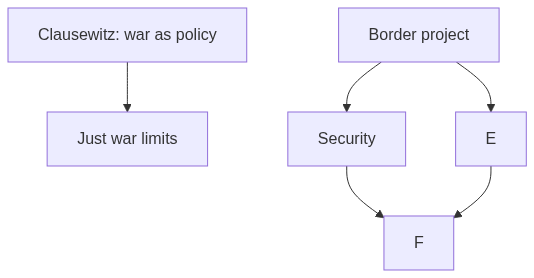
Flow diagram
Conclusion
War still continues politics, but ethics and nuclear risk refuse a blank cheque to force. In border clearances the same mind must hold security, ecology and consent in one reasoned file.
Quick related
Students also ask
-
Does ethics ban all border roads?
No. It bans thoughtless roads. A needed patrol track with slope science is different from a tourist scar through a core habitat.
-
Is every war Clausewitzian?
Some violence is criminal or genocidal and should not be laundered as ordinary policy. The quote is a lens, not an excuse.
More from this topic
UPSC Mains 2025 · GS IV · 10 marks · Solution
(a) In the present digital age, social media has revolutionised our way of communication and interaction. However, it has raised several ethical issues and challenges. Describe the key ethical dilemmas in this regard. (b) "Constitutional morality is not a natural sentiment but a product of civil education and adherence of the rule of law." Examine the significance of constitutional morality for public servant highlighting the role in promoting good governance and ensuring accountability in public administration.
Ethics in Public Administration
Social media speeds speech and also rumour, hate, privacy harm and blurred official voice. The ethical knots are truth versus virality, privacy versus publicity, and freedom versus incitement. Constitutional morality, as Ambedkar taught, is learned respect for constitutional forms, not a natural feeling. For a civil servant it means equality, dignity, reasoned process and files that can face a court. Good governance and accountability rest on that habit when popular anger or a minister wants a shortcut.
Q5(a) · UPSC Mains 2024 · GS IV · 10 marks · Solution
"The 'Code of Conduct' and 'Code of Ethics' are the sources of guidance in public administration. There is code of conduct already in operation, whereas code of ethics is not yet put in place. Suggest a suitable model for code of ethics to maintain integrity, probity and transparency in governance
Ethics in Public Administration
A code of conduct is enforceable do’s and don’ts; a code of ethics states values and how to reason when the rule is silent. India has conduct rules in operation; a living ethics code still needs leaders, cases and whistle protection. A model for integrity, probity and transparency binds the Constitution, public money, reasons on file, impartial queues and data restraint. BNS presents justice, equality and impartiality as its soul and adds victim-centric and community-service tools. The shift from punishment to justice fails if new sections only warehouse the poor.
Q5 · UPSC Mains 2023 · GS IV · 10 marks · Solution
(a) Is conscience a more reliable guide when compared to laws, rules, and regulations in the context of ethical decision-making. Discuss (b) Probity is essential for an effective system of governance and socio-economic development. Discuss.
Ethics in Public Administration
Conscience is inner judgement; laws are shared public standards. Conscience can see unnamed harm and can resist an unjust law; it is also partisan and unequal across persons. A civil servant’s default is lawful rules plus written dissent, not a private veto. Ethical decisions need both a legal file and an inner test against cruelty. Probity is upright use of office; without it, governance becomes a favour market and development leaks. Trust, investment and the poor’s access to services all depend on that uprightness.