
Revision summary
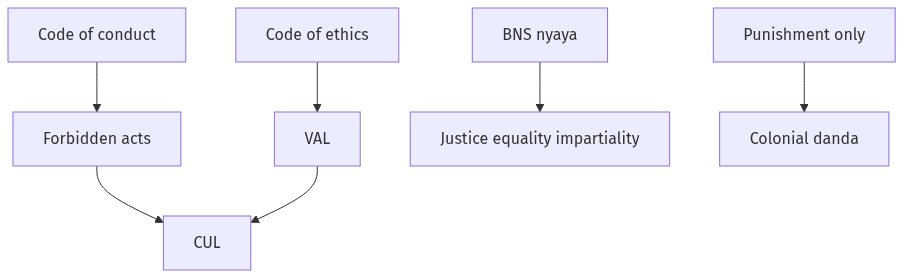
A code of conduct is enforceable do’s and don’ts; a code of ethics states values and how to reason when the rule is silent. India has conduct rules in operation; a living ethics code still needs leaders, cases and whistle protection. A model for integrity, probity and transparency binds the Constitution, public money, reasons on file, impartial queues and data restraint. BNS presents justice, equality and impartiality as its soul and adds victim-centric and community-service tools. The shift from punishment to justice fails if new sections only warehouse the poor.
Model answer
Copper italics in this answer — like this — are the key facts. Each one is unpacked in the Facts & figures rail.
Introduction
India already tells the civil servant what not to do on Tuesday (Conduct Rules). It has been slower to write what we believe on Monday (a living code of ethics). Part (a) wants that model, aimed at integrity, probity and sunlight. Part (b) turns to the Bharatiya Nyaya Sanhita: a claim that the soul of the new criminal law is justice, equality and impartiality, and a shift from punishment as the whole story to justice as the aim.
Body
(a) Code of Conduct versus Code of Ethics — a model
- A Code of Conduct is enforceable behaviour: gifts, political activity, criticism of government, sexual harassment, use of official information, property returns. In the Union it lives in the CCS (Conduct) Rules, 1964 and All-India analogues. It is necessary. It is not sufficient: a person can obey the letter and still hate the citizen, delay a Dalit’s file, or help a nephew within “discretion”.
- A Code of Ethics is values and reasoning: why we refuse the gift, whom we serve, what constitutional morality requires when the rule is silent. Second ARC and the Nolan principles (selflessness, integrity, objectivity, accountability, openness, honesty, leadership) are the usual furniture. Ethics without conduct is a framed poster. Conduct without ethics is a clever compliance.
A suitable model for integrity, probity and transparency: (1) Serve the Constitution, not a person. (2) Integrity: no private price for a public act; family and post-retirement doors counted as conflicts. (3) Probity: public money as trust; GeM, GFR, no split indents, no favourite vendor. (4) Transparency: reasons on the file, proactive disclosure, RTI in spirit. (5) Objectivity and impartiality: same queue for the MLA’s driver and the widow. (6) Empathy and courtesy as professional duties, not extras. (7) Speak-up: protected channel to CVO; no revenge posting. (8) Digital and data ethics: no stalking a citizen through a portal. Induction by cases, leaders who obey first, checked asset declarations, rotation of sensitive desks. The model works only as a culture of Tuesdays.
(b) Bharatiya Nyaya Sanhita: from punishment to justice
- The IPC, 1860 was a colonial penal grammar: the sovereign’s anger, sedition as a mood, procedure that could forget the victim. The BNS, 2023 (in force 2024) claims a soul of nyaya: justice, equality, impartiality named as Indian ethos — not only danda. How far the soul is real is the ethical test, not the Sanskrit title.
Shift from doctrine of punishment to justice shows in design choices: community service as a sentence for some wrongs (repair, not only warehouse); victim-centric timelines and recorded processes; new naming of mob lynching, organised crime, terrorism, hit-and-run — harms that old chapters stretched; recasting sedition-like speech into a sovereignty offence that must not become a slogan jail. Equality demands that a powerful accused and a poor accused meet the same code, which is an old Indian wound. Impartiality is the judge and the police as not a faction. Indian culture here is Ashoka’s dhamma, Gandhi’s means, the Gita’s duty, and also Ambedkar’s warning that forms need cultivation. A harsher clause that only fills prisons with the weak would be punishment in a new font. Justice as soul means proportion, fair hearing, reparation, and a State that does not enjoy pain.
- The civil servant’s ethics in this shift: register the FIR without a caste filter, do not use a new section as a toy, treat community service as work not humiliation, and remember the victim is not a footnote to the accused’s politics.
Flow diagram
Conclusion
Conduct rules fence the worst acts; a code of ethics supplies the values, conflicts and sunlight that fences miss. BNS claims justice rather than colonial danda as its soul; that claim holds only if equality and impartiality reach the weak, and punishment is not simply renamed.
Quick related
Students also ask
-
What do you understand by 'moral integrity' and 'professional efficiency in the context of corporate governance in India? Illustrate with suitable examples.
Next question on this syllabus topic (2023 · Q1(a)). View answer →
-
Can a code of ethics be litigated like Conduct Rules?
Usually it guides and is used in inquiry reasoning. Conduct Rules remain the charge-sheet spine. Both are needed.
-
Is BNS automatically more ethical because it is ‘Bharatiya’?
A name is not a soul. Ethics will judge the code by fair trial, proportion, and whether the powerful are as reachable as the poor.
Same topic · past papers
UPSC has asked this before
These previous-year questions sit on the same topic. Open one to practise the earlier ask.
-
2025 · Q1(a) · GS IV · 10 marks
In the present digital age, social media has revolutionised our way of communication and interaction. However, it has raised several ethical issues and challenges. Describe the key ethical dilemmas in this regard. -
2025 · Q1(b) · GS IV · 10 marks
"Constitutional morality is not a natural sentiment but a product of civil education and adherence of the rule of law." Examine the significance of constitutional morality for public servant highlighting the role in promoting good governance and ensuring accountability in public administration. -
2023 · Q1(a) · GS IV · 10 marks
What do you understand by 'moral integrity' and 'professional efficiency in the context of corporate governance in India? Illustrate with suitable examples. -
2018 · Q3(a) · GS IV · 10 marks
What is meant by conflict of interest? Illustrate with examples, the difference between the actual and potential conflicts of interest. -
2017 · Q1 · GS IV · 10 marks
Conflict of interest in the public sector arises when (a) official duties, (b) public interest, and (c) personal interest are taking priority one above the other. How can this conflict in administration be resolved? Describe with an example. (150 Words, 10).
More from this topic
UPSC Mains 2025 · GS IV · 10 marks · Solution
(a) Carl von Clausewitz once said, "War is a diplomacy by other means." Critically analyse the above statement in the present context of contemporary geo-political conflict. (b) Keeping the national security in mind, examine the ethical dilemmas related to controversies over environmental clearance of development projects in ecologically sensitive border areas in the country.
Ethics in Public Administration
Clausewitz is right that wars have political aims; he is incomplete because civilians, nuclear weapons and non-state actors change the moral math. Just-war rules and Gandhi’s stress on means still bind a democracy. Border projects pit delay-as-threat against forest, landslide and tribal consent. The ethical path is necessity with least harm, not a fake choice between soldier and tree. Integrity is a file that records both the threat and the ecology.
UPSC Mains 2025 · GS IV · 10 marks · Solution
(a) In the present digital age, social media has revolutionised our way of communication and interaction. However, it has raised several ethical issues and challenges. Describe the key ethical dilemmas in this regard. (b) "Constitutional morality is not a natural sentiment but a product of civil education and adherence of the rule of law." Examine the significance of constitutional morality for public servant highlighting the role in promoting good governance and ensuring accountability in public administration.
Ethics in Public Administration
Social media speeds speech and also rumour, hate, privacy harm and blurred official voice. The ethical knots are truth versus virality, privacy versus publicity, and freedom versus incitement. Constitutional morality, as Ambedkar taught, is learned respect for constitutional forms, not a natural feeling. For a civil servant it means equality, dignity, reasoned process and files that can face a court. Good governance and accountability rest on that habit when popular anger or a minister wants a shortcut.
Q5 · UPSC Mains 2023 · GS IV · 10 marks · Solution
(a) Is conscience a more reliable guide when compared to laws, rules, and regulations in the context of ethical decision-making. Discuss (b) Probity is essential for an effective system of governance and socio-economic development. Discuss.
Ethics in Public Administration
Conscience is inner judgement; laws are shared public standards. Conscience can see unnamed harm and can resist an unjust law; it is also partisan and unequal across persons. A civil servant’s default is lawful rules plus written dissent, not a private veto. Ethical decisions need both a legal file and an inner test against cruelty. Probity is upright use of office; without it, governance becomes a favour market and development leaks. Trust, investment and the poor’s access to services all depend on that uprightness.