
Revision summary
Conscience is inner judgement; laws are shared public standards. Conscience can see unnamed harm and can resist an unjust law; it is also partisan and unequal across persons. A civil servant’s default is lawful rules plus written dissent, not a private veto. Ethical decisions need both a legal file and an inner test against cruelty. Probity is upright use of office; without it, governance becomes a favour market and development leaks. Trust, investment and the poor’s access to services all depend on that uprightness.
Model answer
Copper italics in this answer — like this — are the key facts. Each one is unpacked in the Facts & figures rail.
Introduction
Part (a) sets inner conviction against written rules. Part (b) asks why a clean and honest use of office is not a luxury if a society wants growth that people can trust.
Body
(a) Conscience versus laws, rules and regulations
- Conscience is the inner judgement that an act is right or wrong, formed by upbringing, faith, reason and experience.
- Laws, rules and regulations are public standards that bind many people at once and can be reviewed by a court or a legislature.
- Conscience is often faster and can see a harm that a rule has not yet named, such as humiliation that no clause mentions.
- Conscience is also uneven: two officers can have opposite consciences on cow slaughter, conversion, or a strike, so a republic cannot run on private conviction alone.
- Laws can be unjust, as colonial statutes and some emergency excesses were. In those cases conscience, constitutional morality and later judicial review are needed to resist.
- For a sitting civil servant the default is lawful obedience plus recorded dissent. The Central Civil Services (Conduct) Rules, 1964 and the oath of office do not permit a private veto of a valid order.
- Civil disobedience is a citizen’s last resort after public reason, as Gandhi practised it; it is not a daily tool for an officer who holds coercive power.
- The reliable sequence is: follow the Constitution and lawful rules; use conscience to refuse an illegal or manifestly cruel oral order; put the refusal in writing; seek a competent authority; do not become a vigilante.
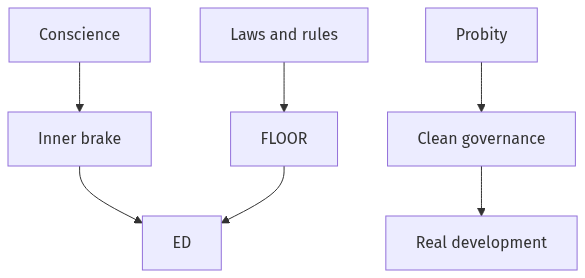
- Neither conscience nor rules are “more reliable” in every case. Rules are more reliable as a shared floor. Conscience is more reliable as an inner brake when the rule is silent or the rule is being used to crush a person.
- Ethical decision-making therefore uses both: the file must be legal, and the officer must still be able to look at the weakest person affected.
(b) Probity, governance and socio-economic development
- Probity is uprightness in office: honesty, impartiality, and the refusal to mix public power with private gain.
- Governance is the way public authority makes and implements decisions. Without probity that way becomes a market for favours.
- Socio-economic development needs roads, schools, credit and health that actually exist, not only budget lines. Leakage from a dishonest procurement is a development failure, not only a moral one.
- Investors and citizens price trust. A State known for clean tenders and predictable tax draws capital; a State known for speed money draws only those who can pay.
- The Second Administrative Reforms Commission’s report on Ethics in Governance treated integrity systems as part of capacity, not as decoration.
- Probity also protects the poor, because the poor cannot buy a queue. A corrupt ration shop or a bribe for a bed is a direct tax on those least able to pay.
- Transparency tools — the Right to Information Act, 2005, social audit, e-procurement — make probity visible. They do not replace the officer who still has to refuse the envelope.
- Development without probity produces ghost schools, unsafe buildings and debt that the next generation pays. That is why probity is essential, not optional, for both governance quality and real growth.
Flow diagram
Conclusion
Conscience is a necessary inner brake and a dangerous sole ruler. Laws are a necessary public floor and can still be unjust. Ethical office uses both, with the Constitution first. Probity is the honesty that makes governance believable and development real rather than stolen.
Quick related
Students also ask
-
Write short notes on the following in 30 words each : (i) Constitutional morality (ii) Conflict of interest (iii) Probity in public life (iv) Challenges of digitalization (v) Devotion to duty.
Next question on this syllabus topic (2022 · Q5(b)). View answer →
-
If a rule is legal but cruel, must the officer still apply it?
Apply the Constitution, natural justice and any humane discretion the rule allows. Record why a harsh reading was refused. Do not invent a private law, and do not hide the file.
-
Is probity only about not taking bribes?
Bribes are the obvious case. Probity also covers impartial posting, truthful data, fair tenders and not using official time as a family business.
More from this topic
UPSC Mains 2025 · GS IV · 10 marks · Solution
(a) Carl von Clausewitz once said, "War is a diplomacy by other means." Critically analyse the above statement in the present context of contemporary geo-political conflict. (b) Keeping the national security in mind, examine the ethical dilemmas related to controversies over environmental clearance of development projects in ecologically sensitive border areas in the country.
Ethics in Public Administration
Clausewitz is right that wars have political aims; he is incomplete because civilians, nuclear weapons and non-state actors change the moral math. Just-war rules and Gandhi’s stress on means still bind a democracy. Border projects pit delay-as-threat against forest, landslide and tribal consent. The ethical path is necessity with least harm, not a fake choice between soldier and tree. Integrity is a file that records both the threat and the ecology.
UPSC Mains 2025 · GS IV · 10 marks · Solution
(a) In the present digital age, social media has revolutionised our way of communication and interaction. However, it has raised several ethical issues and challenges. Describe the key ethical dilemmas in this regard. (b) "Constitutional morality is not a natural sentiment but a product of civil education and adherence of the rule of law." Examine the significance of constitutional morality for public servant highlighting the role in promoting good governance and ensuring accountability in public administration.
Ethics in Public Administration
Social media speeds speech and also rumour, hate, privacy harm and blurred official voice. The ethical knots are truth versus virality, privacy versus publicity, and freedom versus incitement. Constitutional morality, as Ambedkar taught, is learned respect for constitutional forms, not a natural feeling. For a civil servant it means equality, dignity, reasoned process and files that can face a court. Good governance and accountability rest on that habit when popular anger or a minister wants a shortcut.
Q5(a) · UPSC Mains 2024 · GS IV · 10 marks · Solution
"The 'Code of Conduct' and 'Code of Ethics' are the sources of guidance in public administration. There is code of conduct already in operation, whereas code of ethics is not yet put in place. Suggest a suitable model for code of ethics to maintain integrity, probity and transparency in governance
Ethics in Public Administration
A code of conduct is enforceable do’s and don’ts; a code of ethics states values and how to reason when the rule is silent. India has conduct rules in operation; a living ethics code still needs leaders, cases and whistle protection. A model for integrity, probity and transparency binds the Constitution, public money, reasons on file, impartial queues and data restraint. BNS presents justice, equality and impartiality as its soul and adds victim-centric and community-service tools. The shift from punishment to justice fails if new sections only warehouse the poor.