
Revision summary
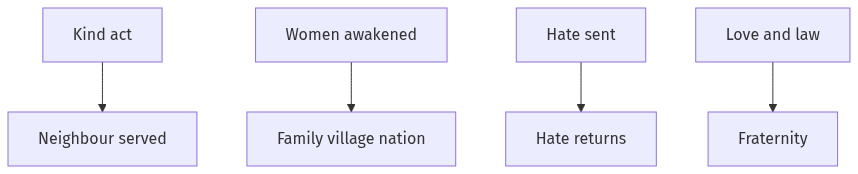
Gandhi ranks a simple kind act above a show of prayer; public piety without a working counter fails the test. Nehru ties national awakening to women’s education, safety, voice and economic freedom. A household or scheme that ignores women is not development. Vivekananda warns that hatred returns as social heat; fraternity and lawful justice break that circle. The three quotes together ask for service, gender justice and refusal of communal revenge.
Model answer
Copper italics in this answer — like this — are the key facts. Each one is unpacked in the Facts & figures rail.
Introduction
Three sentences from Gandhi, Nehru and Vivekananda still test a republic that prays, legislates and argues online. Each quote asks for a public act, not a private feeling.
Body
(a) Gandhi: kindness over a thousand bowed heads
- Gandhi is ranking a small helpful act above a large display of piety.
- Prayer that never becomes food, shelter, or a fair file is incomplete religion.
- In the present context, a viral temple visit or a televised fast does not feed a migrant or stop a communal rumour.
- Kindness here is concrete: a midday meal that arrives, a disability pension that is not delayed, a police officer who does not humiliate a complainant.
- The quote does not mock faith; it says faith is proven in the neighbour, which is also the Gita’s teaching that worship without care for beings is hollow.
- For a civil servant the line is a work rule: the counter is the prayer, and delay is a refusal to bow to the person who needs the service.
(b) Nehru: awaken women, then the rest moves
- Nehru is stating that social change that leaves women unfree is not national awakening.
- If a woman cannot read, own land, walk safely, or speak in the gram sabha, the family and the village remain half-asleep.
- In the present context this is education, nutrition, political reservation, equal pay, and freedom from domestic and workplace violence.
- Laws such as the Protection of Women from Domestic Violence Act, 2005 and the Sexual Harassment of Women at Workplace (Prevention, Prohibition and Redressal) Act, 2013 are tools; awakening also needs property rights, time-use equality, and girls who finish school.
- A growth story that uses women’s unpaid care as invisible subsidy has not heard Nehru.
- For governance, a scheme that is designed only by men for a “household head” will miss the person who actually fetches water and stands in the ration line.
(c) Vivekananda: do not hate, because hate returns
- Vivekananda is describing karma in social form: hatred sent out organises a return of hatred.
- Love here is not a slogan; it is refusal to dehumanise an opponent, a minority, or a defeated group.
- In the present context, communal speech, caste humiliation, and online pile-ons manufacture the circle he named.
- A State that uses hate as a mobilisation tool will later spend that same heat as riot, boycott, and broken trust.
- The civil servant’s duty is fraternity in the Preamble: protect the unpopular person, refuse a communal file, and do not repay abuse with official revenge.
- The quote also warns the reformer: hatred of the corrupt is still hatred if it becomes a licence to lie or to lynch; the circle must be completed by justice under law, not by a crowd.
Flow diagram
Conclusion
Gandhi measures religion by a kind act, not by a crowded prayer. Nehru measures a nation’s waking by the freedom of its women. Vivekananda measures politics by whether it sends out hate or law-bound care. All three are present-tense tests for office and citizenship.
Quick related
Students also ask
-
What does each of the following quotations mean to you? (a) "Every work has got to pass through hundreds of difficulties before succeeding. Those that persevere will see the light, sooner or later" - Swami Vivekananda (b) "We can never obtain peace in the outer world until and unless we obtain peace within ourselves" - Dalai Lama (c) "Life doesn't make any sense without interdependence. We need each other, and the sooner we learn that it is better for us all" - Erik Erikson.
Next question on this syllabus topic (2021 · Q3). View answer →
-
Does Gandhi want public servants to stop being religious?
No. He wants religion that shows up as a kind and just act. A prayer that never becomes a fair file is the target of the quote.
-
Is Vivekananda asking the State to ignore hate speech?
No. He is warning that hate returns. The State’s job is lawful prevention and equal protection, not silence and not a counter-lynch.
Same topic · past papers
UPSC has asked this before
These previous-year questions sit on the same topic. Open one to practise the earlier ask.
More from this topic
Q6(b) · UPSC Mains 2026 · GS IV · 10 marks · Solution
Some moral philosophers argue that spending some of your resources—without significantly affecting your financial stability—to help other people who badly suffer is our moral duty and not merely a matter of charity. Justify this claim by explaining the distinction between duty and charity.
Moral Thinkers and Philosophers
• Duty is a strict moral obligation; charity is optional kindness that goes beyond requirements. • Helping the suffering corresponds to their fundamental right, making it a matter of justice, not grace. • Preventing severe suffering without sacrificing anything of comparable importance is a moral imperative. • Extreme global affluence alongside absolute poverty turns surplus-sharing into a binding duty. • Reclassifying aid shifts philanthropy from a social courtesy to an essential ethical obligation. • This perspective strengthens human dignity and aligns with the constitutional ideal of fraternity.
Q3 · UPSC Mains 2026 · GS IV · 10 marks · Solution
(a) Dr. B. R. Ambedkar had cautioned that employing civil disobedience within a constitutional democracy equates to endorsing 'anarchy'. How should modern democracies navigate the ethical dilemmas posed by civil disobedience movements that aim to promote social justice against policies that may raise genuine concerns? (b) In what ways can an Indian Administrative Officer apply Gandhi's notion of 'trusteeship' to ensure fairness in governance? (c) Shakespeare in Henry IV says, "The arms are fair when the intent of bearing them is just". What ethical implications does this have in governance?
Moral Thinkers and Philosophers
• **Civil Disobedience:** Respect constitutional channels and avoid anarchy, but address root grievances through dialogue rather than coercion. • **Trusteeship Principle:** View public resources as a sacred trust, prioritizing the vulnerable and practicing *Antyodaya*. • **Intent in Power:** Ensure coercive administrative actions serve true public welfare rather than arbitrary convenience. • **Balancing Rule of Law:** Combine legal compliance with moral imperatives and substantive justice. • **Proportionality & Rights:** Respond to public dissent while fully respecting fundamental rights and transparency. • **Fiduciary Duty:** Resist elite capture of policy to guarantee equitable resource allocation. • **Integrity of Purpose:** Align every administrative decision with the true spirit of the Constitution.
Q3(a) · UPSC Mains 2024 · GS IV · 10 marks · Solution
Given below are three quotations of great thinkers. What do each of these quotations convey to you in the present context? a) "Learn everything that is good from others, but bring it in, and in your own way absorb it, do not become others." - Swami Vivekananda
Moral Thinkers and Philosophers
Vivekananda asked India to learn the good from others and digest it, not to become a copy that scorns its own poor. Patel held that faith without strength cannot complete a great public work, and strength without faith is only force. Kant drew a line: law waits for the rights-violating act; ethics already condemns the will to do it. Together they train identity, delivery and inner integrity. A dashboard, a riot plan and an unsent communal file are the present-tense tests.