
Revision summary
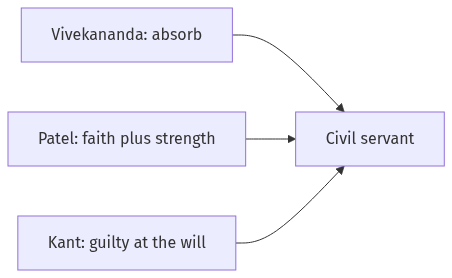
Vivekananda asked India to learn the good from others and digest it, not to become a copy that scorns its own poor. Patel held that faith without strength cannot complete a great public work, and strength without faith is only force. Kant drew a line: law waits for the rights-violating act; ethics already condemns the will to do it. Together they train identity, delivery and inner integrity. A dashboard, a riot plan and an unsent communal file are the present-tense tests.
Model answer
Copper italics in this answer — like this — are the key facts. Each one is unpacked in the Facts & figures rail.
Introduction
Three lamps, one present tense. Vivekananda warns a borrowing nation not to become the lender. Patel warns a pious officer that faith without muscle does not integrate a State. Kant warns that ethics begins before the FIR. Together they are identity, capacity and inner law — still the civil servant’s kit.
Body
(a) Vivekananda: absorb, do not become others
The line is against imitation that erases the self. Learn germ theory, a good civil code, a working port. Do not import contempt for your own people or a costume of another civilisation. “In your own way” is digestion, which is how India took the Constitution’s borrowed furniture and still had to grow constitutional morality (Ambedkar) at home. For a civil servant this is policy transfer with a field visit: a Singapore dashboard that excludes a tribal household is not “world class”. It is becoming others at the poor’s cost. Atmanirbhar is ethical when it is self-respect plus learning, not xenophobia. Vivekananda’s man-making is character that can use a tool without worshipping the tool’s country.
(b) Patel: faith and strength
Sardar Patel integrated hundreds of States with negotiation, pressure and an army in reserve. Faith without strength is a prayer over a collapsing dam. Strength without faith is brutality. The quote is Weber’s ethic of responsibility plus ethic of conviction in one Indian mouth. A communal riot needs belief in fraternity and a lathi that arrives. A welfare scheme needs belief in the widow and a payment system that works. Mission-mode without values is target cruelty. Values without delivery are a speech. Patel’s civil servant is the one who files, moves, and still does not hate.
(c) Kant: guilty in ethics at the thought of violating rights
Law, in a liberal State, generally waits for an act (and sometimes a preparation). Ethics, for Kant, looks at the maxim. If I will to falsify a muster, I have already used persons as means, even if the pen has not moved. This is not a call for a thought police. It is a call for integrity before audit. Professional ethics — a doctor imagining a fake trial, a judge imagining a caste bias, an officer imagining a nephew’s tender — must stop the will, not only the gazette. Mens rea in criminal law is a cousin; Kant is stricter because inner respect for the moral law is the motive he wants, not fear of CBI. In the present context of viral hate and silent communal files, the quote says: the tweet you almost sent already failed ethics if it willed harm.
- The three together: do not become a copy, do not be a weak believer, do not wait for the crime to begin in the street.
Flow diagram
Conclusion
Vivekananda wants learning without self-erasure. Patel wants faith that can actually finish the work. Kant wants guilt to start when the will to violate a right is born, not only when the statute is broken. A public servant needs all three.
Quick related
Students also ask
-
Given below are three quotations of great thinkers. What do each of the quotations convey to you in the present test? (a) "The simplest arts of kindness are by far more powerful than a thousand heads bowing in prayer."- Mahatma Gandhi (b) To awaken the people, it is the women who must be awakened. Once she is on the move, the family moves, the village moves, the nation moves". - Jawaharlal Nehru (c) "Do not hate anybody, because that hatred that comes out from you must, in the long run, come back to you. If you love, that love will me back to you, completing the circle- Swami Vivekananda.
Next question on this syllabus topic (2023 · Q3). View answer →
-
Does Kant want the State to punish thoughts?
No. He is describing the inner court. Criminal law still needs an act. The officer’s honour is to lose the corrupt will before the CBI arrives.
-
Is Patel anti-faith?
No. He is anti faith that cannot protect a Union or a riot-torn street. Strength here is competence and lawful force, not cruelty.
Same topic · past papers
UPSC has asked this before
These previous-year questions sit on the same topic. Open one to practise the earlier ask.
More from this topic
Q6(b) · UPSC Mains 2026 · GS IV · 10 marks · Solution
Some moral philosophers argue that spending some of your resources—without significantly affecting your financial stability—to help other people who badly suffer is our moral duty and not merely a matter of charity. Justify this claim by explaining the distinction between duty and charity.
Moral Thinkers and Philosophers
• Duty is a strict moral obligation; charity is optional kindness that goes beyond requirements. • Helping the suffering corresponds to their fundamental right, making it a matter of justice, not grace. • Preventing severe suffering without sacrificing anything of comparable importance is a moral imperative. • Extreme global affluence alongside absolute poverty turns surplus-sharing into a binding duty. • Reclassifying aid shifts philanthropy from a social courtesy to an essential ethical obligation. • This perspective strengthens human dignity and aligns with the constitutional ideal of fraternity.
Q3 · UPSC Mains 2026 · GS IV · 10 marks · Solution
(a) Dr. B. R. Ambedkar had cautioned that employing civil disobedience within a constitutional democracy equates to endorsing 'anarchy'. How should modern democracies navigate the ethical dilemmas posed by civil disobedience movements that aim to promote social justice against policies that may raise genuine concerns? (b) In what ways can an Indian Administrative Officer apply Gandhi's notion of 'trusteeship' to ensure fairness in governance? (c) Shakespeare in Henry IV says, "The arms are fair when the intent of bearing them is just". What ethical implications does this have in governance?
Moral Thinkers and Philosophers
• **Civil Disobedience:** Respect constitutional channels and avoid anarchy, but address root grievances through dialogue rather than coercion. • **Trusteeship Principle:** View public resources as a sacred trust, prioritizing the vulnerable and practicing *Antyodaya*. • **Intent in Power:** Ensure coercive administrative actions serve true public welfare rather than arbitrary convenience. • **Balancing Rule of Law:** Combine legal compliance with moral imperatives and substantive justice. • **Proportionality & Rights:** Respond to public dissent while fully respecting fundamental rights and transparency. • **Fiduciary Duty:** Resist elite capture of policy to guarantee equitable resource allocation. • **Integrity of Purpose:** Align every administrative decision with the true spirit of the Constitution.
Q3 · UPSC Mains 2023 · GS IV · 10 marks · Solution
Given below are three quotations of great thinkers. What do each of the quotations convey to you in the present test? (a) "The simplest arts of kindness are by far more powerful than a thousand heads bowing in prayer."- Mahatma Gandhi (b) To awaken the people, it is the women who must be awakened. Once she is on the move, the family moves, the village moves, the nation moves". - Jawaharlal Nehru (c) "Do not hate anybody, because that hatred that comes out from you must, in the long run, come back to you. If you love, that love will me back to you, completing the circle- Swami Vivekananda.
Moral Thinkers and Philosophers
Gandhi ranks a simple kind act above a show of prayer; public piety without a working counter fails the test. Nehru ties national awakening to women’s education, safety, voice and economic freedom. A household or scheme that ignores women is not development. Vivekananda warns that hatred returns as social heat; fraternity and lawful justice break that circle. The three quotes together ask for service, gender justice and refusal of communal revenge.