
Revision summary
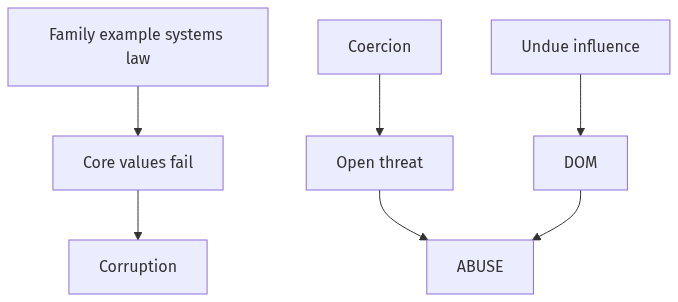
Corruption is private gain from entrusted power and shows that honesty, impartiality and duty have failed. Uplift needs family and school, leadership example, e-systems that cut discretion, and statutes that protect whistle-blowers and punish graft. Coercion is forcing a person by threat of harm such as transfer, violence or a withheld bill. Undue influence is unfair advantage taken from a dominating or fiduciary relation without an open threat. Both appear at work; POSH and Conduct Rules cover the quiet pressure as well as the shout.
Model answer
Copper italics in this answer — like this — are the key facts. Each one is unpacked in the Facts & figures rail.
Introduction
Corruption is not only a missing file. It is a public sign that honesty, fairness and duty have lost force. Part (b) then names two ways power is abused at work without always looking like an open threat.
Body
(a) Corruption as failure of core values, and how to uplift them
- Core values in public life include honesty, integrity, impartiality, empathy, and respect for the Constitution and for other people’s property.
- Corruption is the use of entrusted power for private gain, whether as a bribe, a favour to kin, or a cooked tender.
- When those core values fail, the officer treats the counter as a shop and the citizen as a customer who must pay extra.
- Laws can punish the act; they cannot, by themselves, create the habit of not asking.
- Family and school must treat a stolen rupee as shame, not as cleverness, because the first map of honesty is drawn before the first posting.
- Civic education should teach that tax and a clean tender are duties, not optional virtue.
- Leadership example matters: a minister or secretary who lives simply and refuses a gift sets a visible standard that a circular cannot.
- Institutions that reduce discretion reduce the market for bribes: e-procurement, direct benefit transfer, published queues, and the Right to Information Act, 2005.
- The Prevention of Corruption Act, 1988, the Lokpal and Lokayuktas Act, 2013, and the Whistle Blowers Protection Act, 2014 supply investigation and protection so that a honest junior is not alone.
- Training must use live cases, not only slogans, so that an officer practises refusal before the first envelope arrives.
- Social shame and social honour still work: a community that celebrates the bribe-giver as efficient will keep producing corruption even after a new Act.
- Uplift of core values is therefore simultaneous: character at home, example at the top, systems that make honesty easy, and punishment that is real.
(b) Coercion and undue influence at work
- Coercion is forcing a person’s will by threat of harm: transfer, dismissal, violence, or a false case.
- In contract language, Section 15 of the Indian Contract Act, 1872 treats coercion as committing or threatening to commit an act forbidden by the Indian Penal Code, 1860, or the unlawful detaining of property.
- At work, a superior who says “sign this false muster or I will ruin your annual appraisal” is using coercion.
- A contractor told that the bill will never be paid unless a percentage is returned is under coercion, even if no one raises a hand.
- Undue influence is quieter: one party dominates the will of another because of a real or apparent authority, or a fiduciary relation, and uses that position to obtain an unfair advantage.
- Section 16 of the Indian Contract Act, 1872 defines that relation; a doctor, a guru, a bank manager, or a reporting officer can occupy it.
- At work, a boss who does not threaten firing but uses a junior’s fear, gratitude, or isolation to extract unpaid personal work, political canvassing, or sexual compliance is using undue influence.
- A loan given to a subordinate on terms the subordinate cannot refuse, because the same person writes the promotion, is undue influence even if the paper looks voluntary.
- Coercion is the stick in the open. Undue influence is the stick hidden inside trust and hierarchy.
- Both violate dignity and Article 14 equality in a public office. The Sexual Harassment of Women at Workplace (Prevention, Prohibition and Redressal) Act, 2013 treats a quid-pro-quo demand as harassment whether it arrives as a threat or as a “favour”.
- The Central Civil Services (Conduct) Rules, 1964 require courtesy and forbid conduct unbecoming; they cover both the shout and the soft pressure.
- The ethical response is the same in structure: name the power gap, record the request, refuse the unlawful act, and take the matter to a competent authority rather than bargain in private.
Flow diagram
Conclusion
Corruption shows that honesty and public duty have failed as living values, so repair must join character, example, systems and punishment. Coercion forces the will by threat. Undue influence captures the will through hierarchy and trust. Both are abuse, and both must be recorded and stopped.
Quick related
Students also ask
-
Ethics is knowing the difference between what you have the right to do and what is right to do.'-Potter Stewart .
Next question on this syllabus topic (2022 · Q3(a)). View answer →
-
Can a new anti-corruption law by itself uplift core values?
It can raise the cost of the crime. Values rise when children, leaders and systems treat honesty as normal, which a statute alone cannot do.
-
If no one shouted, can the junior still claim coercion?
A quiet threat of ruin is still coercion. If there was no threat but the superior used rank and dependence to extract an unfair yes, the correct name is undue influence.
More from this topic
Q1(b) · UPSC Mains 2026 · GS IV · 10 marks · Solution
A business house is working on a project that could displace a forest community from their habitat. As the administrative officer of that district, what ethical challenges are you likely to face?
Probity in Governance
This GS4 10-marker examines the ethical dilemmas faced by a district administrator dealing with industrial displacement of a forest community. The answer navigates the core tension between economic development and social justice, highlighting stakeholder conflicts such as corporate pressure versus tribal rights, the paradox of legal compliance versus moral duty, and personal integrity under administrative coercion. It incorporates a structured Mermaid flowchart mapping out the stakeholder dilemma and concludes with a balanced administrative approach upholding constitutional empathy and statutory safeguards like PESA and FRA.
Q1(a) · UPSC Mains 2026 · GS IV · 10 marks · Solution
Owing to paucity of time, a university professor generates a Ph.D. evaluation report using Artificial Intelligence and submits it with some modifications. Discuss this from the perspective of accountability and integrity.
Probity in Governance
This GS4 ethics case study examines the dilemma of a university professor using AI to generate a Ph.D. evaluation report due to time constraints. It analyses the failure of professional accountability in delegating core academic judgment to an automated tool. The response evaluates the breach of intellectual integrity, the erosion of institutional trust in research degrees, and outlines a principled course of action balancing urgency with ethical duty.
Q6 · UPSC Mains 2025 · GS IV · 10 marks · Solution
(a) It is said that for an ethical work culture, there must be code of ethics in place in every organisation. To ensure value-based and compliance-based work culture, what suitable measures would you adopt in your work place? (b) India is an emerging economic power of the world as it has recently secured the status of fourth largest economy of the world as per IMF projection. However, it has been observed that in some sectors, allocated funds remain either under-utilised or misutilised. What specific measures would you recommend for ensuring accountability in this regard to stop leakages and gaining the status of third largest economy of the world in near future?
Probity in Governance
A code of ethics states values; a code of conduct states forbidden acts; both need leaders who obey them. Whistle protection, rotation, checked assets and small consistent punishments build culture. India’s fourth-largest-economy rank (IMF) sits beside under-used and stolen public money in some schemes. PFMS, outcome budgets, social audit, GeM and CAG follow-up are the accountability kit. Growth to third place is ethical only if the ladder is not stolen from the poor.