
Revision summary
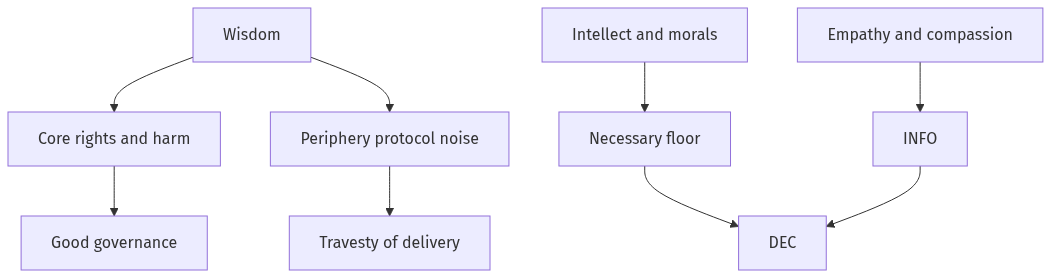
Wisdom in bureaucracy is knowing which issue is the core right and which is ceremonial noise. Living on the periphery delays the weakest citizen and empties good governance. Due process is not periphery; skipping a hearing in the name of speed is another injustice. Intellect and morals are necessary but not sufficient for hard decisions. Empathy gathers true facts; compassion completes the service inside the law.
Model answer
Copper italics in this answer — like this — are the key facts. Each one is unpacked in the Facts & figures rail.
Introduction
An officer’s day is full of files that shout. Part (a) asks whether mistaking noise for work wrecks justice and governance. Part (b) asks why a clever and honest officer still needs to feel the person at the counter.
Body
(a) Reckoning with the core, overlooking the periphery
- Wisdom in office is the trained ability to name the decision that actually moves a citizen’s right, and to let the rest wait or die.
- The periphery is the ritual of noting, the prestige visit, the complaint that is only status, and the file that looks urgent because a powerful person rang.
- The core is the statutory duty: a delayed pension, a missing midday meal, a remand that has crossed the legal hour, a flood that will drown a basti tonight.
- Agreement is largely right. An administrator who lives on the periphery produces a travesty of justice because the person with the weakest voice never becomes the agenda.
- Good governance, as the Second Administrative Reforms Commission treated it, is delivery, accountability and the rule of law. None of those survive if the District Magistrate is busy with a ribbon and a WhatsApp group while a ration shop is dry.
- Example: chasing a ceremonial foundation stone while a maternal-death inquiry file sits unopened is not hard work; it is a failure of justice to the dead woman and of governance to the living.
- Example: an officer who spends the week answering every RTI as a personal duel, and never inspects the muster that the RTI was about, has inverted core and periphery.
- Critical limit: some things that look peripheral are actually safeguards — natural justice, a speaking order, a site visit before demolition. Overlooking those in the name of “core delivery” is another travesty.
- Wisdom is therefore not speed for its own sake. It is triage: Article 14 and Article 21 claims first; ego, protocol and optional events last.
- Tools that help: a written weekly priority list, a public grievance dashboard that ranks by harm not by rank of the complainant, and the courage to tell a superior that a photo-opportunity is not today’s core.
- Preoccupation with the periphery does lead to failed service delivery and hollow governance, except where the so-called periphery is due process that protects the same citizen.
(b) Empathy and compassion besides intellect and morals
- Intellectual competency reads the Act and the map. Moral quality refuses a bribe. Neither, by itself, tells the officer what the waiting person is actually living.
- Empathy is the cognitive act of seeing the situation from the other’s side without becoming the other.
- Compassion is the will to reduce that suffering within the law, not a licence to break the law for a touching story.
- A famine or a riot decision taken only from a conference table will miss the old person who cannot walk to the camp and the child who cannot name a caste in a form.
- Illustration: during COVID-19, an officer who understood quarantine intellectually but had no empathy for a migrant without a smartphone designed a pass that the poorest could not obtain.
- Illustration: a child-protection order that is legally perfect and morally “strict” still fails if the officer has no empathy for a girl who will not speak in front of the uncle who brought her.
- Illustration: disaster compensation that follows the manual but ignores a tenant with no patta is intellect without compassion; inflating a bogus claim out of pity is compassion without morals.
- Empathy improves competence because it improves information: people tell the truth to an officer who is not humiliating them.
- Compassion improves competence because it converts a correct note into a completed service — a bed, a bus, a translated form.
- Training must therefore include field listening and case discussion, not only marks and conduct rules. A civil servant who is only clever and clean can still be cruel by indifference.
Flow diagram
Conclusion
- Wisdom is triage: core rights first, ceremonial noise last, and due process never dismissed as delay. Intellect and morals are necessary. Empathy and compassion are what make those two traits land as justice rather than as a correct and empty file.
Quick related
Students also ask
-
Is ignoring a minister’s call always wise?
No. A minister’s call may itself be the core if it reports a riot or a dam. Wisdom is asking what harm is live, not punishing rank as a habit.
-
Can compassion justify bending a rule for one poor person?
Use every humane discretion the rule allows. Do not invent a private exception that you would hide. Record why the weaker reading was chosen.
More from this topic
Q6(a) · UPSC Mains 2026 · GS IV · 10 marks · Solution
On the request of his Personal Assistant (PA), the District Magistrate (DM) stops the transfer of a schoolteacher who takes private tuition for his daughter diagnosed with learning disability. In this context, discuss the aspects of empathy versus compliance with rules.
Civil Service Aptitude and Values
This case study examines the classic administrative dilemma between empathy and rule compliance. A District Magistrate halts a teacher's transfer on compassionate grounds for a child with learning disabilities, but does so through a subordinate PA, raising governance concerns. The analysis explores the tension between human compassion and the rule of law. It evaluates options ranging from strict bureaucratic compliance to absolute discretion. The recommended approach is to balance empathy with institutional integrity by using established administrative provisions rather than informal channels, ensuring fairness, transparency, and accountability in public service.