
Revision summary
Whistle-blowers risk harm; policy must make the 2014 Act usable with secrecy, security, anti-retaliation and several reporting doors. Lokpal, CVC and the Prevention of Corruption Act, 1988 are companion channels. CSR under Companies Act, 2013, Section 135 is a mandated profit-share for listed social spend. It can help locally and is often inefficient branding. It is not sufficient for environmental and labour duties, which sit in the firm’s core operations and in regulation.
Model answer
Copper italics in this answer — like this — are the key facts. Each one is unpacked in the Facts & figures rail.
Introduction
A whistle-blower is useful to the republic and dangerous to a nexus. Part (a) asks how to keep that person alive and employed. Part (b) asks whether Section 135 spending can stand in for the full social and climate duty of a firm.
Body
(a) Policy measures to protect whistle-blowers
- A whistle-blower reports corruption, illegality or grave misconduct to a competent authority and is then at risk of transfer, dismissal, assault or a false case.
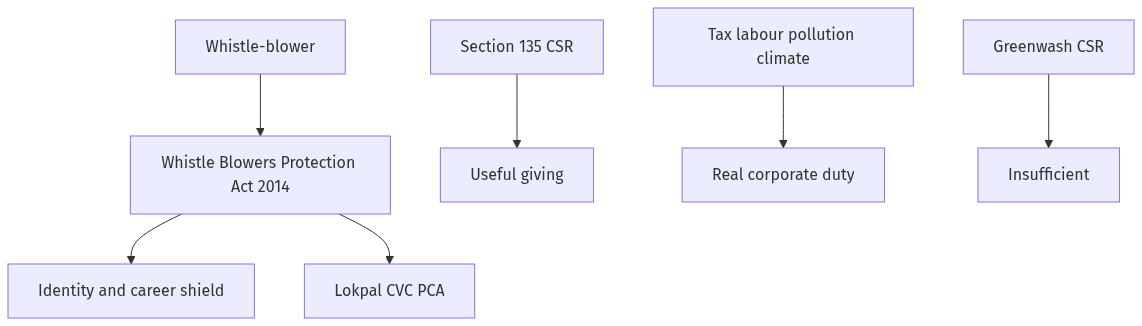
- The Whistle Blowers Protection Act, 2014 is the Union’s dedicated statute. It needs full, notified, usable machinery: a competent authority that is independent of the accused office, time-bound inquiry, and penalties for victimisation.
- Identity protection must be default, with disclosure only when the inquiry truly cannot proceed otherwise, and with criminal cost for leaking a name to the accused.
- Physical security: a graded protocol with the police when a threat is credible, including for family, because victimisation is often domestic.
- Career protection: a bar on punitive transfer, adverse ACR and suspension that is in substance retaliation; a fast external review of such orders.
- Reverse burden in departmental inquiry where the timing of punishment closely follows a protected disclosure, so that the organisation must justify the coincidence.
- Multiple doors: Lokpal and Lokayuktas Act, 2013; the Central Vigilance Commission; the Prevention of Corruption Act, 1988 complaint route; and sector regulators (SEBI, RBI) with their own safe channels.
- Anonymous and digitally secure intake that still filters malice, so that a honest junior is not forced to sign a death warrant with a name-stamp.
- Compensation and interim relief if the person is suspended or attacked, funded so that silence is not the cheaper option.
- Witness-protection style measures for the few cases that go to criminal trial, aligned with the Supreme Court’s witness-protection directions.
- Culture: training that treats a protected disclosure as duty, not as disloyalty, and punishment of the official who hunts the messenger.
- Media leak is not the first policy. It is a last resort when every competent door is captured. The policy aim is a safe official door that works.
(b) Is CSR efficient and sufficient?
- Corporate Social Responsibility in India is given statutory form by Section 135 of the Companies Act, 2013, which requires specified companies to spend a prescribed share of profits on listed social activities, with board oversight.
- Efficiency: CSR can fund schools, health camps and a local pond with speed that a distant budget line may lack, and it can use a firm’s logistics.
- Inefficiency: much spending is advertisement, a temple wall, or a safe urban project far from the factory’s actual pollution. Impact measurement is still weak.
- Capture: a promoter’s pet trust can recycle the mandate as branding. That is not a social duty discharged; it is a marketing line item.
- Sufficiency: CSR is not sufficient for corporate social and environmental roles. A firm that spends two per cent and poisons a river has not balanced the ledger.
- The real duties are in the operating core: tax honesty, lawful labour, occupational safety, product quality, and pollution control under the Environment (Protection) Act, 1986 and related water and air laws.
- Climate duty needs science-based cuts, disclosure, and an end to greenwashing, not only a tree-plantation photograph booked as CSR.
- Employment and supply-chain dignity — no child labour, no unpaid contract workers — are not optional CSR; they are the social role of a firm that generates wealth.
- The “unprecedented onslaught” named in the stem is produced by production and extraction. CSR that does not change production is a bandage on a wound the firm is still cutting.
- Critical conclusion: keep Section 135 as a floor of giving, tighten disclosure and independent audit of CSR, and never treat it as a substitute for regulation, carbon rules, labour inspection and director liability.
- A sufficient corporate ethic is: do not harm in the main business; then the CSR rupee can help. The reverse order is public-relations ethics.
Flow diagram
Conclusion
Whistle-blowers need a working 2014 Act, identity and career shields, and several competent doors. CSR under Section 135 can be a useful floor of spending. It is neither efficient when captured as branding, nor sufficient when the firm’s main business still injures labour, climate and neighbours.
Quick related
Students also ask
-
" Refugees should not be turned back to the country where they would face prosecution or human rights violation." Examine the statement with reference to the ethical dimension being violated by the nation claiming to be democratic with an open society.
Next question on this syllabus topic (2021 · Q5(a)). View answer →
-
Should a whistle-blower go to the press first?
Use the competent statutory channel first. A press leak is a last door if those channels are captured, not a substitute for a working 2014 Act.
-
If a company exceeds its CSR target, has it done enough for the climate?
No. Climate and pollution duties are about the main process, energy and waste. CSR spend cannot offset an unlawful discharge.
More from this topic
Q1(b) · UPSC Mains 2026 · GS IV · 10 marks · Solution
A business house is working on a project that could displace a forest community from their habitat. As the administrative officer of that district, what ethical challenges are you likely to face?
Probity in Governance
This GS4 10-marker examines the ethical dilemmas faced by a district administrator dealing with industrial displacement of a forest community. The answer navigates the core tension between economic development and social justice, highlighting stakeholder conflicts such as corporate pressure versus tribal rights, the paradox of legal compliance versus moral duty, and personal integrity under administrative coercion. It incorporates a structured Mermaid flowchart mapping out the stakeholder dilemma and concludes with a balanced administrative approach upholding constitutional empathy and statutory safeguards like PESA and FRA.
Q1(a) · UPSC Mains 2026 · GS IV · 10 marks · Solution
Owing to paucity of time, a university professor generates a Ph.D. evaluation report using Artificial Intelligence and submits it with some modifications. Discuss this from the perspective of accountability and integrity.
Probity in Governance
This GS4 ethics case study examines the dilemma of a university professor using AI to generate a Ph.D. evaluation report due to time constraints. It analyses the failure of professional accountability in delegating core academic judgment to an automated tool. The response evaluates the breach of intellectual integrity, the erosion of institutional trust in research degrees, and outlines a principled course of action balancing urgency with ethical duty.
Q6 · UPSC Mains 2025 · GS IV · 10 marks · Solution
(a) It is said that for an ethical work culture, there must be code of ethics in place in every organisation. To ensure value-based and compliance-based work culture, what suitable measures would you adopt in your work place? (b) India is an emerging economic power of the world as it has recently secured the status of fourth largest economy of the world as per IMF projection. However, it has been observed that in some sectors, allocated funds remain either under-utilised or misutilised. What specific measures would you recommend for ensuring accountability in this regard to stop leakages and gaining the status of third largest economy of the world in near future?
Probity in Governance
A code of ethics states values; a code of conduct states forbidden acts; both need leaders who obey them. Whistle protection, rotation, checked assets and small consistent punishments build culture. India’s fourth-largest-economy rank (IMF) sits beside under-used and stolen public money in some schemes. PFMS, outcome budgets, social audit, GeM and CAG follow-up are the accountability kit. Growth to third place is ethical only if the ladder is not stolen from the poor.