
Revision summary
High-value crops are horticulture, spices, flowers and similar bets that can earn more than grain. Farmers weigh expected price and a real buyer against water, labour, credit and the chance of a price crash. MSP rice and wheat remain the safer default where they exist. Horticulture tonnage in India has already overtaken foodgrain, which shows the shift is underway. Policy must cut risk with storage, processing and insurance, not only cheer diversification.
Model answer
Copper italics in this answer — like this — are the key facts. Each one is unpacked in the Facts & figures rail.
Introduction
High-value crops (HVCs) such as fruits, vegetables, spices, flowers and medicinal plants can raise farm returns but also involve greater perishability and market risk. Hence, farmers' crop-selection decisions are shaped by the expected return–risk balance, conditioned by ecology, resources, markets, infrastructure and institutions.
Body
Economic & Market Factors
- Expected profitability: Higher prices and value addition encourage farmers to shift from cereals to horticulture, spices and commercial crops.
- Market assurance: Farmers prefer HVCs when reliable buyers, processors, FPOs, contract arrangements or export channels exist. For example, Nashik's grape cluster benefited from export markets and supporting infrastructure.
- Price volatility: High-value crops can generate high returns but also severe price crashes, as seen with tomato and onion. Thus, expected income is weighed against downside risk.
- MSP effect: Assured procurement of rice and wheat in regions such as Punjab-Haryana can discourage diversification towards HVCs despite potentially higher returns.
Agro-Climatic & Resource Factors
- Soil and climate: Crop choice follows local agro-climatic suitability—e.g., grapes in Nashik, bananas in Andhra Pradesh and spices in Kerala.
- Water availability: HVCs often require assured and quality irrigation. Drip irrigation can enable horticulture in water-stressed areas, but high water requirements may constrain adoption.
- Climate risk: Heat waves, unseasonal rainfall, droughts and pest outbreaks make farmers cautious about crops with high upfront investment.
- Input costs: Availability and cost of seeds, fertilisers, energy, irrigation and farm machinery influence the net profitability of the crop.
Infrastructure & Post-Harvest Factors
- Cold-chain and storage: Perishability makes refrigerated transport, pack-houses, warehouses and cold storage critical for fruits and vegetables.
- Processing and value addition: Nearby processing facilities reduce wastage and provide alternative markets when fresh-market prices fall.
- Transport connectivity: Better roads and logistics expand the geographical market available to farmers and make distant urban/export markets viable.
- Market information: Access to price information through digital platforms reduces information asymmetry and improves crop-selection decisions.
Labour, Credit & Knowledge
- Labour availability: HVCs are often more labour-intensive because of planting, pruning, harvesting, grading and packaging requirements.
- Access to credit: Orchards, drip systems, polyhouses and other specialised investments require greater upfront capital; formal credit therefore affects adoption.
- Technical knowledge: Farmers require knowledge of pest management, quality standards, post-harvest handling and export requirements.
- Extension services: Krishi Vigyan Kendras (KVKs), agricultural universities and FPOs can reduce information and technology gaps.
Institutional & Policy Factors
- Government support: Schemes such as Mission for Integrated Development of Horticulture (MIDH) support horticultural production, infrastructure and post-harvest management.
- Irrigation support: PMKSY and micro-irrigation support can make water-efficient high-value cultivation more viable.
- Risk reduction: Crop insurance and other institutional mechanisms can reduce the perceived risk of moving away from relatively secure cereal cultivation.
- Aggregation: Farmer Producer Organisations (FPOs) improve bargaining power, input procurement, aggregation, processing and market access.
- Export opportunities: Crops with established export demand—such as grapes, spices and certain fruits—can attract farmers where quality, logistics and certification systems are available.
Socio-Cultural & Farm-Household Factors
- Traditional knowledge: Farmers tend to prefer crops for which they possess established local knowledge and experience.
- Food-consumption changes: Rising incomes and urbanisation are increasing demand for fruits, vegetables, dairy and other diversified food products, creating a market pull for HVCs.
- Risk preference: Small and marginal farmers may retain cereals alongside HVCs because food grains provide greater familiarity and reduce livelihood risk.
- Landholding size: Perennial horticulture and specialised cultivation may require greater initial investment and may therefore be more difficult for highly resource-constrained smallholders.
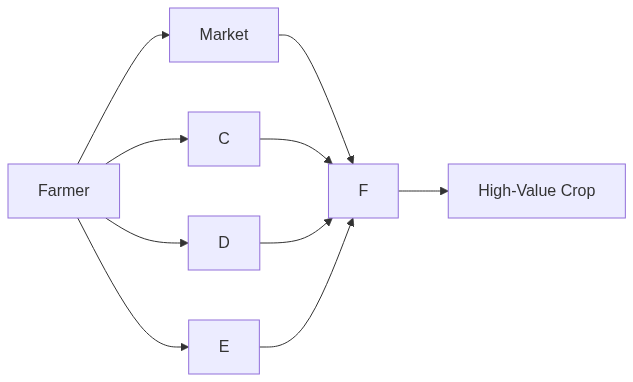
Flow diagram
Conclusion
The selection of high-value crops is therefore not driven by price alone. Farmers make a rational risk-adjusted choice based on profitability, market assurance, agro-climatic suitability, water, labour, credit, infrastructure and institutional support. Hence, sustainable diversification requires reducing the risks surrounding HVCs through cold chains, processing, irrigation efficiency, insurance, FPOs and reliable markets, rather than merely encouraging farmers to shift crops.
Quick related
Students also ask
-
How does nanotechnology offer significant advancements in the field of agriculture? How can this technology help to uplift the socio-economic status of farmers?
Next question on this syllabus topic (2025 · Q15). View answer →
-
Why do farmers return to paddy after a tomato crash?
Because the crash taught them that high value without a floor is a gamble they cannot eat.
-
Is dairy a high-value crop?
It is a high-value farm enterprise. The same logic of buyer, fodder-water and labour applies.
Same topic · past papers
UPSC has asked this before
These previous-year questions sit on the same topic. Open one to practise the earlier ask.
More from this topic
Q14 · UPSC Mains 2026 · GS III · 15 marks · Solution
Discuss the different types of subsidies and supports provided by the Government of India to agricultural sector. Examine the related issues pertaining to Agreement on Agriculture of World Trade Organisation (WTO).
Crops, Irrigation and Marketing
• India supports farmers through MSP procurement, subsidized inputs like fertilizers and power, and cheap
Q13 · UPSC Mains 2026 · GS III · 15 marks · Solution
In which manner has Indian agriculture been transformed from food scarcity to food-surplus level? Describe the various government policies implemented for diversification of Indian agriculture.
Crops, Irrigation and Marketing
• India shifted from chronic post-independence food scarcity to a surplus nation through systemic technological
Q5 · UPSC Mains 2026 · GS III · 10 marks · Solution
Explain by giving two examples, how biotechnology has helped the Indian farmers in processing their perishable crops.
Crops, Irrigation and Marketing
• Biotechnology extends the post-harvest shelf life and processing capabilities of perishable crops, protecting farmers from distress sales. • Silencing ripening enzymes (like polygalacturonase) in transgenic varieties prevents premature softening and reduces transit losses. • Example 1: Genetically modified tomatoes engineered to resist rapid rotting during storage without complete cold-chain dependency. • Microbial fermentation and bio-processing convert surplus perishable harvests into stable, high-value industrial and food products. • Enzymatic maceration using pectinases and cellulases allows efficient fruit pulp breakdown and juice extraction. • Example 2: Biotech-driven conversion of surplus horticulture crops into stable concentrates, purees, and fermented beverages. • Scaling these interventions requires strengthening public-private research partnerships and biosafety frameworks.