
Revision summary
Most Indian irrigation still leans on groundwater, so a falling table is a farm and drinking-water crisis. Free farm power and paddy-wheat in the northwest are the classic drivers, with urban wells and weak licensing close behind. CGWB maps show over-exploited blocks across several States. Atal Bhujal, Jal Shakti Abhiyan, micro-irrigation and aquifer mapping are the main public replies. Without metering and crop change, recharge structures only delay the fall.
Model answer
Copper italics in this answer — like this — are the key facts. Each one is unpacked in the Facts & figures rail.
Introduction
India faces a growing groundwater stress because groundwater supports a major share of irrigation and rural drinking-water needs. The depletion is driven by the mismatch between groundwater extraction and natural recharge, particularly due to water-intensive agriculture, subsidised pumping, urbanisation and weak regulation.
Body
Factors Responsible for Groundwater Depletion
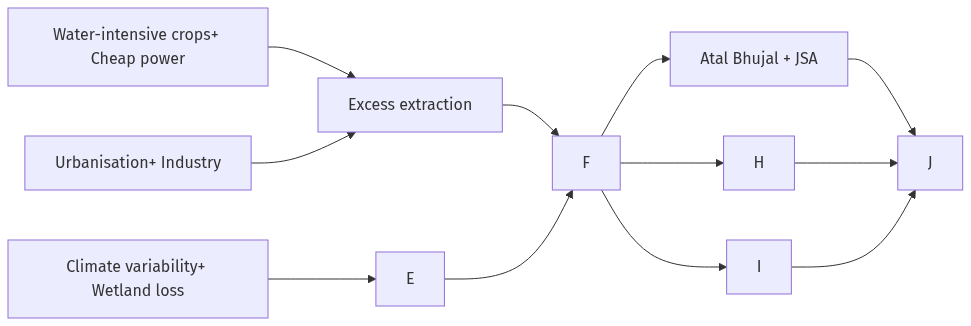
1. Agricultural over-extraction and cropping pattern
- Water-intensive crops: Paddy, wheat and sugarcane require substantial irrigation and intensify groundwater withdrawal.
- Example: The paddy-wheat system in Punjab, Haryana and western Uttar Pradesh sustains heavy dependence on tubewells.
- Green Revolution incentives: Procurement support and assured markets encouraged water-intensive crops even in water-stressed regions.
- Groundwater dependence: High dependence of irrigation on wells makes agricultural demand a major driver of depletion.
2. Subsidised electricity and open-access extraction
- Cheap/free farm power: Low pumping costs encourage farmers to extract groundwater beyond sustainable levels.
- Weak metering: Absence of effective electricity and groundwater metering reduces incentives for conservation.
- Commons problem: Groundwater increasingly behaves like an open-access resource, where individual users have incentives to over-extract.
3. Urbanisation and industrial extraction
- Urban groundwater dependence: Rapid urbanisation, inadequate municipal supply and tanker economies encourage extensive drilling of wells.
- Industrial demand: Industries and brick kilns create additional localised pressure on aquifers.
- Lost recharge zones: Concretisation and loss of wetlands reduce natural groundwater recharge.
4. Climate variability
- Erratic rainfall: Failed monsoons directly reduce groundwater recharge.
- Extreme rainfall: Intense rainfall often produces rapid surface runoff rather than adequate infiltration, further weakening recharge.
5. Sand mining and ecological degradation
- Riverbed sand mining: Excessive extraction can disturb river–aquifer interactions and reduce natural recharge.
- Wetland loss: Destruction of wetlands removes important natural recharge zones.
6. Population and rising demand
- Growing demand: Population growth increases requirements for irrigation, drinking water and industry.
- Dietary and economic changes: Greater demand for water-intensive crops and economic activities further increases extraction.
Steps Taken by the Government
1. Community-led groundwater management
- Atal Bhujal Yojana: Promotes community water-security plans, local water budgeting and sustainable groundwater management in stressed areas.
- Example: Gram-level planning links groundwater availability with local patterns of water use.
2. Water conservation and recharge
- Jal Shakti Abhiyan: Promotes water conservation and groundwater recharge through rainwater harvesting and restoration of water bodies.
- Catch the Rain: Encourages rainwater harvesting and creation of recharge structures.
- Mission Amrit Sarovar: Focuses on revival and creation of ponds and water bodies that can support local water conservation.
3. Improving irrigation efficiency
- PMKSY – Per Drop More Crop: Promotes drip and sprinkler irrigation to improve water-use efficiency and reduce unnecessary groundwater extraction.
4. Scientific aquifer management
- NAQUIM: Maps and scientifically assesses aquifers to understand groundwater availability and guide sustainable utilisation and recharge planning.
- CGWB: Periodically assesses groundwater units and classifies them as safe, semi-critical, critical or over-exploited.
5. Regulation of groundwater extraction
- CGWA: Uses regulatory mechanisms and notifications to control groundwater extraction, particularly for industries and other significant users.
- State-level measures: States have introduced measures relating to groundwater regulation and crop-water management, though implementation remains uneven.
6. Crop diversification and demand-side management
- Crop shift: Encouraging farmers to move away from highly water-intensive crops in stressed regions can reduce groundwater demand.
- Example: Measures such as delaying paddy transplantation can reduce the period of groundwater-intensive irrigation.
- Integrated approach: The most effective strategy combines crop diversification + rational power pricing + recharge rather than relying only on recharge structures.
Flow diagram
Conclusion
- Groundwater depletion in India is fundamentally a demand–supply imbalance: extraction remains high while recharge is constrained. Government initiatives such as Atal Bhujal Yojana, Jal Shakti Abhiyan, PMKSY, NAQUIM and groundwater regulation provide the institutional framework, but lasting results require combining recharge with crop diversification, rational power incentives and effective regulation.
Quick related
Students also ask
-
Mineral resources are fundamental to the country's economy and these are exploited by mining. Why is mining considered an environmental hazard? Explain the remedial measures required to reduce the environmental hazard due to mining.
Next question on this syllabus topic (2025 · Q17). View answer →
-
Does rainwater harvesting fix Punjab?
It helps locally. It cannot offset a paddy crop that evaporates more water than the monsoon puts back.
-
Is bottled water the urban answer?
It is a private exit. The aquifer still needs law, pricing and recharge.
Same topic · past papers
UPSC has asked this before
These previous-year questions sit on the same topic. Open one to practise the earlier ask.
-
2026 · Q4 · GS III · 10 marks
Explain the factors responsible for inefficiency of agri-produce marketing. How does e-commerce help to reduce inefficiency of agri-produce marketing? Explain. -
2024 · Q3 · GS III · 10 marks
What were the factors responsible for the successful implementation of land reforms in some parts of the country? Elaborate. -
2020 · Q13 · GS III · 15 marks
What are the major factors responsible for making rice-wheat system a success? In spite of this success how has this system become bane in India? -
2019 · Q13 · GS III · 15 marks
What are the reformative steps taken by the Government to make food grain distribution system more effective? -
2017 · Q18 · GS III · 15 marks
On December 2004, tsumani brought havoc on 14 countries including India. Discuss the factors responsible for occurrence of Tsunami and its effects on life and economy. In the light of guidelines of NDMA (2010) describe the mechanisms for preparedness to reduce the risk during such events.
More from this topic
Q8 · UPSC Mains 2026 · GS III · 10 marks · Solution
Discuss the aim and goals of Kunming-Montreal global biodiversity framework. Mention India's commitments and initiatives to achieve the goals and targets of this framework giving suitable examples.
Environment and Conservation
• Adopted at CBD COP15, the Kunming-Montreal Global Biodiversity Framework aims to halt and reverse biodiversity loss by 2030. • It outlines a 2050 vision of living in harmony with nature, supported by four long-term goals and 23 actionable targets. • Key global targets include the "30x30" initiative (conserving 30% of land and oceans), restoring 30% of degraded ecosystems, and cutting harmful subsidies. • India aligns its national policies by updating its National Biodiversity Action Plan (NBAP) to match the framework's 23 targets. • India supports the 30x30 goal through an extensive network of over 990 protected areas covering roughly 5.3% of its landmass. • Flagship species conservation efforts like Project Tiger, Project Elephant, and cheetah introductions drive direct ecosystem restoration. • The Biological Diversity Act, 2002 empowers grassroots conservation via local Biodiversity Management Committees and People's Biodiversity Registers.
Q18 · UPSC Mains 2025 · GS III · 15 marks · Solution
Write a review on India's climate commitments under the Paris Agreement (2015) and mention how these have been further strengthened in COP26 (2021). In this direction, how has the first Nationally Determined Contribution intended by India been updated in 2022?
Environment and Conservation
The 2015 NDC promised a 33–35 per cent cut in emissions intensity by 2030, 40 per cent non-fossil power capacity, and a large forest sink. COP26’s Panchamrit raised the political bar, including 500 GW non-fossil, a billion-tonne cut and net zero by 2070. In August 2022 India updated the NDC to 45 per cent intensity reduction and 50 per cent non-fossil installed capacity by 2030. Per-capita equity remains India’s diplomatic line. Pledges now need coal-path honesty and real forest carbon.
Q17 · UPSC Mains 2025 · GS III · 15 marks · Solution
Mineral resources are fundamental to the country's economy and these are exploited by mining. Why is mining considered an environmental hazard? Explain the remedial measures required to reduce the environmental hazard due to mining.
Environment and Conservation
Mining underpins industry but strips forest, dirties air and water, and displaces people. Open-cast coal, metal tailings, sand mining and illegal pits are the main Indian hazard types. EIA, District Mineral Foundations, scientific closure and forest rights are the legal remedies. Illegal mining needs satellite watch and police, not only a new rule. Some deposits should remain unmined where ecology and consent fail.