
Revision summary
Industrial river pollution in India comes from tanneries, textiles, chemicals and similar clusters on living rivers. Mitigation is source control, CETPs, ZLD where needed, online monitoring, zoning and closure under the Water Act. Namami Gange, CPCB’s grossly polluting industry list, CEPI cluster scores and NGT basin orders are the main public initiatives. Sewage and industry mix, so a river mission that ignores either fails. The binding constraint is enforcement at night, not the absence of a statute.
Model answer
Copper italics in this answer — like this — are the key facts. Each one is unpacked in the Facts & figures rail.
Introduction
Indian rivers take factory effluent as well as sewage. Tanneries, textiles, distilleries, paper, chemicals and electroplating have turned stretches of the Ganga, Yamuna, Damodar, Patancheru streams and Pali into industrial drains. Mitigation is not one machine. It is a standard, a pipe, a plant, a court and a closure power. The government’s initiatives only work if those five stay joined.
Body
Mitigation measures
- The first measure is prevention at source: cleaner processes, less water per unit of cloth or leather, and a ban on the worst chemistries. The second is treatment: common effluent treatment plants for clusters of small units that cannot each afford a plant, and zero liquid discharge where the basin is already dead. Online continuous effluent monitoring, linked to the pollution board, makes a midnight bypass harder. Zoning keeps new dirty industry off a floodplain. Polluter-pays cess, bank guarantees and closure under the Water Act are the teeth. Environmental flows and wetland buffers dilute what still escapes, but dilution is not a licence to dump. Community sampling and river-basin data close the gap between a consent order and the actual colour of the water.
- Peg: CETPs for tannery and textile clusters, with ZLD in critically polluted industrial areas, are the standard engineering answer.
- Peg: The Water (Prevention and Control of Pollution) Act, 1974, and EPA, 1986, already allow consent, direction and closure.
Government initiatives
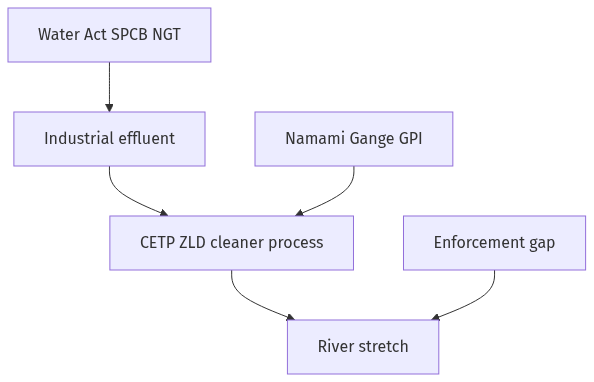
Namami Gange is the flagship basin mission: sewage plants, industrial cluster work, river-front and biodiversity, with the National Mission for Clean Ganga as the vehicle. CPCB and SPCBs set effluent standards and run the Grossly Polluting Industries list on the Ganga main stem. The National Green Tribunal has passed basin-wide orders on Yamuna and Ganga, including industrial inspection. Critically polluted industrial clusters were scored so that expansion could be frozen until CEPI improved. Amritsar to Ganga is not the whole map: Yamuna Action Plans, State river programmes, and extended producer logic for some wastes sit beside it. The gap is enforcement: a CETP that is switched off at night, a board that is under-staffed, and municipalities that still pour sewage, which then mixes with industry so the public cannot see who poisoned the stretch.
- Peg: Namami Gange plus the GPI inventory is the Ganga industrial track; NGT orders are the judicial track.
- Peg: Technology without a working SPCB is a plant on paper.
Flow diagram
Conclusion
Industrial river pollution is mitigated by cleaner processes, CETPs, ZLD, online monitoring and closure powers. Government missions and tribunals have built the kit. The river improves only where that kit is switched on every night, not only on a foundation-stone day.
Quick related
Students also ask
-
What role do environmental NGOs and activists play in influencing Environmental Impact Assessment (EIA) outcomes for major projects in India? Cite four examples with all important details.
Next question on this syllabus topic (2024 · Q8). View answer →
-
Is Namami Gange only about sewage?
Sewage is the larger volume. Industrial clusters and GPI inspections are a stated industrial arm of the same mission.
-
Can a CETP replace enforcement?
No. A shared plant that is bypassed is a monument. The board still has to catch the bypass.
Same topic · past papers
UPSC has asked this before
These previous-year questions sit on the same topic. Open one to practise the earlier ask.
More from this topic
Q8 · UPSC Mains 2026 · GS III · 10 marks · Solution
Discuss the aim and goals of Kunming-Montreal global biodiversity framework. Mention India's commitments and initiatives to achieve the goals and targets of this framework giving suitable examples.
Environment and Conservation
• Adopted at CBD COP15, the Kunming-Montreal Global Biodiversity Framework aims to halt and reverse biodiversity loss by 2030. • It outlines a 2050 vision of living in harmony with nature, supported by four long-term goals and 23 actionable targets. • Key global targets include the "30x30" initiative (conserving 30% of land and oceans), restoring 30% of degraded ecosystems, and cutting harmful subsidies. • India aligns its national policies by updating its National Biodiversity Action Plan (NBAP) to match the framework's 23 targets. • India supports the 30x30 goal through an extensive network of over 990 protected areas covering roughly 5.3% of its landmass. • Flagship species conservation efforts like Project Tiger, Project Elephant, and cheetah introductions drive direct ecosystem restoration. • The Biological Diversity Act, 2002 empowers grassroots conservation via local Biodiversity Management Committees and People's Biodiversity Registers.
Q18 · UPSC Mains 2025 · GS III · 15 marks · Solution
Write a review on India's climate commitments under the Paris Agreement (2015) and mention how these have been further strengthened in COP26 (2021). In this direction, how has the first Nationally Determined Contribution intended by India been updated in 2022?
Environment and Conservation
The 2015 NDC promised a 33–35 per cent cut in emissions intensity by 2030, 40 per cent non-fossil power capacity, and a large forest sink. COP26’s Panchamrit raised the political bar, including 500 GW non-fossil, a billion-tonne cut and net zero by 2070. In August 2022 India updated the NDC to 45 per cent intensity reduction and 50 per cent non-fossil installed capacity by 2030. Per-capita equity remains India’s diplomatic line. Pledges now need coal-path honesty and real forest carbon.
Q17 · UPSC Mains 2025 · GS III · 15 marks · Solution
Mineral resources are fundamental to the country's economy and these are exploited by mining. Why is mining considered an environmental hazard? Explain the remedial measures required to reduce the environmental hazard due to mining.
Environment and Conservation
Mining underpins industry but strips forest, dirties air and water, and displaces people. Open-cast coal, metal tailings, sand mining and illegal pits are the main Indian hazard types. EIA, District Mineral Foundations, scientific closure and forest rights are the legal remedies. Illegal mining needs satellite watch and police, not only a new rule. Some deposits should remain unmined where ecology and consent fail.