
Revision summary
Buffer stocks buy rice and wheat at MSP so harvest prices do not crash, and release them through PDS and open sale so retail prices do not spike. FCI and State agencies hold the central cereal pool; a Price Stabilisation Fund is used for some pulses and perishables. Storage challenges: CAP exposure, rodents and fungus, high carrying cost, and stocks piled in a few surplus States. A rice-wheat mountain does not automatically cool onion or tur inflation. Silos, WDRA warehouses and a wider commodity set are the storage reforms that match the price-stability claim.
Model answer
Copper italics in this answer — like this — are the key facts. Each one is unpacked in the Facts & figures rail.
Introduction
A bumper harvest without a buyer is a crash. A drought without grain in a godown is a riot of prices. Buffer stocks are how the Indian State sits between those two failures: buy when the farm-gate is weak, sell or ration when the kitchen is dear. Wheat and rice, held mainly by the Food Corporation of India and State agencies, are still the core of that instrument.
Body
Why buffers stabilise prices
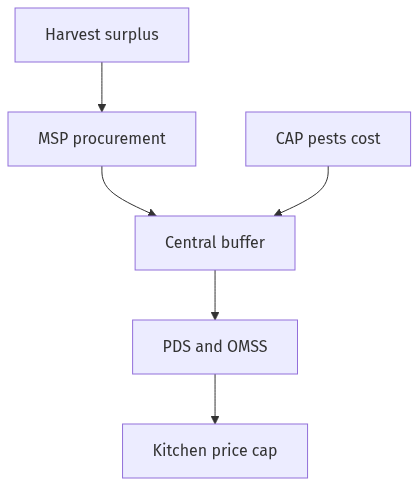
Under MSP procurement, a floor is put under rice and wheat in surplus belts. Grain that would have flooded the mandi is lifted into the central pool. That supports farm prices in the harvest window. In a lean or shock year, open market sale, OMSS and NFSA / PDS issue put grain back, which caps retail spikes for the cereal poor. The buffer is also a war and pandemic reserve: 2020 showed why a public pile matters when private trade panics. For pulses and onion the Union has used a Price Stabilisation Fund and smaller buffers, because those items often lead CPI. The logic is textbook counter-cyclical stock: absorb surplus, release deficit. It is also political: India does not leave cereal security only to a futures screen.
- Peg: FCI plus DCP State agencies are the operational arms of the cereal buffer.
- Peg: NFSA off-take is the regular release valve; OMSS is the extra valve when retail rice or wheat runs hot.
Storage challenges
The pile is uneven. Procurement is concentrated in Punjab, Haryana and a few other States, so grain must travel and sit. Covered capacity has often lagged the stock, forcing Cover and Plinth (CAP) storage that is vulnerable to rain, rodents and theft. Quality loss — refraction, fungus, weevils — is a fiscal and a food-safety cost. Older grain is harder to move before a new harvest arrives. High carrying cost (interest, storage, transit) sits on the food-subsidy bill. Regional mismatch means a deficit State may still see a local spike while a Punjab silo is full. Nutritional narrowness is a policy challenge: a rice-wheat buffer does little for onion or tur unless separate stocks exist. Private warehouses and WDRA receipts are the intended modernisation; uptake is still catching the political need to show a mountain of grain. Climate adds heat and untimely rain on CAP stacks. The challenge is therefore not the idea of a buffer. It is where it sits, in what, and of which crop.
- Peg: CAP versus silo is the physical quality fight; Punjab-Haryana concentration is the geographic fight.
- Peg: A cereal mountain can coexist with horticulture inflation; the buffer is only as wide as what is actually stored.
What a rice-wheat pile cannot do
Stabilisation is crop-specific. A full FCI godown does not cap onion, tomato or tur unless a Price Stabilisation Fund or a separate pulse buffer is actually used. Export bans on top of a pile can scare the next sowing. Open-ended procurement without a storage plan turns a price tool into a quality and fiscal problem. The buffer remains essential for cereal security. It is not a universal inflation switch.
- Peg: OMSS works when grain is moved in time to the deficit market, not when it only exists on a weekly stock statement.
- Peg: Diversifying buffers toward pulses, if storage exists, is how the instrument tracks the modern CPI kitchen.
Flow diagram
Conclusion
Buffer stocks stabilise Indian farm and kitchen cereal prices by buying at MSP and releasing through PDS and open sale. Storage still leaks value through CAP, pests, cost and a narrow rice-wheat map. A modern silo in the right State is the missing half of the stabilisation story.
Quick related
Students also ask
-
What are the direct and indirect subsidies provided to farm sector in India? Discuss the issues raised by the World Trade Organization(WTP) in relation to agricultural subsidies.
Next question on this syllabus topic (2023 · Q14). View answer →
-
Does a larger buffer always mean lower inflation?
It helps cereals if it is released in time. It does not cap tomato or onion unless those have their own stock and trade policy.
-
Why not store everything in silos?
Silos cost more up front. The fiscal system still often chooses CAP because the harvest arrives faster than the concrete.
Same topic · past papers
UPSC has asked this before
These previous-year questions sit on the same topic. Open one to practise the earlier ask.
-
2026 · Q16 · GS III · 15 marks
What is Agentic Artificial Intelligence (AI)? Explain its working. Describe its applications with suitable examples. Discuss the advantages, risks and challenges associated with agentic AI systems. -
2018 · Q16 · GS III · 15 marks
With growing energy needs should India keep on expanding its nuclear energy programme? Discuss the facts and fears associated with nuclear energy. (250 Words, 15 Marks).
More from this topic
Q14 · UPSC Mains 2023 · GS III · 15 marks · Solution
What are the direct and indirect subsidies provided to farm sector in India? Discuss the issues raised by the World Trade Organization(WTP) in relation to agricultural subsidies.
Farm Subsidies and PDS
Direct subsidies include fertiliser, power, irrigation, crop-loan subvention, PM-KISAN and insurance premium support. Indirect subsidies include MSP, public procurement, food subsidy, and cheap public research and seed. WTO Amber Box covers trade-distorting price and input support, with 10 per cent de minimis for developing countries. Green Box is uncapped if genuinely non-distorting; Blue Box is production-limiting payments. The peace clause protects public stockholding from disputes pending a permanent solution.
Q12 · UPSC Mains 2022 · GS III · 15 marks · Solution
Do you think India will meet 50 percent of its energy needs from renewable energy by 2030 ? Justify your answer. How will the shift of subsidies from fossil fuels to renewables help achieve the above objective ? Explain.
Farm Subsidies and PDS
Panchamrit targets 50 per cent of installed electric capacity from non-fossil sources by 2030, including hydro and nuclear. That is not 50 per cent of energy needs, and not even 50 per cent of electricity generation, because solar and wind have lower capacity factors. Half of all energy from renewables by 2030 is unlikely given oil and industrial coal. The capacity target is more plausible if transmission, storage and discom health improve. Shifting subsidies from fossils to renewables and storage helps relative prices and manufacturing; social fuels need targeted DBT, not a blunt cut.
Q3 · UPSC Mains 2022 · GS III · 10 marks · Solution
What are the major challenges of Public Distribution System (PDS) in India ? How can it be made effective and transparent ?
Farm Subsidies and PDS
PDS under NFSA 2013 is a legal grain entitlement, not a discretionary dole. Main challenges are wrong lists, diversion, poor quality, weak last-mile shops, and a rice-wheat nutrition gap. Migrants lose access when the card is locked to one State. Effectiveness needs computerised supply chains, e-PoS, One Nation One Ration Card, social audits, and exception rules when biometrics fail. DBT can complement urban PDS; it is a poor substitute where food markets are thin.