
Revision summary
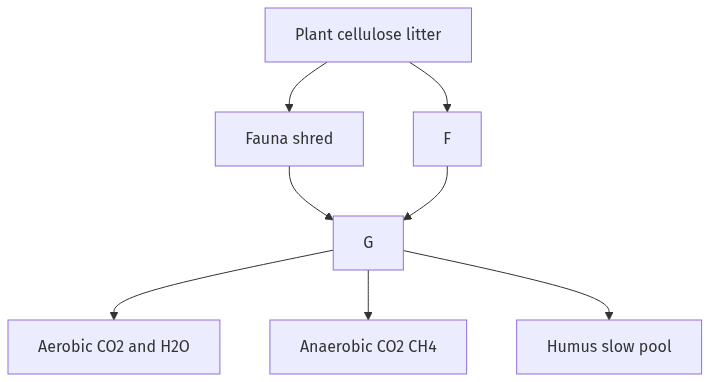
Plants deposit a large annual mass of cellulose in litter, wood and roots. Most animals cannot digest the β-1,4 polymer without microbial cellulases. Fungi and bacteria hydrolyse cellulose to glucose; soil fauna shred and mix. Aerobic respiration yields carbon dioxide and water; anaerobic guts and wetlands also yield methane. Humus and soil organic carbon are slower residues, not instant end gases.
Model answer
Copper italics in this answer — like this — are the key facts. Each one is unpacked in the Facts & figures rail.
Introduction
Land plants lock carbon in cellulose—the polymer that makes cell walls. Each year forests, grasslands and crops add a huge mass of that material as litter, roots and wood. It does not sit forever. Decomposers and, in part, herbivores and fire break cellulose into sugars and then into carbon dioxide, water and residues such as humus and, in wet soils, methane.
Body
What must be broken
- Cellulose is a chain of glucose units joined by β-1,4 links. Most animals cannot hydrolyse it; they need microbes.
- Lignin and hemicellulose travel with cellulose in wood; they slow decay and shape which organisms win.
Natural processes before the end products
- Mechanical breakdown: soil fauna (earthworms, termites, millipedes) shred litter, raise surface area, and mix it with microbes.
- Enzymatic hydrolysis: fungi (especially basidiomycetes and ascomycetes) and bacteria secrete cellulases (endoglucanase, exoglucanase, β-glucosidase). The polymer becomes cellobiose and then glucose.
- Aerobic respiration of that glucose by microbes (and by animals that host cellulolytic symbionts, such as ruminants and termites) yields CO2 and H2O and energy.
- Anaerobic pathways in waterlogged soils, sediments and guts: fermentation and methanogenesis yield organic acids, CO2 and CH4 rather than full oxidation.
- Humification: not all carbon becomes gas in one season. Some becomes humus and soil organic carbon, a slower pool.
- Fire and photodegradation in dry biomes oxidise litter partly to CO2 without passing through a gut; they are natural but not the forest-floor default.
- Ruminants and termites are ecological processors of cellulose at landscape scale; their symbionts do the chemistry.
End products in order
- Immediate: sugars, then microbial biomass.
- Terminal under air: CO2 and water.
- Terminal under anoxia: CO2, methane, and reduced organics.
- Residual: humus, charcoal, and mineral-associated organic matter.
Why it matters for GS-III
- This is the carbon cycle on land. Slowing decay (waterlogging, cold, lignin) stores carbon; accelerating it (tillage, drainage) releases CO2.
Flow diagram
Conclusion
Yearly cellulose is dismantled first by shredders and then by microbial cellulases. Glucose is respired to carbon dioxide and water in air, or fermented to methane in wet systems, with humus as the slow remainder. The end products named in the question are the last step, not the first.
Quick related
Students also ask
-
Discuss global warming and mention its effects on the global climate. Explain the control measures to bring down the level of greenhouse gases which cause global warming, in the light of the Kyoto Protocol, 1997.
Next question on this syllabus topic (2022 · Q17). View answer →
-
Do plants themselves turn cellulose into CO2?
Living plants respire their own sugars. Dead cellulose is mainly decomposed by microbes and fire, not by the dead plant.
-
Is methane an ‘other end product’?
Yes, in anaerobic soils and guts. The question’s CO2 and water are the aerobic terminal pair.
Same topic · past papers
UPSC has asked this before
These previous-year questions sit on the same topic. Open one to practise the earlier ask.
-
2022 · Q13 · GS III · 15 marks
What are the main bottlenecks in upstream and downstream process of marketing of agricultural products in India ?
More from this topic
Q8 · UPSC Mains 2026 · GS III · 10 marks · Solution
Discuss the aim and goals of Kunming-Montreal global biodiversity framework. Mention India's commitments and initiatives to achieve the goals and targets of this framework giving suitable examples.
Environment and Conservation
• Adopted at CBD COP15, the Kunming-Montreal Global Biodiversity Framework aims to halt and reverse biodiversity loss by 2030. • It outlines a 2050 vision of living in harmony with nature, supported by four long-term goals and 23 actionable targets. • Key global targets include the "30x30" initiative (conserving 30% of land and oceans), restoring 30% of degraded ecosystems, and cutting harmful subsidies. • India aligns its national policies by updating its National Biodiversity Action Plan (NBAP) to match the framework's 23 targets. • India supports the 30x30 goal through an extensive network of over 990 protected areas covering roughly 5.3% of its landmass. • Flagship species conservation efforts like Project Tiger, Project Elephant, and cheetah introductions drive direct ecosystem restoration. • The Biological Diversity Act, 2002 empowers grassroots conservation via local Biodiversity Management Committees and People's Biodiversity Registers.
Q18 · UPSC Mains 2025 · GS III · 15 marks · Solution
Write a review on India's climate commitments under the Paris Agreement (2015) and mention how these have been further strengthened in COP26 (2021). In this direction, how has the first Nationally Determined Contribution intended by India been updated in 2022?
Environment and Conservation
The 2015 NDC promised a 33–35 per cent cut in emissions intensity by 2030, 40 per cent non-fossil power capacity, and a large forest sink. COP26’s Panchamrit raised the political bar, including 500 GW non-fossil, a billion-tonne cut and net zero by 2070. In August 2022 India updated the NDC to 45 per cent intensity reduction and 50 per cent non-fossil installed capacity by 2030. Per-capita equity remains India’s diplomatic line. Pledges now need coal-path honesty and real forest carbon.
Q17 · UPSC Mains 2025 · GS III · 15 marks · Solution
Mineral resources are fundamental to the country's economy and these are exploited by mining. Why is mining considered an environmental hazard? Explain the remedial measures required to reduce the environmental hazard due to mining.
Environment and Conservation
Mining underpins industry but strips forest, dirties air and water, and displaces people. Open-cast coal, metal tailings, sand mining and illegal pits are the main Indian hazard types. EIA, District Mineral Foundations, scientific closure and forest rights are the legal remedies. Illegal mining needs satellite watch and police, not only a new rule. Some deposits should remain unmined where ecology and consent fail.