
Revision summary
Global warming is the rise in surface temperature from extra greenhouse gases trapping infrared. Effects include glacier and ice loss, sea-level rise, coral bleaching, harsher extremes, and crop and coastal stress. The Kyoto Protocol 1997 set quantified limits for Annex I countries and created emissions trading, Joint Implementation and the CDM. India was not under a Kyoto cap but hosted CDM projects. Paris 2015 extended pledges to all parties; the control toolkit remains mitigation, markets, efficiency and sinks.
Model answer
Copper italics in this answer — like this — are the key facts. Each one is unpacked in the Facts & figures rail.
Introduction
Global warming is the long-term rise in Earth’s average surface temperature from enhanced greenhouse gases—chiefly carbon dioxide, methane and nitrous oxide—trapping outgoing infrared. The Kyoto Protocol (1997) was the first binding attempt to put quantified emission limits on industrial countries. Control today still uses Kyoto’s logic (count, cap, trade) even after Paris 2015 shifted to universal pledges.
Body
Global warming
- Solar short-wave energy reaches the surface; Earth emits long-wave infrared. Greenhouse gases absorb some of that infrared and re-radiate it, warming the lower atmosphere.
- Anthropogenic extra CO2 from fossil fuels and land-use change, CH4 from livestock, waste and leaks, and N2O from fertiliser thicken that blanket.
- IPCC-assessed warming relative to pre-industrial times is already more than a degree Celsius; the exact tenth is a moving measured quantity—do not invent a false precision here.
- Warming is uneven: land faster than ocean, Arctic faster than tropics.
Effects
- Cryosphere: glacier retreat (Himalayan water towers), ice-sheet loss, permafrost thaw that can release more methane.
- Oceans: thermal expansion and ice melt raise sea level; warmer water bleaches coral and lowers oxygen; CO2 itself causes acidification (a cousin problem).
- Weather: more intense heatwaves, shifting monsoon risk, heavier extreme rain, and compound drought–fire in some regions.
- Biosphere and food: crop heat stress, pest range shifts, fisheries moving poleward.
- People: coastal flooding, heat mortality, climate-related displacement, and security stress over water.
- Tipping elements (AMOC, rainforest dieback, ice sheets) are risks, not a calendar prediction.
Control measures in light of Kyoto 1997
- Kyoto (adopted 1997, entered into force 2005) bound Annex I parties to emission limitation or reduction over a first commitment period, with common but differentiated responsibilities relative to the 1992 UNFCCC.
- Flexible mechanisms: Emissions Trading, Joint Implementation, and the Clean Development Mechanism (CDM) so cuts could occur where cheaper, including projects in developing countries (India hosted many CDM projects: renewables, industrial gases).
- Domestic control toolkit consistent with that architecture: carbon price or trading, renewable standards, energy efficiency, forest sinks (Kyoto allowed land-use accounting with rules), and methane capture.
- Limits of Kyoto: the United States did not ratify; some targets were missed; aviation and much of shipping sat awkwardly; developing-country growth emissions were outside binding Annex I caps—hence Paris nationally determined contributions for all.
- India’s control path in that light: not an Annex I Kyoto cap, but CDM experience, later Panchamrit and non-fossil capacity, energy-efficiency missions, and a possible carbon market—Kyoto’s MRV and market tools without pretending India had a 1997 QELRC.
Continuity
- Measure, report, verify; put a cost on carbon; protect sinks. That is Kyoto’s lasting method. Paris changed who pledges, not the physics.
Flow diagram
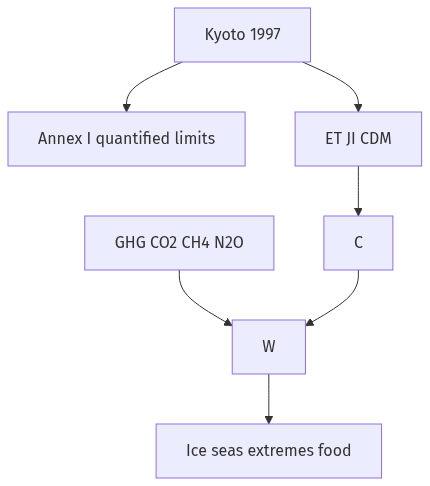
Conclusion
Global warming is greenhouse trapping of infrared, with effects on ice, seas, extremes and food. Kyoto 1997 first capped Annex I emissions and invented trading, JI and CDM. Control still means price, technology, sinks and honesty about who was bound. Paris universalised pledges; it did not repeal the need to cut gases.
Quick related
Students also ask
-
Explain the purpose of the Green Grid Initiative launched at World Leaders Summit of the COP26 UN Climate Change Conference in Glasgow in November, 2021. When was this idea first floated in the International Solar Alliance (ISA) ?
Next question on this syllabus topic (2021 · Q6). View answer →
-
Did Kyoto bind India to a cut?
No quantified Kyoto cap for India. India participated through CDM as a host, under CBDR.
-
Is ocean acidification the same as warming?
It is caused by CO2 dissolving in seawater, often alongside warming. Both come from the same emissions.
Same topic · past papers
UPSC has asked this before
These previous-year questions sit on the same topic. Open one to practise the earlier ask.
More from this topic
Q8 · UPSC Mains 2026 · GS III · 10 marks · Solution
Discuss the aim and goals of Kunming-Montreal global biodiversity framework. Mention India's commitments and initiatives to achieve the goals and targets of this framework giving suitable examples.
Environment and Conservation
• Adopted at CBD COP15, the Kunming-Montreal Global Biodiversity Framework aims to halt and reverse biodiversity loss by 2030. • It outlines a 2050 vision of living in harmony with nature, supported by four long-term goals and 23 actionable targets. • Key global targets include the "30x30" initiative (conserving 30% of land and oceans), restoring 30% of degraded ecosystems, and cutting harmful subsidies. • India aligns its national policies by updating its National Biodiversity Action Plan (NBAP) to match the framework's 23 targets. • India supports the 30x30 goal through an extensive network of over 990 protected areas covering roughly 5.3% of its landmass. • Flagship species conservation efforts like Project Tiger, Project Elephant, and cheetah introductions drive direct ecosystem restoration. • The Biological Diversity Act, 2002 empowers grassroots conservation via local Biodiversity Management Committees and People's Biodiversity Registers.
Q18 · UPSC Mains 2025 · GS III · 15 marks · Solution
Write a review on India's climate commitments under the Paris Agreement (2015) and mention how these have been further strengthened in COP26 (2021). In this direction, how has the first Nationally Determined Contribution intended by India been updated in 2022?
Environment and Conservation
The 2015 NDC promised a 33–35 per cent cut in emissions intensity by 2030, 40 per cent non-fossil power capacity, and a large forest sink. COP26’s Panchamrit raised the political bar, including 500 GW non-fossil, a billion-tonne cut and net zero by 2070. In August 2022 India updated the NDC to 45 per cent intensity reduction and 50 per cent non-fossil installed capacity by 2030. Per-capita equity remains India’s diplomatic line. Pledges now need coal-path honesty and real forest carbon.
Q17 · UPSC Mains 2025 · GS III · 15 marks · Solution
Mineral resources are fundamental to the country's economy and these are exploited by mining. Why is mining considered an environmental hazard? Explain the remedial measures required to reduce the environmental hazard due to mining.
Environment and Conservation
Mining underpins industry but strips forest, dirties air and water, and displaces people. Open-cast coal, metal tailings, sand mining and illegal pits are the main Indian hazard types. EIA, District Mineral Foundations, scientific closure and forest rights are the legal remedies. Illegal mining needs satellite watch and police, not only a new rule. Some deposits should remain unmined where ecology and consent fail.