
Revision summary
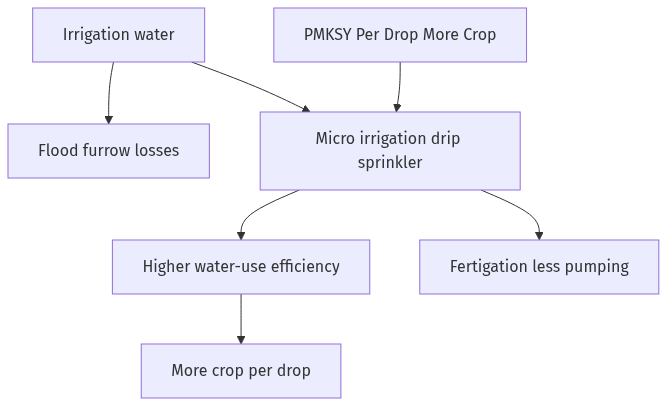
Water-use efficiency is crop output or income per unit of water applied or consumed. Surface irrigation loses much water to evaporation, seepage and percolation. Drip and sprinkler put water in the root zone and allow fertigation, raising yield per drop and often cutting pump hours. Limits are capital cost, clogging and the risk of expanding thirsty crops. PMKSY (2015) and Per Drop More Crop subsidise micro-irrigation as the national programme.
Model answer
Copper italics in this answer — like this — are the key facts. Each one is unpacked in the Facts & figures rail.
Introduction
Water-use efficiency in farming is the useful crop output (or income) obtained per unit of water applied or consumed. Indian irrigation is still dominated by flood and furrow methods that lose water to evaporation, seepage and deep percolation. Micro-irrigation — drip and sprinkler — puts water (and often fertiliser) in the root zone. That is the practical route to more crop per drop.
Body
What water-use efficiency means
- Agronomic efficiency is yield per cubic metre of irrigation water; economic efficiency is rupees of produce per unit of water.
- Basin efficiency also counts return flows reused downstream; on-farm efficiency is what the farmer controls at the plot.
- India's challenge is low on-farm efficiency in rice-wheat and sugarcane belts, falling groundwater, and climate-unreliable monsoon.
- Efficiency is not only hardware. It needs scheduling, crop choice, lining of canals, and pricing or community rules that discourage waste.
Role of micro-irrigation
- Drip irrigation delivers water in drops to the root zone through emitters. It cuts evaporation and wetting of unproductive soil, and it suits horticulture, cotton, sugarcane and vegetables.
- Sprinklers spray water like rain. They suit cereals, pulses and fodder on undulating land where drip laterals are costly.
- Both methods raise application efficiency well above typical surface irrigation, so the same reservoir or tube-well serves more area or the same area with less pumping.
- Fertigation with drip places nutrients with water, raising fertiliser-use efficiency and cutting leaching into groundwater.
- Less waterlogging and soil crusting improve root health and quality of produce, which matters for export horticulture.
- Energy use per kilogram can fall because pumps run fewer hours, which also eases the power-subsidy burden of States.
- Limits: high capital cost, clogging in saline or dirty water, need for filters and farmer training, and weak results if farmers still grow water-guzzling crops on a larger command.
Policy support
- Pradhan Mantri Krishi Sinchayee Yojana (PMKSY, 2015) unifies irrigation efforts with the motto Har Khet Ko Pani and Per Drop More Crop.
- The Per Drop More Crop component subsidises micro-irrigation systems, often with State top-up, and links them to water-user groups.
- National Mission for Sustainable Agriculture and earlier National Mission on Micro Irrigation laid the subsidy path that PMKSY absorbed.
- Efficiency also needs participatory irrigation management, canal lining, and crop diversification away from paddy in severely over-exploited blocks.
Flow diagram
Conclusion
Water-use efficiency is more yield and income from each unit of water. Drip and sprinkler raise that efficiency by cutting non-beneficial losses and enabling fertigation. PMKSY's Per Drop More Crop is the Union vehicle; it works when hardware comes with training, maintenance and sensible crop choice.
Quick related
Students also ask
-
What is allelopathy? Discuss its role in major cropping systems of irrigated agriculture.
Next question on this syllabus topic (2016 · Q8). View answer →
-
Does micro-irrigation always save river or aquifer water at basin scale?
On-farm losses fall, but if farmers expand area or thirsty crops, basin savings can be smaller. Crop choice still matters.
-
Is canal irrigation outdated once drip exists?
No. Canals still fill ponds and aquifers. Micro-irrigation is the on-farm application method that makes that water go further.
Same topic · past papers
UPSC has asked this before
These previous-year questions sit on the same topic. Open one to practise the earlier ask.
-
2021 · Q4 · GS III · 10 marks
How and to what extent would micro-irrigation help in solving India's water crisis ?
More from this topic
Q14 · UPSC Mains 2026 · GS III · 15 marks · Solution
Discuss the different types of subsidies and supports provided by the Government of India to agricultural sector. Examine the related issues pertaining to Agreement on Agriculture of World Trade Organisation (WTO).
Crops, Irrigation and Marketing
• Input subsidies: fertiliser, power, irrigation, credit interest subvention. • Output support: MSP and public procurement where operational. • Income/insurance: PM-KISAN-type transfers and crop insurance premium help. • Infrastructure support is largely Green Box-compatible public goods. • AoA boxes: Green, Blue, Amber (AMS) plus market access and export rules. • India disputes outdated reference prices for stockholding AMS math. • Bali peace clause temporary; permanent stockholding solution still sought. • SSM and careful shift to decoupled/Green supports are strategic responses.
Q13 · UPSC Mains 2026 · GS III · 15 marks · Solution
In which manner has Indian agriculture been transformed from food scarcity to food-surplus level? Describe the various government policies implemented for diversification of Indian agriculture.
Crops, Irrigation and Marketing
• Mid-1960s crises exposed import dependence and ship-to-mouth risk. • HYV wheat/rice, irrigation and chemicals raised yields in key plains. • MSP–FCI–PDS converted yield into national buffer security. • Surplus mainly means staple confidence; nutrition gaps remain. • MIDH drives fruit–vegetable diversification and post-harvest links. • Dairy/livestock and fisheries add protein and cash incomes. • Pulses, oilseeds and millets missions address imports and climate diets. • Market, storage and groundwater policies must accompany crop shifts.
Q5 · UPSC Mains 2026 · GS III · 10 marks · Solution
Explain by giving two examples, how biotechnology has helped the Indian farmers in processing their perishable crops.
Crops, Irrigation and Marketing
• Perishables lose value fast; biotech helps at nursery and packhouse stages. • Tissue-culture banana gives disease-indexed, uniform plantlets for processing. • Uniform bunches cut sorting waste in chips, puree and export packs. • Ethylene ripening chambers apply plant physiology to replace carbide and time firmness. • Enzyme treatments improve juice clarity and extraction from mango/banana. • Surplus fruit can enter fermentation or dehydrated product lines. • Prefer deployed Indian examples over unverified commercial GM shelf-life claims. • Net effect: less spoilage, better processing fit, higher chance of organised-market sales.