
Revision summary
Citizens’ Charters, after the 1997 Chief Ministers’ conference, promise standards, time, information and grievance. They stall for want of legal force, measurable clocks, compensation, staff ownership and public awareness. Sevottam tried quality certification; many charters remain posters. State Right to Service Acts with penalties are the working Indian upgrade. Dashboards, local-language co-drafting and third-party audit would close the gap. RTI is about information; a charter is about the service clock — they stack.
Model answer
Copper italics in this answer — like this — are the key facts. Each one is unpacked in the Facts & figures rail.
Introduction
The Citizens’ Charter was imported from John Major’s Britain and adopted in India after the 1997 Chief Ministers’ conference: a public promise of standards, time, grievance and information for each service. It was a landmark because it said the clerk exists for the citizen. It has not reached full potential because a promise without a remedy becomes a poster.
Body
What the charter promised
A charter is the citizen’s face of administrative law, not the whole of it.
- Peg: It lists what the department does, how long it should take, what the citizen must bring, and where to complain.
- Peg: Sevottam later tried to certify quality; together with the Right to Information and State public-service guarantee Acts, it was the language of citizen-centric administration.
Why the promise stalled
A poster is not a right.
- Peg: There is no uniform central statute making the charter a right; many remain departmental resolutions.
- Peg: Standards are vague — “expeditious” rather than seven working days — and there is often no compensation when the clock blows.
- Peg: Staff who did not write the charter do not own it; awareness is low; the poster is in English on a peeling wall.
- Peg: Charters are not rewritten when the scheme changes; outsourced centres add a vendor who is not in the charter; without audit, a 30-day promise is literature.
Measures
The 1997 conference needs a justiciable clock.
- Peg: State Right to Service Acts with named services, days, and a small penalty that actually pays.
- Peg: Live dashboards, co-drafting with users in the local language, a revision date, and third-party audit of Sevottam claims.
- Peg: Train the frontline, not only the Joint Secretary who launched the PDF; link the charter to CPGRAMS so the grievance code is the same as the clock.
- Peg: Copy SMS tracking from Passport Seva and India Post rather than printing another brochure.
Flow diagram
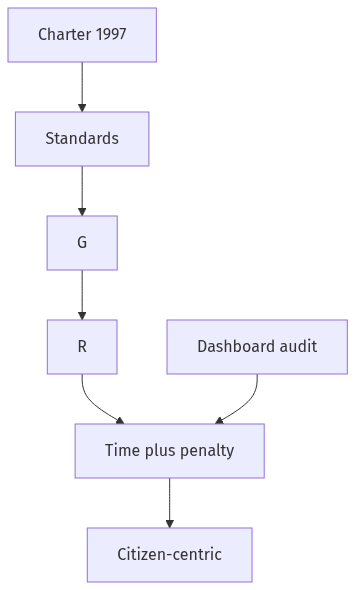
Conclusion
The Citizens’ Charter named a standard of service. It under-performs because it is rarely a right. Statutory time limits, compensation, language and audit would finish the job the 1997 conference started.
Quick related
Students also ask
-
e-governance is not just about the routine application of digital technology in service delivery process. It is as much about multifarious interactions for ensuring transparency and accountability. In this context, evaluate the role of the 'Interactive Service Model' of e-governance.
Next question on this syllabus topic (2024 · Q18). View answer →
-
Is a Citizens’ Charter a contract?
Usually no. It is an administrative promise. Right to Service statutes are closer to a right.
-
Did RTI make charters redundant?
RTI is about information. A charter is about the service clock. They stack; they do not replace each other.
Same topic · past papers
UPSC has asked this before
These previous-year questions sit on the same topic. Open one to practise the earlier ask.
-
2018 · Q18 · GS II · 15 marks
The Citizen's Charter is an ideal instrument of organisational transparency and accountability, but it has its own limitations. Identify the limitations and suggest measures for greater effectiveness of the Citizen's Charters. (15). -
2026 · Q5 · GS II · 10 marks
Do constitutional bodies like the National Commission for Scheduled Castes (NCSC) and the National Commission for Scheduled Tribes (NCST) possess adequate enforcement powers to secure substantive social equality? Suggest measures to enhance their institutional effectiveness. -
2026 · Q13 · GS II · 15 marks
How far has the Indian federal framework been successful in accommodating regional and cultural diversities? Highlight the role of asymmetric federalism and suggest measures to make dispute resolution mechanisms more effective. -
2025 · Q18 · GS II · 15 marks
The National Commission for Protection of Child Rights has to address the challenges faced by children in the digital era. Examine the existing policies and suggest measures the Commission can initiate to tackle the issue. -
2024 · Q13 · GS II · 15 marks
What changes has the Union Government recently introduced in the domain of Centre-State relations? Suggest measures to be adopted to build the trust between the Centre and the States and for strengthening federalism.
More from this topic
Q16 · UPSC Mains 2026 · GS II · 15 marks · Solution
"Transparency and accountability in governance are not about controlling corruption but about creating the trust of stakeholders in the policy process by following the Rule of Law and Participatory Governance." Comment.
Transparency and e-Governance
• Transparency and accountability go beyond stopping corruption to build positive systemic trust and institutional legitimacy. • They anchor the Rule of Law by ensuring predictable policies, preventing arbitrary executive abuse, and offering procedural fairness. • Participatory governance transforms top-down administration into a collaborative compact through citizen engagement. • Pre-legislative consultations and platforms like MyGov allow substantive public input before laws are finalized. • Social audits, such as those under MGNREGA, empower grassroots stakeholders to verify implementation and course-correct locally. • State machinery functions best when administrative actions are justifiable, fair, and rooted in public interest. • Embedding these elements into administrative DNA fulfills the constitutional promise of securing justice and fraternity for all.
Q7 · UPSC Mains 2025 · GS II · 10 marks · Solution
e-governance projects have a built-in bias towards technology and back-end integration than user-centric designs. Examine.
Transparency and e-Governance
User-centric e-governance starts from the citizen’s journey; many projects start from ID, ledger and dashboard. NeGP, GSTN, Aadhaar and PFMS are strong backs; language, OTP-on-one-phone and failed biometrics are weak fronts. 2nd ARC, Sevottam and public-service guarantee laws already asked for time-bound citizen outcomes. DPDP and RPwD add consent and accessibility duties. Correction: assisted kiosks, local language, offline fallback, and the same data for the ward as for the secretary.
Q18 · UPSC Mains 2024 · GS II · 15 marks · Solution
e-governance is not just about the routine application of digital technology in service delivery process. It is as much about multifarious interactions for ensuring transparency and accountability. In this context, evaluate the role of the 'Interactive Service Model' of e-governance.
Transparency and e-Governance
E-governance is not only digitising a counter; it is multi-way interaction for transparency and accountability. The Interactive Service Model is two-way apply–track–grieve–reply, the top of the usual model ladder. Indian examples: UMANG, CPGRAMS, Passport Seva, RTI Online, GST replies, GeM. Gains: time-stamped trails. Losses: digital divide, kiosk touts, privacy risk, vanity dashboards. Assisted access and honest back-ends decide whether the model is real. Direct Benefit Transfer is interactive only when failure can be queried.