
Revision summary
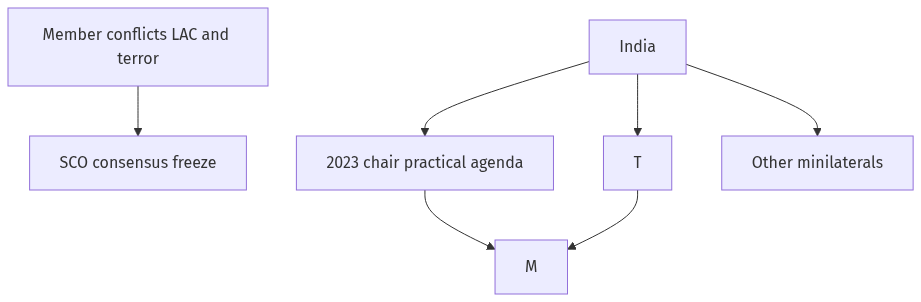
The SCO is consensus-based, so India–China LAC tension and India–Pakistan terror disputes stall it. Russia–Ukraine and expansion add further strain among members. India mitigates by keeping channels, chairing practical 2023 cooperation, and putting counter-terrorism on the agenda. It will not treat Jammu and Kashmir as an SCO bilateral dispute. Full political settlement of LAC or Pakistan issues will not come from the SCO itself.
Model answer
Copper italics in this answer — like this — are the key facts. Each one is unpacked in the Facts & figures rail.
Introduction
The Shanghai Cooperation Organisation is a Eurasian security and connectivity forum whose members include India, China, Russia, Pakistan, and the Central Asian States. Bilateral conflict among members, especially on the Line of Actual Control and on India–Pakistan terror and Kashmir, has slowed consensus, which is the working method of the SCO.
Body
How conflict has affected the SCO
- The SCO runs on consensus; a clash between two members on the agenda can freeze joint statements, military exercises, or connectivity text.
- India–China relations after the 2020 Galwan clash and the continuing LAC standoff reduced trust inside a body that China helped to found.
- India–Pakistan disputes over cross-border terrorism, and India’s refusal to discuss Jammu and Kashmir as a bilateral SCO item, block the security-conversation the charter advertises.
- Russia’s war in Ukraine after 2022 split extra-regional partners and made energy and payment talk harder even when the SCO itself is not a party to that war.
- Expansion, including Iran’s membership track, adds more unresolved neighbourhoods to the same consensus table.
India’s role in mitigation
- India uses the SCO to keep a working channel with China and Russia without accepting a China-led security order, which is damage-limitation rather than full political settlement.
- As SCO Chair in 2022–23 India hosted the Council of Heads of State (the virtual 2023 summit) and pushed practical files: connectivity, start-ups, traditional medicine, and counter-narcotics, instead of a single security narrative.
- India has consistently placed United Nations-listed terrorist groups and the need for action against safe havens on the SCO agenda, which is mitigation by naming the security problem rather than by pretending harmony.
- India skipped some China-hosted SCO military events after 2020 when LAC conditions did not allow business as usual, showing that mitigation is not silence.
- India also balances the SCO with the Quad, I2U2, and bilateral Central Asian summits, so Eurasian engagement does not depend on one blocked forum.
Limits of that role
- India cannot adjudicate the LAC or Pakistan-sponsored terrorism inside an SCO statement that China or Pakistan will not sign.
- Mitigation is therefore issue-based cooperation, chair-year agenda-setting, and refusal to let the forum be used against Indian territorial integrity.
Flow diagram
Conclusion
Conflict among members has slowed the SCO because the organisation needs consensus. India’s role is to keep the table open, to chair practical cooperation as it did in 2023, and to insist on counter-terrorism language, not to dissolve the LAC or India–Pakistan disputes inside the SCO.
Quick related
Students also ask
-
Do you think that BIMSTEC is a parallel organisation like the SAARC ? What are the similarities and dissimilarities between the two ? How are Indian foreign policy objectives realized by forming this new organisation ?
Next question on this syllabus topic (2022 · Q10). View answer →
-
Can the SCO settle the LAC?
No. The LAC is a bilateral military and diplomatic issue. The SCO can at most keep a multilateral channel open.
-
Did India leave the SCO after Galwan?
No. It stayed, skipped some military events, and used the 2023 chair to shift the agenda toward practical cooperation and terror language.
Same topic · past papers
UPSC has asked this before
These previous-year questions sit on the same topic. Open one to practise the earlier ask.
-
2024 · Q19 · GS II · 15 marks
'Terrorism has become a significant threat to global peace and security.' Evaluate the effectiveness of the United Nations Security Council's Counter Terrorism Committee (CTC) and its associated bodies in addressing and mitigating this threat at the international level.
More from this topic
Q10 · UPSC Mains 2026 · GS II · 10 marks · Solution
"BRICS acts as a powerful counterweight in global governance, actively amplifying the voice and influence of the Global South." Explain the role of BRICS in projecting itself as an alternative to other groupings.
Bilateral and Regional Groupings
• BRICS acts as a major geopolitical platform challenging Western-dominated global governance to champion the Global South. • The New Development Bank (NDB) offers infrastructure funding without the strict conditions of the IMF or World Bank. • The Contingent Reserve Arrangement (CRA) provides a mutual financial safety net during balance of payment crises. • Promoting local currency trade settlements helps member states reduce their heavy dependency on the US Dollar. • The grouping pushes for UN Security Council expansion to give permanent representation to emerging economies. • It firmly opposes unilateral sanctions and protectionism, advocating instead for inclusive, WTO-centric trade rules. • Balancing internal differences and maintaining strategic autonomy are key to its future success in a multipolar world.
Q9 · UPSC Mains 2026 · GS II · 10 marks · Solution
"IPMDA (Indo-Pacific Partnership for Maritime Domain Awareness) bridges the gap between India's SAGAR (Security and Growth for All in the Region) vision and the Quad's collective Indo-Pacific strategy." Make a critical assessment of the statement focusing on IPMDA.
Bilateral and Regional Groupings
• Launched at the 2022 Quad Tokyo Summit, IPMDA provides a near-real-time maritime picture across the Indo-Pacific. • It directly links India’s SAGAR vision of regional security and growth with the Quad’s free and open Indo-Pacific strategy. • The initiative utilizes commercial satellite tracking and radio frequency data to monitor un-transpondered or 'dark' shipping. • It empowers smaller island nations against illegal, unreported, and unregulated (IUU) fishing by connecting regional information fusion centres. • Key challenges include heavy reliance on US-led funding and potential institutional overlaps with existing bodies like Gurugram's IFC-IOR. • Long-term success depends on equitable burden-sharing, smooth data integration, and respect for ASEAN centrality in regional security.
Q10 · UPSC Mains 2022 · GS II · 10 marks · Solution
Do you think that BIMSTEC is a parallel organisation like the SAARC ? What are the similarities and dissimilarities between the two ? How are Indian foreign policy objectives realized by forming this new organisation ?
Bilateral and Regional Groupings
SAARC is a South Asian organisation including Pakistan; BIMSTEC is a Bay of Bengal grouping including Myanmar and Thailand. They share five members and a development vocabulary. They differ in geography, in Pakistan’s presence, and in SAARC’s summit freeze after 2016. BIMSTEC is therefore not a duplicate SAARC; it is a different regional canvas. India uses BIMSTEC to join Neighbourhood First with Act East without a Pakistan veto. SAARC still exists on paper; BIMSTEC is the platform that currently works.