
Revision summary
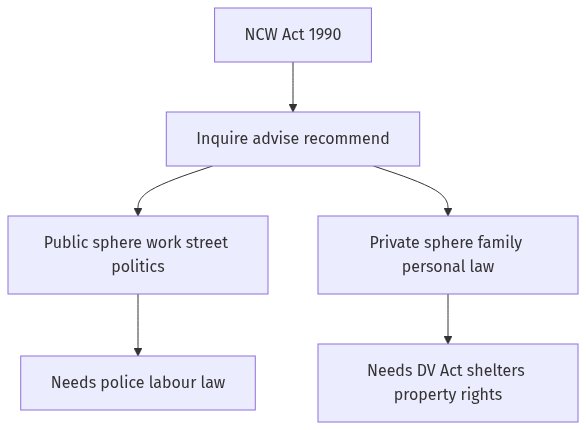
NCW is a statutory Commission under the 1990 Act, not a constitutional court. It can investigate, recommend, inspect custodial places, and support important litigation. Public-sphere tools (POSH, police, local-body reservation) do the heavy tackling; NCW watches. Private-sphere harm needs the Domestic Violence Act, economic rights and local officers, which NCW cannot command. It can strategise in both spheres; it cannot adequately tackle either without the executive.
Model answer
Copper italics in this answer — like this — are the key facts. Each one is unpacked in the Facts & figures rail.
Introduction
The National Commission for Women is a statutory body under the National Commission for Women Act, 1990. It can inquire, advise, litigate in a limited way, and run awareness. Public-sphere harms are workplaces, streets, police stations and political office. Private-sphere harms are the household, personal law, and unpaid care. The Commission can strategise on both; it cannot, by itself, tackle either with the power of a court or a ministry.
Body
What the Commission can do
- Section 10 of the 1990 Act lets it investigate deprivation of women’s rights, inspect jails and remand homes, fund litigation of a typical importance, and recommend on law and policy.
- It can summon, call for documents, and receive complaints of violence, dowry, workplace harassment, and denial of property or maintenance, which is a national letterbox for both spheres.
- It has used public hearings, research, and draft Bills (for example on trafficking, sexual harassment before the 2013 Act, and parts of criminal law) to set an agenda the government may pick up.
- As a specialised body it can coordinate with State Commissions for Women, the police, and the National Legal Services Authority, which is strategy by network, not by command.
Public sphere: partial reach
- Street violence, trafficking, political under-representation, and workplace harassment are public problems. The Commission can shame, recommend POSH compliance, and ask for more women in the force and in tickets.
- It cannot prosecute, cannot pass a budget, and cannot post a Superintendent of Police. Those remain with the criminal system and the executive.
- After Vishaka (1997) and the Sexual Harassment of Women at Workplace Act, 2013, the legal tools in the public workplace are stronger than the Commission’s own teeth; NCW is a watchdog, not the Internal Committee.
- Reservation in local bodies (Articles 243D and 243T) did more for public political presence than any NCW circular. The Commission can support that presence; it did not create it.
Private sphere: structural limits
- The family is where most unpaid labour, domestic violence, and personal-law inequality sit. The Protection of Women from Domestic Violence Act, 2005, and criminal provisions are the tackling instruments; NCW is a referral and monitoring voice.
- Personal law and the household are politically sensitive. A recommendatory Commission will hesitate, or will be ignored, when reform touches marriage, divorce, guardianship, or the marital home.
- Privacy of the home, social stigma, and economic dependence mean many women never reach a Commission office. Strategy that does not include local protection officers, shelters, and independent income will fail the private sphere.
- NCW has no all-India field army. State Commissions are uneven. A Delhi-centred body cannot casework every private harm.
Reasons for a balanced answer
- Able to strategise: yes, because statute, visibility, and a complaint mandate let it name problems in both spheres and push model laws.
- Able to tackle: only in a weak sense — inquiry, recommendation, and occasional court intervention. Tackling needs police, prosecutors, labour inspectors, and fiscal rights (land, wages, pensions).
- The body is not constitutional, unlike the National Commission for Scheduled Castes. Governments can starve it of members, money, and independence, which is why performance swings with political will.
- A honest answer is therefore “strategise, yes; tackle, not adequately, unless the executive and courts carry the load.”
Flow diagram
Conclusion
The National Commission for Women can strategise on public and private harms through inquiry, draft law, and complaint handling under the 1990 Act. It cannot tackle those harms by itself because it lacks prosecution power, field staff, and control of personal-law or budget reform. It is a necessary watchdog; it is not a substitute for a gender-just State.
Quick related
Students also ask
-
'The emergence of Self Help Groups(SHGs) in contemporary times points to the slow but steady withdrawal of the state from developmental activities'. Examine the role of the SHGs in developmental activities and the measures taken by the Government of India to promote the SHGs. (250 words).
Next question on this syllabus topic (2017 · Q16). View answer →
-
Can NCW punish a harasser or a violent spouse?
No. It can inquire, recommend, and sometimes go to court. Punishment needs the criminal or POSH or domestic-violence process.
-
Why does the private sphere resist NCW strategy?
Because the household is guarded by personal law, stigma, and economic dependence. A recommendatory Delhi body cannot enter every home; local law and income can.
Same topic · past papers
UPSC has asked this before
These previous-year questions sit on the same topic. Open one to practise the earlier ask.
More from this topic
Q15 · UPSC Mains 2026 · GS II · 15 marks · Solution
To what extent do pressure groups, social movements and corporate lobbies deepen pluralistic democracy in India by representing excluded interests? Analyse whether the growing convergence of corporate wealth and political power poses a threat to the autonomy of formal democratic institutions.
Governance and Policy
• Pluralism needs many competing groups so that no single interest dominates policy • Trade unions, farmer bodies and movements such as Chipko and Narmada Bachao Andolan have brought excluded voices into public debate • Movements delivered RTI, Forest Rights and Lokpal laws that give citizens lasting tools • Weak resources and FCRA and protest restrictions limit civil society reach • Corporate influence runs through party funding, lobbying, regulators and media ownership • The electoral bonds scheme was struck down in 2024 for violating citizens' right to information • Institutions such as the Supreme Court, CAG and the Election Commission still check capture, but risks remain • Reforms include funding transparency, a lobbying law, cooling-off periods and protection of dissent
Q12 · UPSC Mains 2026 · GS II · 15 marks · Solution
What is meant by judicial legislation? In this context, discuss the verdicts of the apex court allowing "passive euthanasia" and a "living will".
Governance and Policy
• Judicial legislation is court-made law that fills a legislative vacuum, using Articles 32, 141 and 142 • Vishaka, Prakash Singh and NALSA are common examples, and each invited later legislation • Gian Kaur (1996) denied a right to die but spoke of dying with dignity when death is imminent • Aruna Shanbaug (2011) permitted passive euthanasia with High Court supervision • Common Cause (2018) held the right to die with dignity to be part of Article 21 and recognised living wills • The 2023 modification simplified attestation, board composition and timelines • The tension is between dignity under Article 21 and the legislature's domain on a sensitive moral issue • A national statute on terminal illness would replace interim court guidelines
Q6 · UPSC Mains 2026 · GS II · 10 marks · Solution
Does India's tribal development policy reflect the aspirations for a socially grounded and equity-based governance? Justify your answer.
Governance and Policy
• Constitution: Fifth and Sixth Schedules create tribal self-rule, with Tribes Advisory Councils and autonomous district councils. • Law: PESA 1996 makes the Gram Sabha central and FRA 2006 recognises individual and community forest rights. • Welfare: DAPST, Article 275(1) grants, Eklavya schools, PM JANMAN and the sickle cell mission target the gap. • Weakness: mining, dams and forest clearance rules often override Gram Sabha consent. • Weakness: delayed PESA rules, FRA claim rejections and diverted funds blunt equity. • Security: LWE districts show the cost of land alienation and weak service delivery. • Verdict: strong legal design, uneven delivery, so equity is partial and conditional. • Way ahead: enforce consent, social audit, benefit-sharing through District Mineral Foundations.