
Revision summary
Terrorism and wars have made distrust the default in India–Pakistan ties. Cricket, films, music, pilgrimage and campaigns such as Aman ki Asha can humanise the other side. Goodwill from sport and culture is real, shallow, and reversed by the next major attack. Soft power is a floor for people-to-people contact, not a substitute for ending cross-border terrorism. Multilateral cricket and humanitarian visas are the most durable practical tools.
Model answer
Copper italics in this answer — like this — are the key facts. Each one is unpacked in the Facts & figures rail.
Introduction
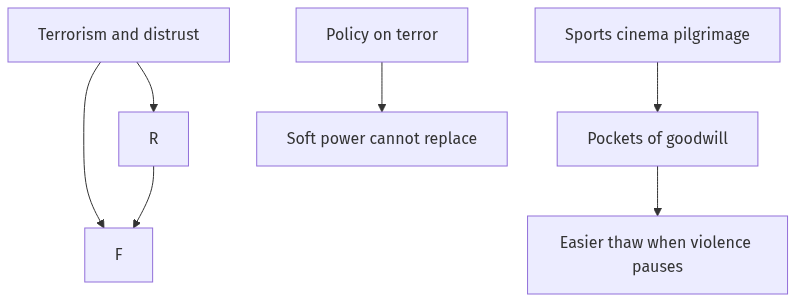
India–Pakistan relations have been shaped by Partition, wars, Kashmir, and repeated terrorist attacks on Indian soil, from the 2001 Parliament attack to 26/11 Mumbai. Official talks freeze when blood is shed; publics learn to expect the freeze. Soft power — cricket, films, music, pilgrimage, literature — still moves ordinary people when the border is shut. It can generate pockets of goodwill. It cannot, by itself, replace a credible end to cross-border terrorism or a political process. The extent of help is real, limited, and easily reversed.
Body
Why distrust is the baseline
- Terrorism with alleged sanctuary or support from Pakistani soil is, for India, not a composite dialogue item but a first condition. Each attack resets the political clock.
- Military crises, ceasefire violations, and media nationalism on both sides punish leaders who look “soft”.
- People-to-people contact is already thin: visas, the Attari–Wagah theatre, and suspended bus and train links after shocks.
- Soft power that ignores this structure will be called naive in Delhi and insufficient in the families of victims.
How sports and culture can still help — with examples
- Cricket: India–Pakistan matches at World Cups and Champions Trophies draw huge shared audiences. The 2004 Indian tour of Pakistan, in a thaw after the 2003 ceasefire, showed stadiums as temporary public diplomacy. Players’ visits and commentary humanise the other side in a way a joint statement does not.
- Hockey, kabaddi and tennis have smaller but similar effects when series are allowed.
- Cinema and television: Hindi films and Pakistani television dramas have crossed the border in both directions in calmer years. Artists (khayal, qawwali, Sufi circuits) share a civilisational grammar that Partition did not fully cut.
- Aman ki Asha (Times of India and Jang group, 2010) was a media-led cultural and dialogue campaign that kept a civilian channel when official talks were brittle.
- Pilgrimage: the Kartarpur corridor idea (later opened in 2019) and older visas for the Nankana Sahib and Ajmer Sharif circuits show religion as a people-to-people route, not only as a conflict fuel.
- Track-two dialogues, writers’ festivals, and alumni of shared universities create elites who can argue for restraint in a crisis — a thin but useful layer.
- Shared disaster response or sports ceasefires (playing on after a tragedy, or using a tournament as cover to resume talks) have occasionally lowered the temperature.
Extent and limits
- Soft power works best as a supplement when violence is down and visas exist. It does not survive a Mumbai-scale attack; films get banned, series get cancelled, and cricketers become symbols, not ambassadors.
- State-controlled narratives can turn a match into a nationalist test. Then sport increases distrust rather than goodwill.
- Goodwill among fans is not policy. The Pakistan Army–civilian balance and non-State groups are not moved by a cover drive.
- Asymmetry: Indian entertainment has a larger market. Cultural flow can feel like one-way influence in Pakistan, which creates its own resentment.
- Useful extent: keep human contact alive, reduce caricature, give both governments a face-saving off-ramp after a pause, and protect pilgrims and students from becoming hostages of every incident.
- Not useful as a substitute for intelligence cooperation, FATF-type pressure, or a clear Indian red line on terrorism.
A realistic mix
- Continue cricket in multilateral events even when bilateral series are politically impossible.
- Keep pilgrimage and medical visas as humanitarian exceptions.
- Do not pretend a concert equals a composite dialogue. Do not, either, empty the relationship of every civilian tie; that only feeds the next generation of distrust.
Flow diagram
Conclusion
Sports and cultural exchange can generate real but perishable goodwill between Indians and Pakistanis, as cricket tours, films, Sufi and Punjabi culture, media campaigns such as Aman ki Asha, and pilgrimage show. The extent of help is limited: terrorism and the security establishments reset the relationship faster than a stadium can rebuild it. Soft power is worth keeping as a people-to-people floor. It is not a foreign-policy ceiling until violence stops being the opening move.
Quick related
Students also ask
-
Should India refuse all cricket until terrorism ends?
Bilateral series are a political choice. Multilateral matches still let publics meet without treating sport as a full substitute for security policy.
-
Can Bollywood fix the relationship?
No. Films can soften caricatures in calm years. They are banned or trolled after attacks, which shows culture follows security, not the other way around.
Same topic · past papers
UPSC has asked this before
These previous-year questions sit on the same topic. Open one to practise the earlier ask.
More from this topic
Q15 · UPSC Mains 2026 · GS II · 15 marks · Solution
To what extent do pressure groups, social movements and corporate lobbies deepen pluralistic democracy in India by representing excluded interests? Analyse whether the growing convergence of corporate wealth and political power poses a threat to the autonomy of formal democratic institutions.
Governance and Policy
• Pluralism needs many competing groups so that no single interest dominates policy • Trade unions, farmer bodies and movements such as Chipko and Narmada Bachao Andolan have brought excluded voices into public debate • Movements delivered RTI, Forest Rights and Lokpal laws that give citizens lasting tools • Weak resources and FCRA and protest restrictions limit civil society reach • Corporate influence runs through party funding, lobbying, regulators and media ownership • The electoral bonds scheme was struck down in 2024 for violating citizens' right to information • Institutions such as the Supreme Court, CAG and the Election Commission still check capture, but risks remain • Reforms include funding transparency, a lobbying law, cooling-off periods and protection of dissent
Q12 · UPSC Mains 2026 · GS II · 15 marks · Solution
What is meant by judicial legislation? In this context, discuss the verdicts of the apex court allowing "passive euthanasia" and a "living will".
Governance and Policy
• Judicial legislation is court-made law that fills a legislative vacuum, using Articles 32, 141 and 142 • Vishaka, Prakash Singh and NALSA are common examples, and each invited later legislation • Gian Kaur (1996) denied a right to die but spoke of dying with dignity when death is imminent • Aruna Shanbaug (2011) permitted passive euthanasia with High Court supervision • Common Cause (2018) held the right to die with dignity to be part of Article 21 and recognised living wills • The 2023 modification simplified attestation, board composition and timelines • The tension is between dignity under Article 21 and the legislature's domain on a sensitive moral issue • A national statute on terminal illness would replace interim court guidelines
Q6 · UPSC Mains 2026 · GS II · 10 marks · Solution
Does India's tribal development policy reflect the aspirations for a socially grounded and equity-based governance? Justify your answer.
Governance and Policy
• Constitution: Fifth and Sixth Schedules create tribal self-rule, with Tribes Advisory Councils and autonomous district councils. • Law: PESA 1996 makes the Gram Sabha central and FRA 2006 recognises individual and community forest rights. • Welfare: DAPST, Article 275(1) grants, Eklavya schools, PM JANMAN and the sickle cell mission target the gap. • Weakness: mining, dams and forest clearance rules often override Gram Sabha consent. • Weakness: delayed PESA rules, FRA claim rejections and diverted funds blunt equity. • Security: LWE districts show the cost of land alienation and weak service delivery. • Verdict: strong legal design, uneven delivery, so equity is partial and conditional. • Way ahead: enforce consent, social audit, benefit-sharing through District Mineral Foundations.