
Revision summary
The 1789 Declaration treated rights as universal and the nation as the source of law. Secular public authority and the attack on privilege still shape constitutions and civil codes. The Terror remains the warning that revolution can devour procedure and people. Contemporary human-rights talk, square protests and populist claims to be the people all use this inheritance. Colonial limits of French liberty, as in Haiti, also remain relevant to debates on race and international order. Enduring relevance is a live choice among rights, nation, equality and violence.
Model answer
Copper italics in this answer — like this — are the key facts. Each one is unpacked in the Facts & figures rail.
Introduction
The French Revolution (1789–1799) did not stay in Paris. It named the people as the source of law, wrote rights as universal sentences, and showed how a revolution can eat its children. Contemporary politics still speaks that language, and still fears that ending.
Body
What it bequeathed
- Declaration of 1789: The Rights of Man and of the Citizen said men are born free and equal in rights, a sentence that travelled into later bills of rights.
- Nation as sovereign: Dynasty was replaced by the nation, which still organises maps, citizenship and wars.
- Attack on privilege: Clergy and nobility lost legal estates, which is why later land reforms and uniform civil-code debates have a distant French cousin.
- Secular public law: The idea that a priest does not own the state still shapes public schools and republican constitutions.
- Terror as warning: Virtue plus emergency produced the scaffold, Napoleon, and a lasting lesson about procedure destroyed in the name of the people.
Why the world still uses 1789
- Human rights language: UN Charter dignity talk and rights organisations still borrow the revolutionary grammar of equal persons.
- Square politics: Movements that occupy a plaza in the name of the people are revolutionary grandchildren, even when their local causes differ.
- Consent and legitimacy: When a government is told it lacks legitimacy without consent, Rousseau's ghost is as live as a local activist.
- Post-colonial constitutions: Fundamental-rights chapters often carry the French claim that rights are written for persons, not only for subjects.
- Secular contests: Debates on religion in public law still replay the Revolution's fight over who owns the civic space.
Dark relevance and unfinished universality
- Populism: Leaders who claim to be the people and to skip parliaments reuse Jacobin rhetoric without Jacobin philosophy.
- Exclusive nationalism: The nation born in 1789 can still shut out the stranger.
- Inequality after liberalism: Tax and wealth fights can look like new Estates when a few hold the surplus.
- Haiti's test: The Haitian Revolution showed that French rights were not universal in the colonies until the enslaved took them.
- Race and global order: That colonial limit remains relevant whenever universal rights are claimed and then rationed.
Flow diagram
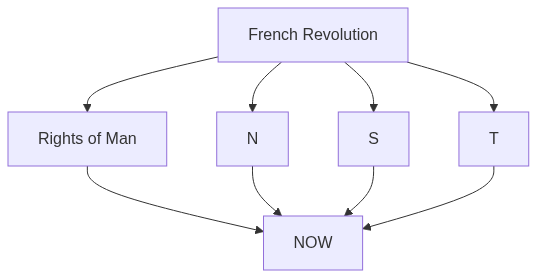
Conclusion
The French Revolution gave the modern world a language of equal rights, national sovereignty and secular law. It also warned that emergency virtue can become terror. Constitutions, protests and populisms still ride those tracks.
Quick related
Students also ask
-
How far is it correct to say that the First World War was fought essentially for the preservation of balance of power?
Next question on this syllabus topic (2024 · Q12). View answer →
-
Is every protest a French Revolution?
No. The Revolution is a toolbox. Not every crowd that borrows a slogan is 1789.
-
Did it create human rights as we know them?
It created a powerful European language of rights. Later movements had to expand who counted as man.
Same topic · past papers
UPSC has asked this before
These previous-year questions sit on the same topic. Open one to practise the earlier ask.
More from this topic
Q13 · UPSC Mains 2024 · GS I · 15 marks · Solution
How far was the Industrial Revolution in England responsible for the decline of handicrafts and cottage industries in India?
History of the World
England’s mills produced cheap, uniform cloth that undercut many Indian handlooms after trade opened wider in the nineteenth century. Colonial specialisation pushed raw cotton out and piece-goods in. Naoroji and Dutt named this pattern as drain. Railways carried mill cloth inland and tied India into that division of labour. Company monopoly, land revenue, and loss of court patronage had already hurt artisans. Revisionists note adaptation and later Indian mills. Nationalists note a real industrial share loss in regions such as the east. The Industrial Revolution was a major cause. Empire was the political condition that made it so destructive.
Q12 · UPSC Mains 2024 · GS I · 15 marks · Solution
How far is it correct to say that the First World War was fought essentially for the preservation of balance of power?
History of the World
The balance-of-power view sees 1914 as a response to German hegemony and a rigid alliance system. Britain’s Belgian case fits an old habit of stopping one power from dominating the Channel coast. Imperial rivalry, Balkan nationalism, and railway mobilisation are causes that this view underplays. Fischer and others stress German war aims, not only equilibrium. 1919 did not restore a stable balance. It created new grievances. The word “essentially” is too strong. Balance of power was a major logic. It was not the only one.
Q13 · UPSC Mains 2021 · GS I · 15 marks · Solution
" There arose a serious challenge to the Democratic State System between the two World Wars." Evaluate the statement.
History of the World
Fascist Italy, Nazi Germany, Franco, and Japanese militarism attacked parliamentary systems. The Depression and a weak League made dictators look effective. The USSR offered a second non-democratic path. Britain, the US, and some others held their elections. The challenge was serious and regional, not the end of democracy as an idea.