
Revision summary
The balance-of-power view sees 1914 as a response to German hegemony and a rigid alliance system. Britain’s Belgian case fits an old habit of stopping one power from dominating the Channel coast. Imperial rivalry, Balkan nationalism, and railway mobilisation are causes that this view underplays. Fischer and others stress German war aims, not only equilibrium. 1919 did not restore a stable balance. It created new grievances. The word “essentially” is too strong. Balance of power was a major logic. It was not the only one.
Model answer
Copper italics in this answer — like this — are the key facts. Each one is unpacked in the Facts & figures rail.
Introduction
One common reading of the First World War is that the European powers fought in 1914 to keep a balance of power after the rise of Germany. Europe had become a system of alliances that claimed to keep peace by deterring rivals. That reading is partly true. It is not the whole explanation. Imperial rivalry, nationalism, military timetables, and the Balkan crisis also made a general war more likely. The word “essentially” in the question needs to be tested against those other causes.
Body
The balance-of-power case
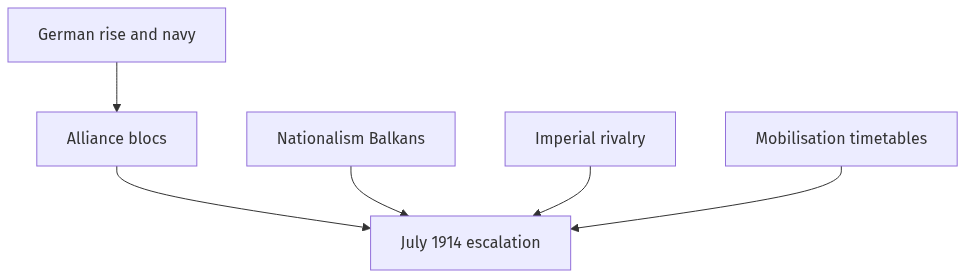
Since 1871 a German Empire had sat in the middle of Europe with industry, a general staff, and, under Wilhelm II, a Weltpolitik fleet that frightened Britain. Bismarck’s old isolation of France gave way to a Triple Alliance of Germany, Austria-Hungary, and Italy against a Triple Entente of France, Russia, and Britain. Britain’s entente was not a blank cheque. Naval rivalry and the Schlieffen plan for a two-front war made every crisis a test of who would be isolated. When Austria moved on Serbia after Sarajevo, Russia backed a Slav cause. Germany backed Vienna. France stood by Russia. Britain entered over Belgian neutrality. That was the old British habit of not letting a single power own the Channel coast. In that story, 1914 is balance of power pursued by war.
- German rise: Industry and navy looked like a bid for hegemony.
- Alliance blocs: Two camps turned a Balkan war into a continental one.
- British tradition: Britain sought to prevent a hostile dominant power in Western Europe.
What the formula leaves out
Imperialism made the blocs global. Morocco, the Baghdad railway, Africa, and the Ottoman lands were extra-European stakes. Nationalism in the Balkans and among subject peoples of Austria-Hungary was not only a diplomatic move. It was a demand for states of their own. Arms races and railway mobilisation plans meant that once a cabinet chose war, the trains ran. Fischer’s reading of German war aims, and the later Versailles war-guilt clause, stress aggression, not only equilibrium. Socialist and liberal opinion at the time named capitalist rivalry. Colonial soldiers died for a European conflict they had not designed.
Italy’s switch and the Ottoman and Japanese entries show a war that rewrote the balance rather than preserving a known one. The peace of 1919 created new imbalances. It left a punished Germany, a dissatisfied Italy, and a revolutionary Russia.
- Empire: Extra-European stakes were not a sideshow.
- Nation: Serbia, Poland, Czech, and South Slav questions were not mere weights on a scale.
- Contingency: Blank cheques, misread telegrams, and elite honour codes also mattered.
How far “essentially”
It is correct that cabinets spoke the language of encirclement, prestige, and equilibrium. Britain’s entry fits an old balance reflex. It is incorrect to say the war was essentially only that. Balance of power was the usual method of great-power diplomacy. Imperialism and nationalism ran through that method. Without the German–British naval race the system still might have held. Without Sarajevo and mobilisation timetables it might have held a few years more. The word “essentially” overstates a real strand.
A fair verdict is this. The war was fought among other things to stop a feared German hegemony. That was a balance-of-power aim. It was also fought to settle who would own colonial margins and whose nation would exist.
Flow diagram
Conclusion
Balance of power explains the alliance map and Britain’s Belgian argument. It does not cover empire, nation, and mobilisation plans. The First World War was a hegemonic war in Europe and an imperial war abroad. To say it was fought essentially for balance alone is too simple for 1914.
Quick related
Students also ask
-
How far was the Industrial Revolution in England responsible for the decline of handicrafts and cottage industries in India?
Next question on this syllabus topic (2024 · Q13). View answer →
-
Was Britain fighting only for Belgium?
Belgium was the public and legal trigger. Naval rivalry with Germany and the fear of a hostile Channel coast were the strategic core.
-
Does balance of power excuse all powers equally?
No. All had imperial stakes. The question of who issued the blank cheque to Vienna remains a live historical argument.
Same topic · past papers
UPSC has asked this before
These previous-year questions sit on the same topic. Open one to practise the earlier ask.
More from this topic
Q13 · UPSC Mains 2025 · GS I · 15 marks · Solution
The French Revolution has enduring relevance to the contemporary world. Explain.
History of the World
The 1789 Declaration treated rights as universal and the nation as the source of law. Secular public authority and the attack on privilege still shape constitutions and civil codes. The Terror remains the warning that revolution can devour procedure and people. Contemporary human-rights talk, square protests and populist claims to be the people all use this inheritance. Colonial limits of French liberty, as in Haiti, also remain relevant to debates on race and international order. Enduring relevance is a live choice among rights, nation, equality and violence.
Q13 · UPSC Mains 2024 · GS I · 15 marks · Solution
How far was the Industrial Revolution in England responsible for the decline of handicrafts and cottage industries in India?
History of the World
England’s mills produced cheap, uniform cloth that undercut many Indian handlooms after trade opened wider in the nineteenth century. Colonial specialisation pushed raw cotton out and piece-goods in. Naoroji and Dutt named this pattern as drain. Railways carried mill cloth inland and tied India into that division of labour. Company monopoly, land revenue, and loss of court patronage had already hurt artisans. Revisionists note adaptation and later Indian mills. Nationalists note a real industrial share loss in regions such as the east. The Industrial Revolution was a major cause. Empire was the political condition that made it so destructive.
Q13 · UPSC Mains 2021 · GS I · 15 marks · Solution
" There arose a serious challenge to the Democratic State System between the two World Wars." Evaluate the statement.
History of the World
Fascist Italy, Nazi Germany, Franco, and Japanese militarism attacked parliamentary systems. The Depression and a weak League made dictators look effective. The USSR offered a second non-democratic path. Britain, the US, and some others held their elections. The challenge was serious and regional, not the end of democracy as an idea.