
Revision summary
Professionalism in the service means competence, procedure and political neutrality in the file. Nationalistic consciousness means the constitutional oath, not loyalty to a faction or a crowd. Patel’s all-India services were meant to hold both together after 1947. Punishment postings and partisan pressure tear the combination. The district is where the ethos is proved, in flood, poll and the speaking order. Mission Karmayogi restates the professional half as competency for today’s officer.
Model answer
Copper italics in this answer — like this — are the key facts. Each one is unpacked in the Facts & figures rail.
Introduction
The Indian civil service was built as a steel frame of people who could run a district by the book. The independence movement then asked those same people to feel the nation, not only the file. The ethos in the question is that combination. Professionalism without country becomes a clever clerk for whoever sits in the chair. Nationalism without profession becomes a slogan that breaks the law.
Body
Professionalism
- Competence: The officer must know the Act, the budget rule, and the district facts.
- Speaking order: Decisions should be written so a court or a CAG can read the reasons.
- GFR discipline: Procedure and financial rules keep power inside lawful channels.
- Neutrality: Every citizen is treated as a citizen, not as a party worker.
- Patel bargain: After 1947, an all-India service was kept as a competent permanent executive.
- Mussoorie training: Induction and Conduct Rules teach the professional half of the ethos.
- Lawful dissent: An officer may disagree in the file and still implement a lawful decision.
Nationalistic consciousness
- Constitutional oath: Loyalty is to the republic’s document, not to a faction.
- Unity and integrity: National purpose means one country under constitutional forms.
- State that shows up: Flood, poll, and famine duty are nationalist acts in practice.
- All-India fairness: Cross-state posting is meant to hold one country, not one lobby.
- Not ethnic chest-thumping: Slogans that break law are the opposite of this consciousness.
- Post-1947 continuity: Officers who stayed and served the new republic lived that creed.
Combination and strain
- Both at once: Patel wanted national purpose inside a professional cadre, not a spoils system.
- Mission Karmayogi: Recent capacity building restates professionalism as competency.
- Punishment posting: Factional transfer tears neutrality from competence.
- Pliable notes: Partisan pressure turns the file into a party tool.
- Exam leaks: Corruption in entry wounds the professional half.
- Communal conduct: Bias in the field wounds the national half.
- District test: The ethos is proved in flood, poll, and the speaking order.
- Exam elucidation: Skill plus a public creed is the intended union; either half alone fails.
Flow diagram
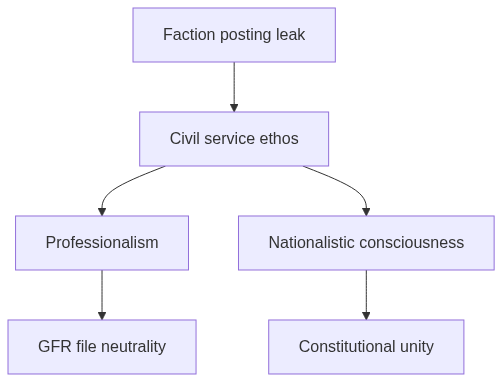
Conclusion
Professionalism is lawful competence and neutrality. Nationalistic consciousness is loyalty to the constitutional nation. The Indian civil service ethos is their union. Politicisation and sloppiness are how that union is lost.
Quick related
Students also ask
-
Discuss how the changes in shape and sizes of continents and ocean basins of the planet take place due to tectonic movements of the crustal masses.
Next question on this syllabus topic (2025 · Q16). View answer →
-
Is nationalism the same as following the minister blindly?
No. The oath is to the Constitution. A lawful order is implemented; an unlawful one is not.
-
Does professionalism mean coldness?
It means fairness. Courtesy and empathy are part of a professional public face.
Same topic · past papers
UPSC has asked this before
These previous-year questions sit on the same topic. Open one to practise the earlier ask.
More from this topic
Q17 · UPSC Mains 2026 · GS I · 15 marks · Solution
Analyze the major drivers of human-induced land-use changes in India and their geographical consequences.
World's Physical Geography
Anthropogenic pressures driven by population growth and economic development are the primary catalysts of rapid land-use and land-cover change (LULCC) across India. Agricultural expansion and intensive multi-cropping, particularly
Q16 · UPSC Mains 2026 · GS I · 15 marks · Solution
"The centre of global trade is gradually shifting from the Atlantic region to the Indo-Pacific region." Examine this statement.
World's Physical Geography
• The global center of economic gravity has decisively shifted from the Euro-Atlantic axis to the Indo-Pacific. • The rise of China, Southeast Asia, and India as primary manufacturing and consumption hubs drives this transition. • Vital maritime chokepoints like the Malacca Strait serve as critical arteries for global energy and merchant trade. • Mega free-trade agreements such as RCEP and IPEF have established new regional trade and rule-making architectures. • Post-pandemic supply chain vulnerabilities have accelerated diversification strategies like 'China-plus-one' and 'friend-shoring'. • Control over critical mineral supply chains powers the ongoing digital and green energy transitions in the region. • Sustaining this geo-economic shift requires robust multilateral frameworks, freedom of navigation, and rules-based maritime governance.
Q14 · UPSC Mains 2026 · GS I · 15 marks · Solution
Compare the Loo, Chinook and Foehn winds with respect to their regions of prevalence, their nature and climatic impacts.
World's Physical Geography
• Local winds like the Loo, Chinook, and Foehn are driven by distinct regional pressure gradients and orographic barriers. • The Loo prevails over the Indo-Gangetic Plain, the Chinook along the Rockies' eastern slopes, and the Foehn across the northern Alpine valleys. • The Loo is a scorching, dust-laden convective surface wind generated by intense summer continental heating. • Both the Chinook and Foehn are warm, dry katabatic winds formed via rapid adiabatic compression on the leeward sides of mountains. • The Loo induces severe agricultural stress, crop wilting, and high health risks like heat strokes in South Asia. • Chinooks act as 'snow eaters' in North America, rapidly melting winter snowpacks and opening up pasturelands for grazing. • Foehn winds accelerate Alpine snowmelt, which simultaneously triggers hazardous avalanches and elevates regional wildfire risks.