
Revision summary
Solar replaces some coal generation and therefore some ash, sulphur and carbon. Large parks work best in the dry, sunny west of India; rooftops work on city buildings. Bhadla, Pavagada and the Andhra-Karnataka parks are the locational examples. Economics include lower auction prices, PLI manufacturing and less diesel on farms. Grazing land, groundwater for cleaning, and night storage are the ecological and grid limits. The benefit is real when solar displaces thermal power and when siting is honest.
Model answer
Copper italics in this answer — like this — are the key facts. Each one is unpacked in the Facts & figures rail.
Introduction
India sits in the tropics with long sunshine and a coal-heavy grid. Solar generation turns that sunshine into kilowatt-hours before more coal is dug. The ecological case is cleaner air and lower carbon. The economic case is cheaper daytime power and less imported fuel. Both hold only if land, water, and the grid are handled honestly.
Body
Ecological benefits and caveats
- Less coal smoke: Solar displaces sulphur and ash when it replaces thermal generation.
- Lower carbon: Life-cycle emissions are far below a coal unit of the same output.
- Paris path: Cleaner daytime power helps India’s climate commitments.
- Lung cost: Thermal belts such as Singrauli and parts of Chhattisgarh face less local pollution when solar grows.
- Rooftop advantage: City roofs use built space and spare open habitat.
- Land caveat: Parks on common grazing land can hurt the poor unless siting is honest.
- Water caveat: Panel cleaning in arid zones can stress scarce groundwater.
- Manufacturing footprint: Cell production still has a chemical cost, often abroad.
- Storage limit: Night demand may still need coal, hydro, or batteries.
Economic benefits and Indian locations
- Cheap auctions: Falling module prices made solar among the cheapest new bulk power options.
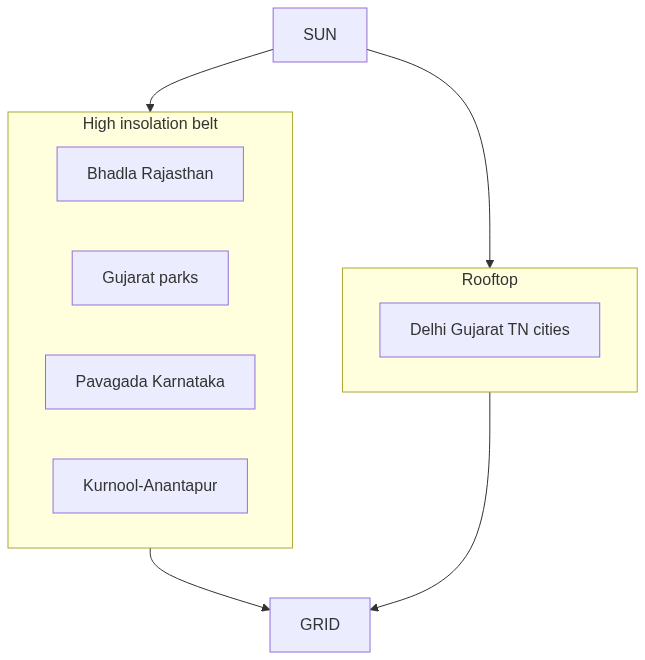
- Bhadla, Rajasthan: High Thar sunshine and open land created one of the world’s largest parks.
- Gujarat parks: Western insolation supports utility-scale daytime power.
- Pavagada, Karnataka: A dry southern site follows the same high-insolation logic.
- Kurnool–Ananthapuramu: Andhra parks sit in the sunny Rayalaseema belt.
- Cold-desert trials: Himalayan sites such as Kaza show sun with harder logistics.
- Construction jobs: Parks and rooftops create local work in building and upkeep.
- PLI modules: Production-linked incentives pull manufacturing into India.
- Coal freight saved: Less daytime coal burn cuts transport and import pressure.
- PM-KUSUM: Solar pumps reduce diesel use on farms.
- City rooftops: Delhi, Gujarat, and Tamil Nadu schemes show distributed economics.
- DISCOM condition: Poor households still need subsidy and a working utility, or panels never arrive.
Flow diagram
Conclusion
Solar cuts coal smoke and carbon when it displaces thermal power. It also cheapens daytime electricity in India’s sunny west. The map is Rajasthan, Gujarat, Karnataka, and Andhra parks plus city roofs. Land, water, and night storage remain the conditions of the benefit.
Quick related
Students also ask
-
The ethos of civil service in India stand for the combination of professionalism with nationalistic consciousness - Elucidate.
Next question on this syllabus topic (2025 · Q9). View answer →
-
Does solar work in the cloudy northeast?
Yield is lower. Rooftops and hybrids still help, but the cheapest parks cluster in the drier west and south.
-
Is solar always better for land?
A roof is. A park on common grazing land can hurt the poor unless siting is honest.
Same topic · past papers
UPSC has asked this before
These previous-year questions sit on the same topic. Open one to practise the earlier ask.
-
2025 · Q5 · GS I · 10 marks
What are non-farm primary activities? How are these activities related to physiographic features in India? Discuss with suitable examples. -
2020 · Q16 · GS I · 15 marks
India has immense potential of solar energy though there are regional variations in its developments. Elaborate. -
2019 · Q17 · GS I · 15 marks
How do ocean currents and water masses differ in their impacts on marine life and coastal environment? Give suitable examples. -
2016 · Q9 · GS I · 12 marks
"An essential condition to eradicate poverty is to liberate the poor from the process of deprivation." Substantiate this statement with suitable examples.
More from this topic
Q17 · UPSC Mains 2026 · GS I · 15 marks · Solution
Analyze the major drivers of human-induced land-use changes in India and their geographical consequences.
World's Physical Geography
Anthropogenic pressures driven by population growth and economic development are the primary catalysts of rapid land-use and land-cover change (LULCC) across India. Agricultural expansion and intensive multi-cropping, particularly
Q16 · UPSC Mains 2026 · GS I · 15 marks · Solution
"The centre of global trade is gradually shifting from the Atlantic region to the Indo-Pacific region." Examine this statement.
World's Physical Geography
• The global center of economic gravity has decisively shifted from the Euro-Atlantic axis to the Indo-Pacific. • The rise of China, Southeast Asia, and India as primary manufacturing and consumption hubs drives this transition. • Vital maritime chokepoints like the Malacca Strait serve as critical arteries for global energy and merchant trade. • Mega free-trade agreements such as RCEP and IPEF have established new regional trade and rule-making architectures. • Post-pandemic supply chain vulnerabilities have accelerated diversification strategies like 'China-plus-one' and 'friend-shoring'. • Control over critical mineral supply chains powers the ongoing digital and green energy transitions in the region. • Sustaining this geo-economic shift requires robust multilateral frameworks, freedom of navigation, and rules-based maritime governance.
Q14 · UPSC Mains 2026 · GS I · 15 marks · Solution
Compare the Loo, Chinook and Foehn winds with respect to their regions of prevalence, their nature and climatic impacts.
World's Physical Geography
• Local winds like the Loo, Chinook, and Foehn are driven by distinct regional pressure gradients and orographic barriers. • The Loo prevails over the Indo-Gangetic Plain, the Chinook along the Rockies' eastern slopes, and the Foehn across the northern Alpine valleys. • The Loo is a scorching, dust-laden convective surface wind generated by intense summer continental heating. • Both the Chinook and Foehn are warm, dry katabatic winds formed via rapid adiabatic compression on the leeward sides of mountains. • The Loo induces severe agricultural stress, crop wilting, and high health risks like heat strokes in South Asia. • Chinooks act as 'snow eaters' in North America, rapidly melting winter snowpacks and opening up pasturelands for grazing. • Foehn winds accelerate Alpine snowmelt, which simultaneously triggers hazardous avalanches and elevates regional wildfire risks.