
Revision summary
Conservation, coal closure and land for solar can clash with tribal, miner and grazier livelihoods. The poor also suffer first from dirty air, bad water and heat, so environment is not only a rich concern. Conflict is sharp when the poor do not write the rule and do not get a new livelihood. Forest rights, LPG for indoor air, and planned coal-district jobs are examples of easing the clash. Sustainable growth in India has to be a just transition, not green austerity for the already poor. Holding both sentences means clean air with livelihood, not a gated solar roof alone.
Model answer
Copper italics in this answer — like this — are the key facts. Each one is unpacked in the Facts & figures rail.
Introduction
Sustainable growth means using the environment so that tomorrow's poor are not poorer. In a country like India the today's poor already live on the forest edge, in a coal district, or by a dirty river. A rule that saves a tiger or a carbon target can look, from that hut, like a second enclosure. The conflict is real. It is not the whole story.
Body
Where the clash is sharp
- Protected areas: A conservation map can stop a tribal family from collecting tendu or grazing after a life in that forest.
- Forest Rights Act tension: Patta claims and sanctuary management often fight over the same hectare.
- Coal and thermal belts: Thousands of workers will not automatically become solar technicians when pits and plants close.
- Dirty kiln bans: The poorest worker can be sacked first when a pollution order arrives without a transition plan.
- Fuel and transport costs: Urban air rules that raise fuel prices hit the scooter before the SUV.
- Solar on commons: Large parks can fence graziers if commons are treated as empty land.
- Class capture of green: If environment is only an urban middle-class good, the poor will treat it as an enemy.
Where the poor need the environment
- Poisoned groundwater: The same poor drink the chemical load of industrial and agricultural waste.
- Brick-kiln air: Outdoor and household pollution hits labouring lungs first.
- Dead rivers and lost fish: Livelihood collapse is an environmental failure, not a luxury complaint.
- Heatwaves: Open-site labourers die in extreme heat that climate stress intensifies.
- Women's forest walk: When the forest is gone, fuel and fodder collection becomes a longer unpaid burden.
- Health is not a luxury good: Environmental protection is often the poor person's clinic.
Comment: a just path
- No pollute-then-treat copy: India cannot copy a rich country's dirty sequence without drowning its own deltas.
- No green austerity for the already poor: People who never sat in carbon first class cannot be the only ones asked to pay.
- Just transition: Coal districts need public jobs and reskilling before pits close.
- Community title plus conservation: Forest policy needs FRA recognition and habitat protection together.
- Ujjwala lesson: LPG cut indoor smoke without a lecture, which is environment as poor women's health.
- Who writes the rule: The clash eases when the poor are authors of the green rule, not only its targets.
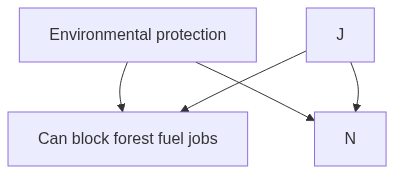
Flow diagram
Conclusion
Green rules can hurt poor people when they take forest, job or cheap fuel without a replacement. The same people also need clean air and water. The way through is a just transition, not a choice between growth for some and environment for others.
Quick related
Students also ask
-
Why do large cities tend to attract more migrants than smaller towns? Discuss in the light of conditions in developing countries.
Next question on this syllabus topic (2024 · Q5). View answer →
-
Should India wait to grow before it protects the environment?
Waiting means locking in dirty infrastructure the poor will breathe. Growth and protection have to be designed together.
-
Are tigers a luxury?
A forest that holds a tiger also holds water and non-timber livelihoods. The luxury is a policy that ignores the people in that forest.
Same topic · past papers
UPSC has asked this before
These previous-year questions sit on the same topic. Open one to practise the earlier ask.
More from this topic
Q17 · UPSC Mains 2026 · GS I · 15 marks · Solution
Analyze the major drivers of human-induced land-use changes in India and their geographical consequences.
World's Physical Geography
Anthropogenic pressures driven by population growth and economic development are the primary catalysts of rapid land-use and land-cover change (LULCC) across India. Agricultural expansion and intensive multi-cropping, particularly
Q16 · UPSC Mains 2026 · GS I · 15 marks · Solution
"The centre of global trade is gradually shifting from the Atlantic region to the Indo-Pacific region." Examine this statement.
World's Physical Geography
• The global center of economic gravity has decisively shifted from the Euro-Atlantic axis to the Indo-Pacific. • The rise of China, Southeast Asia, and India as primary manufacturing and consumption hubs drives this transition. • Vital maritime chokepoints like the Malacca Strait serve as critical arteries for global energy and merchant trade. • Mega free-trade agreements such as RCEP and IPEF have established new regional trade and rule-making architectures. • Post-pandemic supply chain vulnerabilities have accelerated diversification strategies like 'China-plus-one' and 'friend-shoring'. • Control over critical mineral supply chains powers the ongoing digital and green energy transitions in the region. • Sustaining this geo-economic shift requires robust multilateral frameworks, freedom of navigation, and rules-based maritime governance.
Q14 · UPSC Mains 2026 · GS I · 15 marks · Solution
Compare the Loo, Chinook and Foehn winds with respect to their regions of prevalence, their nature and climatic impacts.
World's Physical Geography
• Local winds like the Loo, Chinook, and Foehn are driven by distinct regional pressure gradients and orographic barriers. • The Loo prevails over the Indo-Gangetic Plain, the Chinook along the Rockies' eastern slopes, and the Foehn across the northern Alpine valleys. • The Loo is a scorching, dust-laden convective surface wind generated by intense summer continental heating. • Both the Chinook and Foehn are warm, dry katabatic winds formed via rapid adiabatic compression on the leeward sides of mountains. • The Loo induces severe agricultural stress, crop wilting, and high health risks like heat strokes in South Asia. • Chinooks act as 'snow eaters' in North America, rapidly melting winter snowpacks and opening up pasturelands for grazing. • Foehn winds accelerate Alpine snowmelt, which simultaneously triggers hazardous avalanches and elevates regional wildfire risks.