
Revision summary
Migrants follow expected work, services and kin. They do not follow town size as a slogan. Large cities offer thick labour markets and a huge informal sector that still beats village slack. Hospitals, universities and airports are stacked in metros in developing countries. Harris–Todaro and chain migration explain why people come even when open urban unemployment exists. Colonial ports, state capitals and later service hubs created urban primacy. Small towns pull only when they have a real bundle of jobs and public goods.
Model answer
Copper italics in this answer — like this — are the key facts. Each one is unpacked in the Facts & figures rail.
Introduction
People do not move toward a pin on the map. They move toward work, wages, schools, hospitals and a relative who already has a room. In developing countries those goods are stacked in a few large cities. They are not spread evenly through small towns. The result is urban primacy. Mumbai, Lagos, Dhaka or Mexico City pull harder than the district headquarters down the road.
Body
Why the large city attracts more migrants
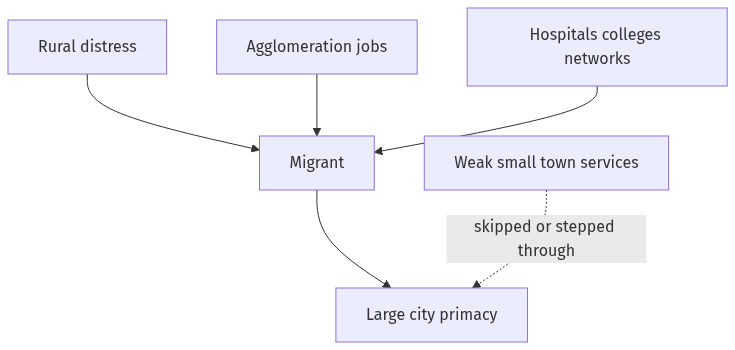
Agglomeration is the dry word for a thick labour market. A big city offers many employers, so a lost job is not the end. Informal work — construction, street trade, domestic service, gig tasks — still pays more, in expectation, than a slack village. Harris–Todaro taught that people migrate on expected urban income, even if open unemployment exists, because the prize of a formal job is high. Cumulative causation then runs. Each newcomer spends. That spending creates another stall. The stall then calls another relative.
Public goods are skewed. Tertiary hospitals, universities, courts, airports and English-medium coaching sit in metros. In developing countries the small town often has a bus stand and a weak municipality. It often does not have a functioning industrial estate. Networks lower risk. A chawl, a jhuggi, a language cluster, a church or a caste lodge is an arrival kit that a small town rarely matches at scale.
- Jobs: Diverse formal markets and thick informal markets beat a single mill town.
- Services: Education and specialist health are metropolitan.
- Chain migration: Information and credit travel along kin, so the big city reproduces itself.
Developing-country conditions
Colonial and post-colonial transport was built to ports and capitals. Import-substituting industry and then services and IT clustered where power, ports and the state already were. Rural distress — tiny holdings, monsoon risk, agrarian underemployment — pushes people out. The metro pulls them in. Land and housing shortages create slums, but slums are still a foothold. Small towns may grow, yet they often lack water, sewage, colleges and non-farm jobs. They therefore become stepping stones, or they are skipped.
Gender and youth matter. Young men enter construction. Young women enter garments, care and BPO. Both groups target large labour markets. Climate shocks and conflict add pulses of movement toward the city that can absorb people, even if it absorbs them badly.
- Primacy: One or two cities dominate national urban population in many poor and middle-income states.
- Informality: The shock-absorber is the unorganised sector, not a Western welfare city.
- Policy skew: Investment, elite schools and tertiary care follow the large city. That city then looks even more rational to the next migrant.
The small town will attract more people only when it offers a credible bundle of work and services. Until then, developing-country migration is a choice for the metro. It is not a failure of rural character.
Flow diagram
Conclusion
Large cities attract more migrants because they concentrate expected income, public services and social networks. In developing countries that concentration is extreme. Primacy and slums are therefore the form of urbanisation. Balanced regional development is the policy name for giving the small town a reason to be chosen.
Quick related
Students also ask
-
What is the phenomenon of 'cloudbursts'? Explain.
Next question on this syllabus topic (2024 · Q6). View answer →
-
Why not stop metro migration by rural jobs alone?
Rural jobs reduce push. They do not erase the metro’s hospitals, colleges and thick markets unless small cities are built up too.
-
Are slums proof that migration is irrational?
Slums are a housing failure. For the migrant they are often still a rational foothold in a labour market the small town does not offer.
Same topic · past papers
UPSC has asked this before
These previous-year questions sit on the same topic. Open one to practise the earlier ask.
More from this topic
Q17 · UPSC Mains 2026 · GS I · 15 marks · Solution
Analyze the major drivers of human-induced land-use changes in India and their geographical consequences.
World's Physical Geography
Anthropogenic pressures driven by population growth and economic development are the primary catalysts of rapid land-use and land-cover change (LULCC) across India. Agricultural expansion and intensive multi-cropping, particularly
Q16 · UPSC Mains 2026 · GS I · 15 marks · Solution
"The centre of global trade is gradually shifting from the Atlantic region to the Indo-Pacific region." Examine this statement.
World's Physical Geography
• The global center of economic gravity has decisively shifted from the Euro-Atlantic axis to the Indo-Pacific. • The rise of China, Southeast Asia, and India as primary manufacturing and consumption hubs drives this transition. • Vital maritime chokepoints like the Malacca Strait serve as critical arteries for global energy and merchant trade. • Mega free-trade agreements such as RCEP and IPEF have established new regional trade and rule-making architectures. • Post-pandemic supply chain vulnerabilities have accelerated diversification strategies like 'China-plus-one' and 'friend-shoring'. • Control over critical mineral supply chains powers the ongoing digital and green energy transitions in the region. • Sustaining this geo-economic shift requires robust multilateral frameworks, freedom of navigation, and rules-based maritime governance.
Q14 · UPSC Mains 2026 · GS I · 15 marks · Solution
Compare the Loo, Chinook and Foehn winds with respect to their regions of prevalence, their nature and climatic impacts.
World's Physical Geography
• Local winds like the Loo, Chinook, and Foehn are driven by distinct regional pressure gradients and orographic barriers. • The Loo prevails over the Indo-Gangetic Plain, the Chinook along the Rockies' eastern slopes, and the Foehn across the northern Alpine valleys. • The Loo is a scorching, dust-laden convective surface wind generated by intense summer continental heating. • Both the Chinook and Foehn are warm, dry katabatic winds formed via rapid adiabatic compression on the leeward sides of mountains. • The Loo induces severe agricultural stress, crop wilting, and high health risks like heat strokes in South Asia. • Chinooks act as 'snow eaters' in North America, rapidly melting winter snowpacks and opening up pasturelands for grazing. • Foehn winds accelerate Alpine snowmelt, which simultaneously triggers hazardous avalanches and elevates regional wildfire risks.