
Revision summary
Aurora borealis is the northern lights. Aurora australis is the southern lights. Both are ovals of glowing upper air around the geomagnetic poles. Colours come mainly from excited oxygen and nitrogen at ionospheric heights. The trigger is solar-wind plasma coupling to Earth’s magnetosphere, especially after coronal mass ejections. Precipitating electrons collide with the upper atmosphere and make it emit light. Strong geomagnetic storms expand the oval toward mid-latitudes.
Model answer
Copper italics in this answer — like this — are the key facts. Each one is unpacked in the Facts & figures rail.
Introduction
Aurora borealis is the name for the northern lights. Aurora australis is the name for the southern lights. Both are coloured glows in the upper air when the Sun’s charged wind meets Earth’s magnetic field and sends energy into the ionosphere. They are the same physical process in the two polar regions. They are not ordinary weather. They are not fire. They are not an astrological sign. They are a visible form of space weather.
Body
What the two auroras are
Both are luminous ovals around the geomagnetic poles, typically in a ring offset from the geographic pole. Green is common. It comes from atomic oxygen. Reds and rare blues and purples come from oxygen and nitrogen at different heights, often tens to a few hundreds of kilometres up. The australis is the southern counterpart over Antarctica and the Southern Ocean. Most people never see it. The borealis is famous over Fennoscandia, Canada, and Alaska. During strong storms the oval expands toward mid-latitudes. That is when people in unusual places report lights.
They are not rainbows, which are refraction in rain. They are not lightning. They can flicker and form arcs, curtains, and coronas. They are accompanied by magnetic disturbance on the ground.
- Borealis: This is the northern oval. It is better observed because more inhabited land sits under it.
- Australis: This is the southern oval. It is the same process with fewer witnesses.
- Colour and height: Colour depends on the chemistry of oxygen and nitrogen and on the energy of incoming particles.
How they are triggered
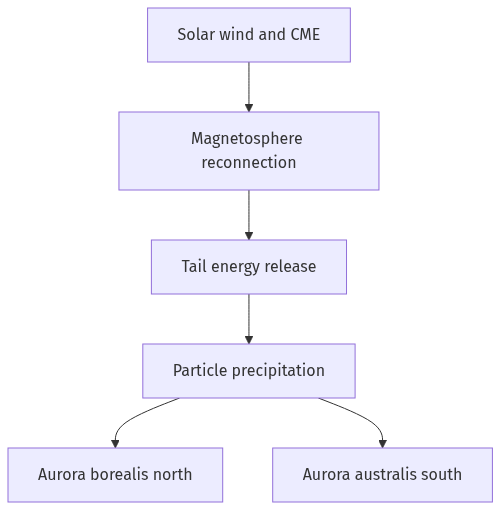
The Sun emits a solar wind of plasma. Coronal mass ejections and fast streams from coronal holes add extra energy and a southward interplanetary magnetic field that couples efficiently to Earth’s magnetosphere. Reconnection on the dayside opens the magnetic shield. Energy is stored in the magnetotail and then released along field lines into the polar ionosphere. Electrons and protons precipitate, collide with upper-air atoms, and excite them. Light is released as the atoms relax. The auroral oval is the footprint of that circuit, closed through field-aligned currents.
A geomagnetic storm, measured operationally by a high Kp index, is the trigger for vivid, expanded displays. The 11-year sunspot cycle changes how often such storms occur. Earth’s dipole tilt and the season affect how well coupling works.
- Solar source: Wind, flares, and CMEs supply the trigger on the Sun.
- Magnetospheric gate: Only certain field orientations dump energy into the poles.
- Atmospheric screen: Collisions in the ionosphere turn particle energy into photons.
Without a magnetic field, the air would be stripped over geological time. With a magnetic field, particle energy appears as polar lights instead of a stripped atmosphere. That is the chain from the photosphere to the polar sky.
Why two names, one mechanism
Borealis and australis are geographic labels. They are not two different kinds of light. Earth’s dipole has two polar funnels. The same solar storm can light both ovals, sometimes with a time lag as the magnetosphere responds. The south is mostly ocean, so the australis is photographed less often. It is not weaker. During extreme events the ovals swell. Radio, GPS, and power grids feel the same storm that observers see as coloured light. The GS point is that the trigger is solar and magnetic, and the place is the polar ionosphere in both hemispheres.
Flow diagram
Conclusion
Aurora borealis and aurora australis are polar ionospheric glows produced by the same solar–terrestrial process. They are triggered when the solar wind couples to the magnetosphere and sends electrons into the upper air. A GS answer should treat them as physics, not as folklore. They are space weather made visible as colour.
Quick related
Students also ask
-
What is a twister? Why are the majority of twisters observed in areas around the Gulf of Mexico?
Next question on this syllabus topic (2024 · Q16). View answer →
-
Can India see the aurora?
Almost never at inhabited latitudes. Only extreme geomagnetic storms push the oval far enough; India is too close to the magnetic equator for a regular display.
-
Is the southern light different in kind?
No. It is the same mechanism in the southern hemisphere. Geography, not physics, makes it less photographed.
More from this topic
Q17 · UPSC Mains 2026 · GS I · 15 marks · Solution
Analyze the major drivers of human-induced land-use changes in India and their geographical consequences.
World's Physical Geography
Anthropogenic pressures driven by population growth and economic development are the primary catalysts of rapid land-use and land-cover change (LULCC) across India. Agricultural expansion and intensive multi-cropping, particularly
Q16 · UPSC Mains 2026 · GS I · 15 marks · Solution
"The centre of global trade is gradually shifting from the Atlantic region to the Indo-Pacific region." Examine this statement.
World's Physical Geography
• The global center of economic gravity has decisively shifted from the Euro-Atlantic axis to the Indo-Pacific. • The rise of China, Southeast Asia, and India as primary manufacturing and consumption hubs drives this transition. • Vital maritime chokepoints like the Malacca Strait serve as critical arteries for global energy and merchant trade. • Mega free-trade agreements such as RCEP and IPEF have established new regional trade and rule-making architectures. • Post-pandemic supply chain vulnerabilities have accelerated diversification strategies like 'China-plus-one' and 'friend-shoring'. • Control over critical mineral supply chains powers the ongoing digital and green energy transitions in the region. • Sustaining this geo-economic shift requires robust multilateral frameworks, freedom of navigation, and rules-based maritime governance.
Q14 · UPSC Mains 2026 · GS I · 15 marks · Solution
Compare the Loo, Chinook and Foehn winds with respect to their regions of prevalence, their nature and climatic impacts.
World's Physical Geography
• Local winds like the Loo, Chinook, and Foehn are driven by distinct regional pressure gradients and orographic barriers. • The Loo prevails over the Indo-Gangetic Plain, the Chinook along the Rockies' eastern slopes, and the Foehn across the northern Alpine valleys. • The Loo is a scorching, dust-laden convective surface wind generated by intense summer continental heating. • Both the Chinook and Foehn are warm, dry katabatic winds formed via rapid adiabatic compression on the leeward sides of mountains. • The Loo induces severe agricultural stress, crop wilting, and high health risks like heat strokes in South Asia. • Chinooks act as 'snow eaters' in North America, rapidly melting winter snowpacks and opening up pasturelands for grazing. • Foehn winds accelerate Alpine snowmelt, which simultaneously triggers hazardous avalanches and elevates regional wildfire risks.