
Revision summary
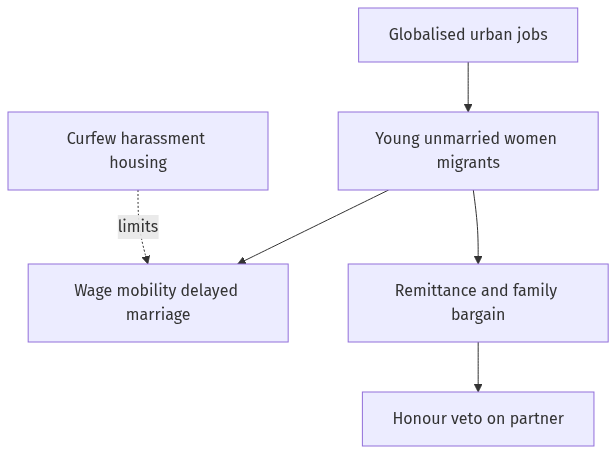
Globalisation pulled young unmarried women into urban garments, care, hospitality, and IT-enabled work. The stream cuts across classes, from professionals to shop-floor workers. Personal freedom grows through wages, delayed marriage, and city skills. It remains bounded by curfews, street risk, precarious contracts, and digital surveillance by kin. Families often allow the move for remittances while keeping honour and marriage as levers. The relationship is renegotiated. It is not simply broken and not simply liberated.
Model answer
Copper italics in this answer — like this — are the key facts. Each one is unpacked in the Facts & figures rail.
Introduction
After economic liberalisation, many young unmarried women moved to Indian cities for work in garments, care, hospitality, and IT-enabled services. Globalisation expanded those sectors. The stream includes skilled and semi-skilled women from more than one class, not only the metropolitan elite. They send money home and live in hostels, paying-guest rooms, and shared flats. The move has increased personal freedom in some ways. It has also forced families to renegotiate control. Patriarchy has not simply ended.
Body
The trend
After liberalisation, cities demanded nurses, teachers, BPO staff, designers, boutique and mall workers, and graduate professionals. Air travel, mobiles, and women’s education, still uneven, made a solo or all-woman move thinkable. Kerala’s nurses abroad were an earlier template. The 2000s added NCR, Bengaluru, Hyderabad, Pune, and garment clusters. Women move as students then workers, or straight to a contract. Class matters. A software engineer and a garment tailor share the city and not the same safety net. Both, if unmarried, sit outside the old script that a woman leaves home only for her husband’s house.
- Sectors: Care, garments, services, and IT are global production networks that hire many women.
- Demography: The movers are young and unmarried, so the move is not yet folded into marriage.
- Class mix: There is not a single new woman. Several class positions sit in one statistic.
Personal freedom
A wage in her account, a phone, and a lock on a paying-guest door can mean mobility, delayed marriage, choice of clothes and friends, and the right to refuse a match. Public transport, night shifts, and paying-guest life teach the city. Freedom is real and conditional. Hostels impose curfews. Companies police safety as control. The street still punishes. Sexual harassment at work and the fear of being sent back home limit the body. For some, live-in and intercaste relationships become possible. For others, the city only extends family control through a brother who calls every evening.
- Gains: Income, skills, delayed marriage, and a self that is not only a daughter.
- Limits: Safety costs, moral policing, precarious contracts, and no affordable housing.
- Ambivalence: Freedom to earn can coexist with no freedom to stay out after eight.
Relationship with family
Families often permit the move because of remittances, dowry-saving, and prestige of a city job. This is a bargain. It is not a conversion to feminism. The daughter remains a duty-bearer. She is still expected to care for parents later, to accept a marriage the family still wants to arrange, and to protect honour that she must not stain. Some households relax after seeing the money. Some tighten surveillance with location apps and sudden visits. Conflict peaks over choice of partner, night work, and whether she will return to the village. Married skilled women in the same stream face a different file of care drain and double shift. For the unmarried, the family relation becomes a long-distance intimate tie even inside one country. Love and control travel by phone.
- Bargain: Money and honour are traded daily.
- Renegotiation: She may have more say in siblings’ education. She may have less say in her own marriage.
- Not rupture only: Many women want both the job and the family’s blessing.
Globalisation did not free women as a bloc. It opened an urban work path in which freedom and family are rewritten under pressure, class by class.
Flow diagram
Conclusion
Skilled young unmarried women in globalised urban work have more income and a wider range of daily choices. Families take the remittance and often keep the veto on marriage and reputation. The trend’s honest impact is a contested expansion of freedom. It is not a clean break from kinship. Policy that treats them only as cheap flexible labour, without housing, safety, and portable social security, will take away the freedom that the market claims to sell.
Quick related
Students also ask
-
Explain why suicide among young women is increasing in Indian Society.
Next question on this syllabus topic (2023 · Q9). View answer →
-
Does a city job end arranged marriage?
Often it delays it. Many women still enter a family-negotiated match; some use the wage to refuse. Both happen.
-
Is this only a middle-class story?
No. Garment and care workers are central to the trend, with less legal protection than campus-to-IT migrants.
Same topic · past papers
UPSC has asked this before
These previous-year questions sit on the same topic. Open one to practise the earlier ask.
More from this topic
Q18 · UPSC Mains 2026 · GS I · 15 marks · Solution
Is caste disappearing in urban India? Illustrate your answer with examples.
Women, Population and Urbanisation
Urbanization does not erase caste but mutates it from a ritual hierarchy into modern
Q17 · UPSC Mains 2025 · GS I · 15 marks · Solution
Discuss the distribution and density of population in the Ganga River Basin with special reference to land, soil and water resources.
Women, Population and Urbanisation
The Ganga plains from western Uttar Pradesh through Bihar to the Bengal delta are among the world's densest rural regions. Alluvial soil, shallow water and a long growing season explain that density. Himalayan hills and some dry western margins of the basin are thinner. The same water that feeds the field produces flood, and some groundwater is now chemically unsafe. Cities on the corridor are the urban expression of the same fertile strip. Land, soil and water therefore explain both the crowd and the hazard.
Q8 · UPSC Mains 2024 · GS I · 10 marks · Solution
Distinguish between gender equality, gender equity and women's empowerment. Why is it important to take gender concerns into account in programme design and implementation?
Women, Population and Urbanisation
Gender equality is sameness of rights and opportunities in law and public life. Gender equity uses special measures because starting points and unpaid care are unequal. Women’s empowerment is agency over body, income, voice and movement. Article 15(3) allows special provision for women; CEDAW and SDG 5 frame empowerment as a process. Gender-blind schemes leak through male capture, unsafe access and digital exclusion. Design and implementation need data, safety, childcare and control of the benefit by the woman herself.