
Revision summary
Gender equality is sameness of rights and opportunities in law and public life. Gender equity uses special measures because starting points and unpaid care are unequal. Women’s empowerment is agency over body, income, voice and movement. Article 15(3) allows special provision for women; CEDAW and SDG 5 frame empowerment as a process. Gender-blind schemes leak through male capture, unsafe access and digital exclusion. Design and implementation need data, safety, childcare and control of the benefit by the woman herself.
Model answer
Copper italics in this answer — like this — are the key facts. Each one is unpacked in the Facts & figures rail.
Introduction
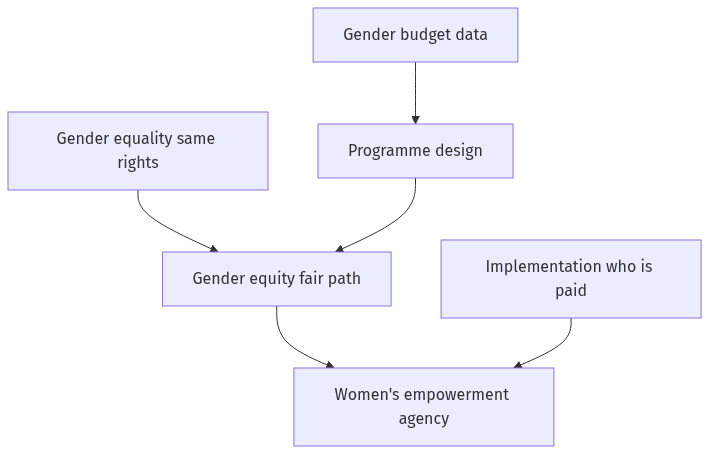
The three phrases are used as if they were one slogan. They are not. Equality is sameness of rights and of the finish line in law. Equity is fairness of the path when starting points differ. Women’s empowerment is the power to choose and to act. It means voice, assets and bodily autonomy. It is not only a seat in a scheme photograph. Programmes that ignore this grammar waste money and can harm.
Body
Three ideas, not one
Gender equality means women and men (and persons of other genders in a full reading) have the same rights, entitlements and opportunities. Articles 14, 15 and 16, equal pay for equal work, the vote, and the right to hold property belong here. It is the normative goal. There should be no legal caste of sex.
Gender equity admits that identical treatment can freeze disadvantage. A woman who already does unpaid care, who owns less land, and who faces violence on the way to the site, does not meet the “same” job halfway. Equity uses special measures — maternity support, childcare, reserved seats, targeted scholarships, safe transport — so that equality becomes real. Article 15(3) is the constitutional name for this in India.
Women’s empowerment is agency. It is control over income, mobility, contraception, political voice and the right to say no. A scheme can raise a female headcount without empowerment if the husband still holds the passbook, or if work is only unpaid SHG labour. CEDAW and SDG 5 treat empowerment as process, not a one-time benefit transfer.
- Equality: Same rights and same claim on the public world.
- Equity: Unequal starting points need unequal help toward that claim.
- Empowerment: The person can decide. The household and the state cannot pocket her entitlement.
Why programmes must build this in
If design is gender-blind, a rural job may assume a male body and daytime hours. A city bus may ignore last-mile safety. A digital DBT may assume a phone and KYC the woman does not control. Implementation then leaks. Male capture of wages, exclusion of disabled and minority women, and frontline workers without creches follow. Gender budgeting in the Union Budget, sex-disaggregated data, female field staff, and grievance paths for violence are design tools. They are not courtesy.
Outcomes improve when women eat, learn and earn. Fertility, child nutrition and household poverty respond. That is the development case. The rights case is simpler. A Republic that promises equality cannot deliver schemes as if the citizen were only a man.
- Design: Who can reach the office, the app, the worksite, the court.
- Implementation: Who signs, who is paid, who is safe, who is counted.
- Correction: Feedback from women users, not only from contractors.
Gender concern is therefore accuracy about how power sits in the household and the street.
Flow diagram
Conclusion
Equality is the same right. Equity is a fair path. Empowerment is the power to use both. Programme design that skips this distinction subsidises the already powerful. Article 15(3), gender budgets and sex-disaggregated monitoring are the constitutional and administrative hooks for doing it properly.
Quick related
Students also ask
-
Globalization has increased urban migration by skilled, young, unmarried women from various classes. How has this trend impacted upon their personal freedom and relationship with family?
Next question on this syllabus topic (2024 · Q19). View answer →
-
Is reservation equity or equality?
It is an equity measure meant to make equality real. It is not a denial of equality unless it becomes a substitute for universal rights.
-
Can a cash transfer empower women?
Only if she controls the account and the cash does not buy silence about violence or unpaid work. Money without agency is relief, not empowerment.
Same topic · past papers
UPSC has asked this before
These previous-year questions sit on the same topic. Open one to practise the earlier ask.
More from this topic
Q18 · UPSC Mains 2026 · GS I · 15 marks · Solution
Is caste disappearing in urban India? Illustrate your answer with examples.
Women, Population and Urbanisation
Urbanization does not erase caste but mutates it from a ritual hierarchy into modern
Q17 · UPSC Mains 2025 · GS I · 15 marks · Solution
Discuss the distribution and density of population in the Ganga River Basin with special reference to land, soil and water resources.
Women, Population and Urbanisation
The Ganga plains from western Uttar Pradesh through Bihar to the Bengal delta are among the world's densest rural regions. Alluvial soil, shallow water and a long growing season explain that density. Himalayan hills and some dry western margins of the basin are thinner. The same water that feeds the field produces flood, and some groundwater is now chemically unsafe. Cities on the corridor are the urban expression of the same fertile strip. Land, soil and water therefore explain both the crowd and the hazard.
Q19 · UPSC Mains 2024 · GS I · 15 marks · Solution
Globalization has increased urban migration by skilled, young, unmarried women from various classes. How has this trend impacted upon their personal freedom and relationship with family?
Women, Population and Urbanisation
Globalisation pulled young unmarried women into urban garments, care, hospitality, and IT-enabled work. The stream cuts across classes, from professionals to shop-floor workers. Personal freedom grows through wages, delayed marriage, and city skills. It remains bounded by curfews, street risk, precarious contracts, and digital surveillance by kin. Families often allow the move for remittances while keeping honour and marriage as levers. The relationship is renegotiated. It is not simply broken and not simply liberated.