
Revision summary
Globalisation carries new technology across borders as machines, patents, and platforms. Scarcity of oil, water, land, and minerals is the test of that pair. Yield-raising, digital, and renewable tools can stretch Indian resources. The same pair fuels consumption, e-waste, and imported mineral thirst. India’s way is public digital and green technology, not resource-blind consumer globalism.
Model answer
Copper italics in this answer — like this — are the key facts. Each one is unpacked in the Facts & figures rail.
Introduction
Globalisation moves goods, capital, and ideas across borders; new technology changes how much resource each unit of output needs. In a world of scarce oil, water, land, and rare minerals, the two together can save resources or burn them faster. India lives both sides.
Body
How the two forces join
- Open trade after 1991 let India import machines, seeds, and later smartphones, so new technology arrived as a global package, not only as a domestic lab.
- Digital networks, the internet, and now renewable hardware are global production systems; no country, including India, makes the whole stack at home.
- Scarcity is the third term: hydrocarbons, groundwater, fertile land, and critical minerals are finite, so technology is asked to decouple growth from depletion.
Easing scarcity
- The Green Revolution’s high-yield seed, later drip and satellite weather, and now soil sensors show technology stretching land and water, even as they created new chemical loads.
- Solar modules, wind turbines, and LED lighting, traded globally, let India cut some oil for power and lighting despite poor domestic oil reserves.
- UPI, Aadhaar-enabled delivery, and remote work reduce some travel and leakages, which is a resource saving in time, fuel, and subsidy waste.
- Indian IT and generic pharma used global demand and licensed or off-patent technology to earn without a matching claim on domestic mines.
- Recycling, electric mobility, and efficiency standards are the scarcity-facing face of the same global tech market.
Tightening scarcity and unequal access
- Global middle-class consumption, copied in Indian cities, raises meat, air-travel, and gadget demand that technology often serves rather than caps.
- Export agriculture and data centres are thirsty; chips and batteries need minerals India does not dominate, so scarcity is offshored, not abolished.
- E-waste, leftover patents, and a digital divide mean new technology can waste rare metals and leave the water-poor farmer outside the saving.
- TRIPS-era rules can raise the price of green and health technologies unless public procurement and compulsory paths are used.
- Climate change, itself a global-technology-and-growth product, makes Indian monsoon water more scarce in some regions even as apps improve forecasts.
India’s special reference
- India must use global technology to leapfrog dirty industrial stages, and must regulate global consumption models that treat groundwater and clean air as free.
- Public digital infrastructure plus renewable manufacturing is the scarce-resource path; uncritical consumer globalisation is the waste path.
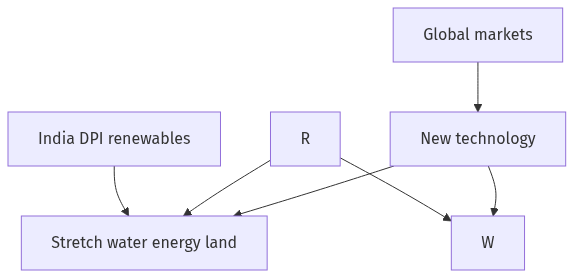
Flow diagram
Conclusion
Globalisation delivers new technology at speed; scarcity decides whether that technology is used to stretch land, water, and energy or to multiply wants. India’s task is to import and make saving technologies while refusing a global lifestyle that treats finite resources as infinite.
Quick related
Students also ask
-
Is diversity and pluralism in India under threat due to globalisation? Justify your answer.
Next question on this syllabus topic (2020 · Q18). View answer →
-
Does technology end resource scarcity?
It can raise efficiency. It does not end wants, waste, or the mineral base of the devices themselves.
-
Is globalisation only a resource threat to India?
It also brought IT earnings, generics, and renewable gear. The threat is unregulated consumption on a scarce water-energy map.
Same topic · past papers
UPSC has asked this before
These previous-year questions sit on the same topic. Open one to practise the earlier ask.
More from this topic
Q20 · UPSC Mains 2026 · GS I · 15 marks · Solution
Evaluate the impact of globalization on Indian youths with reference to social, political, economic and cultural spheres.
Globalisation and Indian Society
Globalization has profoundly transformed the lives of Indian youth since the 1991 reforms, offering unprecedented economic opportunities through the IT sector and startup ecosystems alongside digital political engagement. However, this shift is accompanied by severe structural vulnerabilities, including precarious gig work, the rural-urban digital divide, and intense professional competition. Socially and culturally, youth navigate a complex terrain of rising individualism, changing family structures, and mental health challenges driven by the tension between Western consumerism and traditional roots. While digital platforms enable decentralized activism and global awareness, they also expose this demographic to polarization and misinformation. Ultimately, harnessing India's demographic dividend requires robust policy interventions that ensure social safety nets, mental health support, and inclusive digital education.
Q18 · UPSC Mains 2020 · GS I · 15 marks · Solution
Is diversity and pluralism in India under threat due to globalisation? Justify your answer.
Globalisation and Indian Society
Global brands and platforms can flatten language and craft. Internal politics and caste also threaten pluralism. GI tags, regional OTT, and diaspora archives use global pipes to save difference. Hybrid culture is a new pluralism, not only a loss. Stand: partial threat from globalisation, not a single-cause collapse.
Q19 · UPSC Mains 2018 · GS I · 15 marks · Solution
'Globalisation is generally said to promote cultural homogenisation but due to this cultural specificities appear to be strengthened in the Indian society.' Elucidate.
Globalisation and Indian Society
Global media, brands, and English work-life spread a similar urban consumer style. That is the homogenisation usually blamed on globalisation. In India the same openness enlarges regional film, language politics, caste association, and religious publicness. Glocalisation packages yoga, food, and pilgrimage for a world market without ending local rules of marriage. The result is hybrid everyday life plus stronger identity badges, not simple cultural sameness.