
Revision summary
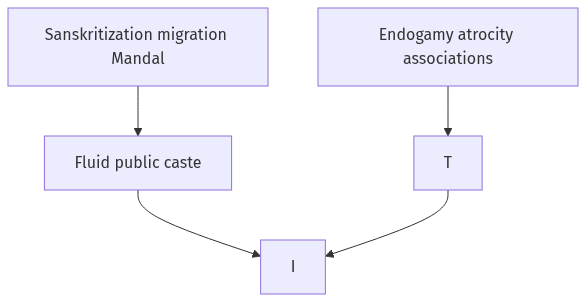
Sanskritization, migration, and quota politics make caste claims move. Endogamy, atrocities, and caste associations keep rank sticky. The office can be fluid while the wedding remains static. Law bans untouchability; practice often does not. Both words in the question are therefore right at the same time.
Model answer
Copper italics in this answer — like this — are the key facts. Each one is unpacked in the Facts & figures rail.
Introduction
Caste in India is a ranked kinship identity that can shift in occupation, public claim, and local status. It is also sticky in marriage, stigma, and politics, so the same identity can be fluid and static at once.
Body
Why caste is fluid
- M. N. Srinivas’s sanskritization describes lower jatis copying ritual of higher groups to claim a new local rank over generations.
- Urban jobs, migration, and the factory or office can hide a surname in daily work even when the village still knows it.
- Mandal (1990) and OBC lists made caste a resource for quotas, so groups campaign to enter or leave categories, which is political fluidity.
- Conversion, sects, and new gurus have historically moved people across Hindu–Sikh–Buddhist–Muslim boundaries without erasing all jati memory.
- A small rise in inter-caste marriage and courtship in cities shows some exit from endogamy, though the share remains limited.
Why caste is static
- Endogamy remains the main rule in arranged marriage, matrimonial columns, and many online filters, which reproduces jati every generation.
- The Scheduled Castes and Scheduled Tribes (Prevention of Atrocities) Act, 1989, exists because violence and untouchability still freeze rank in the street and the well.
- Khap-type panchayats and honour rules punish those who cross marriage lines, which is static power, not old folklore only.
- Caste associations, temples, and hostels keep a named identity alive in towns that look modern.
- Electoral arithmetic and reservation certificates require a stable official caste, so the state itself freezes what society also treats as birth.
How both can be true
- Varna is a broad ladder that people argue about; jati is the marriage circle that moves slowly.
- A person may be fluid in the office and static in the wedding hall, which is why surveys show change in work and stubbornness in marriage.
- Article 15 and 17 ban caste disability in law, while social practice still assigns care work, manual scavenging, and priestly rights by birth in many places.
Way forward
- Enforce atrocity law and end manual scavenging through the 2013 Act in practice.
- Use education and urban housing mix to widen the marriage circle, because that is where static caste is reproduced.
- Keep reservation as a tool against frozen disadvantage without treating every certificate as the whole of a person.
Flow diagram
Conclusion
Caste is fluid in work, politics, and some ritual claim, and static in endogamy, stigma, and official lists. The double character will last until marriage and violence change as much as the job market already has.
Quick related
Students also ask
-
Discuss the impact of post-liberal economy on ethnic identity and communalism.
Next question on this syllabus topic (2023 · Q20). View answer →
-
If caste is fluid, why keep reservations?
Fluidity in a job does not erase inherited stigma or unequal assets. Reservations answer the static side.
-
Is urban India caste-free?
Work can anonymise. Housing, marriage, and networks often do not.
Same topic · past papers
UPSC has asked this before
These previous-year questions sit on the same topic. Open one to practise the earlier ask.
-
2023 · Q20 · GS I · 15 marks
Discuss the impact of post-liberal economy on ethnic identity and communalism. -
2015 · Q13 · GS I · 12 marks
Debate the issue whether and how contemporary movements for assertion of Dalit identity work towards annihilation of caste. -
2019 · Q3 · GS I · 10 marks
Examine the linkages between the nineteenth century's 'Indian Renaissance' and the emergence of national identity. -
2019 · Q20 · GS I · 15 marks
Are we losing our local identity for the global identity? Discuss. -
2018 · Q13 · GS I · 15 marks
Why indentured labour was taken by the British from India to their colonies? have they been able to preserve their cultural identity over there?
More from this topic
Q10 · UPSC Mains 2026 · GS I · 10 marks · Solution
Do you think digital technology promotes social empowerment? Explain with examples.
Social Empowerment, Communalism and Secularism
Digital technology acts as a double-edged sword for social empowerment, bridging gaps in marginalized communities while simultaneously creating new forms of exclusion. On one hand, e-governance, financial inclusion via Jan Dhan, and digital literacy schemes enable grassroots mobility and amplify subaltern voices. On the other hand, the digital divide, algorithmic bias, and cyber-exclusion exacerbate existing socio-economic hierarchies. Therefore, structural interventions alongside technological deployment are necessary to ensure inclusive empowerment.
Q8 · UPSC Mains 2026 · GS I · 10 marks · Solution
Unity in diversity remains the defining feature of Indian society despite the challenges from communalism and regionalism. Comment.
Social Empowerment, Communalism and Secularism
India's civilizational ethos of unity in diversity persists despite structural pressures from communalism and regionalism. The answer analyses how historical syncretism and constitutional pluralism absorb societal friction. Communal polarization threatens the secular fabric through identity politics and majoritarianism. Regional aspirations, while occasionally manifesting as divisive sub-nationalism, often reflect genuine developmental imbalances. The conclusion highlights constitutionalism and inclusive governance as the anchors for reinforcing national cohesion.
Q9 · UPSC Mains 2024 · GS I · 10 marks · Solution
Intercaste marriages between castes which have socio-economic parity have increased, to some extent, but this is less true of interreligious marriages. Discuss.
Social Empowerment, Communalism and Secularism
Intercaste marriage has increased a little where education, income and urban life already match. The Hindu Marriage Act does not bar intercaste unions. The Special Marriage Act offers a civil path. The rise is selective and still a minority practice. Caste violence has not vanished. Interreligious marriage is rarer because personal law, conversion fears and honour politics raise the cost. Class can sometimes buy a caste exception. It rarely buys a religious exception in today’s climate. Constitutional choice of partner exists. Social enforcement is still family and community.