
Revision summary
After 1991, markets, private jobs, and mass media grew together. Ethnic claims for language, tribe, and new states continued inside that growth. Communal mobilisation used television, rumour, and later social media. Riots and polarising politics showed that GDP does not cancel religious conflict. The market can mix people at work and still sell identity at home and at the vote.
Model answer
Copper italics in this answer — like this — are the key facts. Each one is unpacked in the Facts & figures rail.
Introduction
The post-liberal economy after 1991 opened markets, media, and cities to faster private growth. Ethnic identity and communalism did not fade in that market; they found new money, new audiences, and new insecurities.
Body
The economic setting
- Liberalisation, a smaller licence raj, and global capital expanded private jobs in IT, retail, real estate, and private education, especially in a few metros.
- Satellite television, later cheap mobiles, and advertising created a national consumer public that could also be a national political public.
- Inequality and informal work rose beside a new middle class, so dignity and fear travelled with growth.
Impact on ethnic identity
- Regional language pride, tribal statehood, and caste blocs did not dissolve; Jharkhand, Chhattisgarh, and Uttarakhand (2000) show ethnic-administrative claims inside the liberal decades.
- Diaspora money and satellite channels funded language academies, churches, temples, and homeland politics from Punjab to the north-east.
- Market competition for land, mines, and city space sharpened Assamese, Naga, Mizo, and other ethnic claims against insiders and outsiders.
- At the same time, English workplaces and mixed campuses created thinner ethnic performance in daily work for a small professional layer.
Impact on communalism
- The 1990s joined Mandal and Mandir with the new economy: Babri Masjid demolition (1992) and later riots showed that growth years were not secular by default.
- Private 24-hour news, later social media, and urban rumour made communal frames travel faster than the old neighbourhood gossip.
- A consumer Hindutva and a consumer Muslim identity could both be sold as style, pilgrimage packages, and vote banks, which is communalism in the market, not only in the mob.
- Gujarat 2002 and later polarising campaigns showed that a liberalised state can still see communal violence and then return to investment summits.
- Economic losers in deindustrialised towns could be told to blame another community, which is an ethnicised reading of market shock.
Not a single arrow
- Liberal cities also produce mixed offices, inter-faith malls, and couples who leave the mohalla, so the market can dilute as well as inflame.
- The dominant public pattern since the 1990s is that ethnic and communal identities were re-tooled for television, votes, and urban fear, not retired by GDP.
Way forward
- Enforce the rule of law after riots as strictly as after a tax default, or the market will treat communal peace as optional.
- Reduce inequality and informal insecurity so ethnic entrepreneurs find fewer angry customers.
- Keep public culture, textbooks, and platform rules from turning every economic rumour into a communal story.
Flow diagram
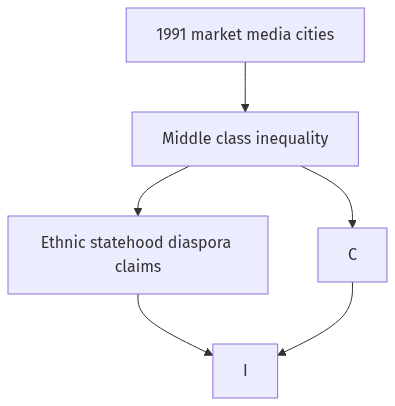
Conclusion
The post-liberal economy enriched a consumer India and did not automatically secularise it. Ethnic identity and communalism gained media, money, and grievance; the way forward is equal law and less economic fear, not a hope that growth alone will cool identity.
Quick related
Students also ask
-
Analyze the salience of 'sect' in Indian society vis-a-vis caste, region and religion.
Next question on this syllabus topic (2022 · Q18). View answer →
-
Did liberalisation cause communalism?
It did not invent it. It changed the stage: media, cities, inequality, and vote markets re-tooled older communal and ethnic stocks.
-
Can the market reduce ethnic conflict?
Shared workplaces can dilute daily boundaries. Without equal law and less insecurity, the same market funds identity entrepreneurs.
Same topic · past papers
UPSC has asked this before
These previous-year questions sit on the same topic. Open one to practise the earlier ask.
-
2026 · Q8 · GS I · 10 marks
Unity in diversity remains the defining feature of Indian society despite the challenges from communalism and regionalism. Comment. -
2018 · Q20 · GS I · 15 marks
'Communalism arises either due to power struggle or relative deprivation.' Argue by giving suitable illustrations. -
2017 · Q19 · GS I · 15 marks
Distinguish between religiousness/religiosity and communalism giving one example of how the former has got transformed into the latter in independent India. (250 words).
More from this topic
Q10 · UPSC Mains 2026 · GS I · 10 marks · Solution
Do you think digital technology promotes social empowerment? Explain with examples.
Social Empowerment, Communalism and Secularism
Digital technology acts as a double-edged sword for social empowerment, bridging gaps in marginalized communities while simultaneously creating new forms of exclusion. On one hand, e-governance, financial inclusion via Jan Dhan, and digital literacy schemes enable grassroots mobility and amplify subaltern voices. On the other hand, the digital divide, algorithmic bias, and cyber-exclusion exacerbate existing socio-economic hierarchies. Therefore, structural interventions alongside technological deployment are necessary to ensure inclusive empowerment.
Q8 · UPSC Mains 2026 · GS I · 10 marks · Solution
Unity in diversity remains the defining feature of Indian society despite the challenges from communalism and regionalism. Comment.
Social Empowerment, Communalism and Secularism
India's civilizational ethos of unity in diversity persists despite structural pressures from communalism and regionalism. The answer analyses how historical syncretism and constitutional pluralism absorb societal friction. Communal polarization threatens the secular fabric through identity politics and majoritarianism. Regional aspirations, while occasionally manifesting as divisive sub-nationalism, often reflect genuine developmental imbalances. The conclusion highlights constitutionalism and inclusive governance as the anchors for reinforcing national cohesion.
Q9 · UPSC Mains 2024 · GS I · 10 marks · Solution
Intercaste marriages between castes which have socio-economic parity have increased, to some extent, but this is less true of interreligious marriages. Discuss.
Social Empowerment, Communalism and Secularism
Intercaste marriage has increased a little where education, income and urban life already match. The Hindu Marriage Act does not bar intercaste unions. The Special Marriage Act offers a civil path. The rise is selective and still a minority practice. Caste violence has not vanished. Interreligious marriage is rarer because personal law, conversion fears and honour politics raise the cost. Class can sometimes buy a caste exception. It rarely buys a religious exception in today’s climate. Constitutional choice of partner exists. Social enforcement is still family and community.