
Revision summary
Medieval temples carved daily work, music, war, and household scenes beside the gods. Khajuraho, Konark, Hoysala, and Chola walls show rank, craft, and kama as public facts. Women, dancers, and donors appear as social actors, not only as ornaments. The stone favours elite donors, so it is a partial census. Inscriptions must sit beside the panels for a full social reading.
Model answer
Copper italics in this answer — like this — are the key facts. Each one is unpacked in the Facts & figures rail.
Introduction
Medieval temple walls were public stone books. Beside gods they carved dancers, soldiers, donors, animals, and household scenes, so the temple recorded how those societies worked, ranked people, and spent surplus.
Body
Sculpture as a social document
- Khajuraho, Konark, Halebidu, Belur, and the Chola temples of the Kaveri delta show mithuna couples, musicians, and craftsmen, which means devotion sat next to ordinary desire and skill.
- Processions, hunting, war, and royal gifts carved in relief display the court, the army, and the donor, so political rank is as visible as myth.
- Dress, jewellery, hairstyles, and musical instruments fix regional fashion and craft, which later historians read as evidence of textile, metal, and dance guilds.
- Animals, farms, and river boats appear in narrative panels, which ties the shrine to the agrarian and trade world that paid for it.
Groups, work, and gender
- Brahmana priests, temple dancers, drummers, and stone-cutters are shown in their tasks, so jati work is part of the sacred programme, not hidden behind it.
- Women appear as devotees, dancers, mothers, and donors, which records a public female presence even in a patriarchal household order.
- Erotic panels at Khajuraho and Konark are not a private scandal; they sit on a royal temple and show that kama was an admitted limb of courtly and householder life.
- Foreign-looking traders and soldiers on some Deccan and coastal temples hint at war and long-distance contact that the locality already knew.
Limits of the stone
- The temple records elite donors and ideal types more than the landless poor, so sculpture is a partial social census.
- Iconoclasm, later plaster, and museum removal mean the surviving wall is not the full medieval street.
- Read the sculpture with inscriptions and land grants, or the social claim stays only visual.
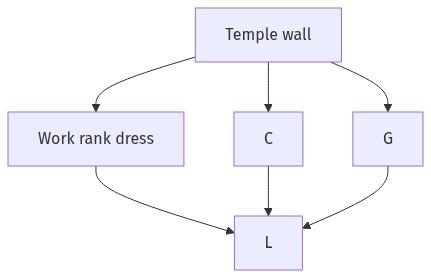
Flow diagram
Conclusion
Medieval temple sculpture represents social life because it carves work, rank, music, war, and household love onto a public wall. It is a rich source for dress and occupation, and a weaker source for those who never paid for a panel.
Quick related
Students also ask
-
Discuss the meaning of colour-coded weather warnings for cyclone prone areas given by India Meteorological department.
Next question on this syllabus topic (2022 · Q5). View answer →
-
Are erotic sculptures proof that medieval society was freely sensual?
They prove that kama was an admitted public theme on royal temples. They do not prove equal freedom for every caste or woman.
-
Can sculpture replace texts for social history?
No. It shows dress, work, and rank as the elite wished them seen. Grants and literature complete the picture.
More from this topic
Q11 · UPSC Mains 2026 · GS I · 15 marks · Solution
Vijayanagara architecture exemplifies the amalgamation of past traditions with contemporary practices. Elucidate with examples.
Indian Heritage and Culture
• The Vijayanagara architectural style (14th–17th centuries) brilliantly synthesized classical Dravidian traditions with contemporary Deccan innovations. • It preserved grand spatial layouts, towering gopurams, and enclosed prakaras inspired by earlier Chola and Pandya idioms. • Sacred centers maintained canonical sanctum alignments while expanding peripheral structures to encourage greater public participation. • Secular buildings, such as the Lotus Mahal and Elephant Stables, integrated Islamic arched vaults and domes. • Builders utilized locally available hard granite, shifting ornamentation techniques toward bold, deep-relief stone carving. • Innovative structural typologies included multi-shafted composite pillars featuring rearing yalis, horse riders, and hanging brackets. • The Vittalaswami Temple at Hampi showcased pioneering acoustic engineering through famous resonant musical pillars.
Q1 · UPSC Mains 2026 · GS I · 10 marks · Solution
Analyze the importance of Ashokan inscriptions for reconstructing Mauryan history.
Indian Heritage and Culture
Ashokan inscriptions serve as the bedrock for reconstructing Mauryan history by offering authentic, contemporaneous evidence directly from the emperor. Written primarily in Brahmi, Kharosthi, Aramaic, and Greek scripts, they illuminate Ashoka's administrative reach, socio-religious policies, and the moral framework of Dhamma. Distributed across the Indian subcontinent and beyond, these edicts document spatial boundaries, diplomatic ties with Hellenistic kingdoms, and the socio-economic milieu. They bridge the gap between literary accounts and archaeological finds, providing an invaluable indigenous chronology.
Q15 · UPSC Mains 2025 · GS I · 15 marks · Solution
How can Artificial Intelligence (AI) and drones be effectively used along with GIS and RS techniques in locational and areal planning?
Indian Heritage and Culture
Remote sensing supplies pictures of land and water; GIS stores them with administrative boundaries. Drones add cheap, repeatable local maps for disasters, utilities and village layouts. Artificial intelligence classifies pixels and can forecast flood, heat or sprawl on that GIS base. Indian platforms such as Bhuvan and Gati Shakti already try to combine these tools. Planning still needs ground checks and a public purpose, or the map only watches the poor. The four tools are a chain: locate, refresh, read, then choose the public use.