
Revision summary
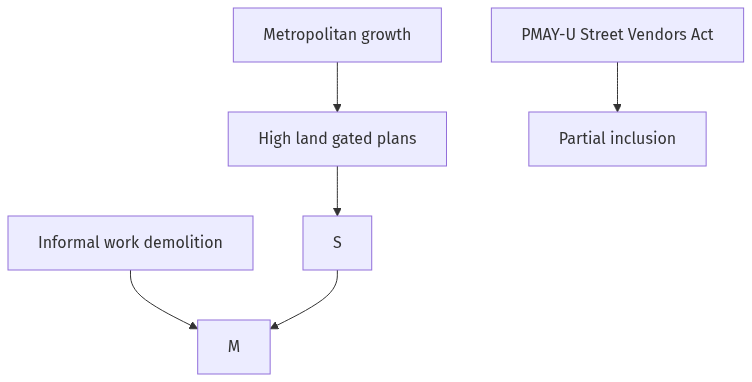
High land prices and master plans push the poor into slums and edges. Gated housing and caste mohallas harden spatial segregation. Informal work and demolition without fair rehab marginalise the same people. Some mixing and central schemes exist but do not yet reverse the pattern. The honest answer is yes, urbanisation here has meant more segregation and marginalisation, unless housing near jobs is forced into the plan.
Model answer
Copper italics in this answer — like this — are the key facts. Each one is unpacked in the Facts & figures rail.
Introduction
Indian metropolises concentrate jobs, but they also sort people by rent, caste, and papers. Urbanisation here often means both segregation of the poor into slums and margins, and marginalisation in work, services, and the law.
Body
Segregation in space
- Master plans and high land prices push low-income workers into jhuggi-jhopri clusters, unauthorised colonies, and peri-urban villages, as in parts of Delhi, Mumbai, and Bengaluru.
- Gated housing, malls, and elevated corridors physically separate the paying city from the service city that cooks and drives for it.
- Dharavi, Bhalswa, and similar settlements are not random; they sit on leftover, flood-prone, or disputed land that the formal market will not sell cheaply.
- Caste and religion still cluster in urban mohallas, so class segregation overlaps older social maps.
Marginalisation in work and citizenship
- A large share of metropolitan labour is informal: street vending, domestic work, construction, and gig delivery without written contracts.
- Slum demolition without rehabilitation, despite Olga Tellis (1985) on livelihood and later right-to-shelter talk, treats the poor as encroachers on their own workplace city.
- Water tankers, shared toilets, and school and clinic gaps mean the poor pay more for worse services, which is marginalisation by the utility.
- Women in slums face unsafe last-mile transport and unpaid care, so the metro’s opportunity is not equally usable.
Is it automatic?
- Urbanisation also mixes people in factories, metros, and universities, and it can weaken village caste watch in some neighbourhoods.
- PMAY-U, NULM, street-vendor protection after the Street Vendors Act, 2014, and the 74th Amendment promise inclusion.
- In practice, these schemes often under-fund rental housing and fail against builder-led gentrification, so the dominant metropolitan pattern is still segregation plus marginalisation.
Way forward
- Expand in-situ slum upgrading and public rental housing near job corridors, not only distant resettlement.
- Give vendors and waste-pickers legal standing, and bind metro master plans to affordable housing quotas.
- Use the 74th Amendment so ward committees, not only development authorities, decide whose house is illegal.
Flow diagram
Conclusion
In Indian metropolises, urbanisation has largely segregated the poor in slums and peri-urban belts and marginalised them in informal work and services. Mixing and housing schemes exist, but they will count only if housing near jobs is treated as infrastructure.
Quick related
Students also ask
-
what are the environmental implications of the reclamation of the water bodies into urban land use? Explain with examples.
Next question on this syllabus topic (2021 · Q6). View answer →
-
Does urbanisation always segregate?
It tends to where land is left to the market and eviction is easy. Public rental housing can blunt that.
-
Is marginalisation only about slums?
No. Informal contracts, unsafe transport, and no tap water marginalise even when a hut is not demolished.
More from this topic
Q18 · UPSC Mains 2026 · GS I · 15 marks · Solution
Is caste disappearing in urban India? Illustrate your answer with examples.
Women, Population and Urbanisation
Urbanization does not erase caste but mutates it from a ritual hierarchy into modern
Q17 · UPSC Mains 2025 · GS I · 15 marks · Solution
Discuss the distribution and density of population in the Ganga River Basin with special reference to land, soil and water resources.
Women, Population and Urbanisation
The Ganga plains from western Uttar Pradesh through Bihar to the Bengal delta are among the world's densest rural regions. Alluvial soil, shallow water and a long growing season explain that density. Himalayan hills and some dry western margins of the basin are thinner. The same water that feeds the field produces flood, and some groundwater is now chemically unsafe. Cities on the corridor are the urban expression of the same fertile strip. Land, soil and water therefore explain both the crowd and the hazard.
Q19 · UPSC Mains 2024 · GS I · 15 marks · Solution
Globalization has increased urban migration by skilled, young, unmarried women from various classes. How has this trend impacted upon their personal freedom and relationship with family?
Women, Population and Urbanisation
Globalisation pulled young unmarried women into urban garments, care, hospitality, and IT-enabled work. The stream cuts across classes, from professionals to shop-floor workers. Personal freedom grows through wages, delayed marriage, and city skills. It remains bounded by curfews, street risk, precarious contracts, and digital surveillance by kin. Families often allow the move for remittances while keeping honour and marriage as levers. The relationship is renegotiated. It is not simply broken and not simply liberated.