
Revision summary
Company rule after the mid-eighteenth century raised cash revenue just as drought hit Bengal in 1770. Settlements and cash crops left peasants paying rupees after a failed harvest. Older tax remission and local stores weakened, while grain followed price to the port. Nineteenth-century famines and Bengal 1943 showed policy and entitlement failure, not climate alone. Railways moved grain; they did not create a right to eat.
Model answer
Copper italics in this answer — like this — are the key facts. Each one is unpacked in the Facts & figures rail.
Introduction
Famine was not new to India, but from the Bengal famine of 1770 onward dearth became more frequent and more commercial under Company and Crown rule. Climate still failed; colonial revenue and grain export decided who starved.
Body
Revenue and the market
- After Plassey the Company squeezed Bengal’s land revenue, which left peasants with no grain reserve when the 1769–70 drought came.
- Permanent Settlement, ryotwari, and mahalwari treated the peasant as a cash payer, so a bad year still owed rupees, and land passed to moneylenders.
- Cash crops such as indigo, opium, cotton, and later oilseeds took acreage from food in some belts, which raised market risk when rains failed.
- Grain moved by river and later by rail toward ports and deficit towns that could pay, so high prices in a famine district did not keep food at home.
Collapse of older buffers
- Pre-colonial states, temples, and village granaries had uneven relief, but they often remitted tax or opened stores; colonial collectors still demanded revenue in many famine years.
- Deindustrialisation of textiles threw weavers onto a crowded agrarian labour market, which made wage earners the first to starve when grain spiked.
- Forest and common-grazing closures cut wild foods and cattle fodder that poor households had used as a last store.
Policy and the great famines
- Laissez-faire dogma in the nineteenth century delayed public grain, as in the 1876–78 and 1896–97 famines, until mortality had already soared.
- The 1943 Bengal famine showed that war demand, boat denial, and a failed entitlement to buy rice could kill even when the calendar was not a simple all-India drought.
- Railways could import grain, yet they also exported it; transport without a right to food did not end famine.
Flow diagram
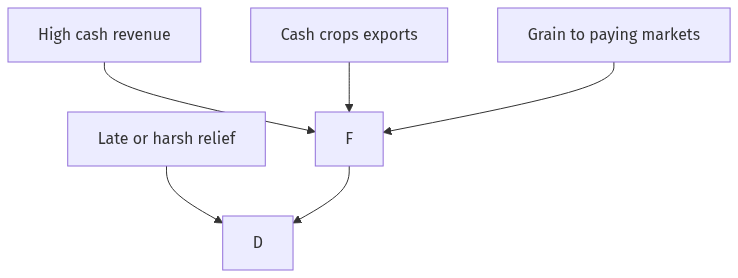
Conclusion
The mid-eighteenth-century spurt in famines followed Company revenue, cash cropping, and a market that moved grain to money, not to need. Drought remained the trigger; colonial political economy made the death roll modern and large.
Quick related
Students also ask
-
Assess the role of British imperial power in complicating the process of transfer of power during the 1940s.
Next question on this syllabus topic (2019 · Q12). View answer →
-
Did colonialism invent Indian famine?
No. It changed frequency and lethality by tying food to cash revenue and export markets.
-
Did railways cause famine?
They could relieve a district if grain was paid to stay. They also drained grain toward ports when price commanded.
Same topic · past papers
UPSC has asked this before
These previous-year questions sit on the same topic. Open one to practise the earlier ask.
-
2017 · Q2 · GS I · 10 marks
Clarify how mid-eighteenth century India was beset with the spectre of a fragmented polity.
More from this topic
Q13 · UPSC Mains 2026 · GS I · 15 marks · Solution
The model of planned economy was adopted in India to address the regional imbalances left behind by colonial rule. Comment.
Modern Indian History
Post-independence India adopted state-led economic planning to counter deep-seated regional imbalances inherited
Q2 · UPSC Mains 2026 · GS I · 10 marks · Solution
Discuss the impact of Macaulay's Minute on colonial administration and education in India.
Modern Indian History
Macaulay's Minute of 1835 fundamentally altered India's trajectory by anchoring colonial administration to English-language proficiency and Western legal codes. In education, it shifted state patronage from Oriental learning to English education, creating a clerical class to serve British interests. While it modernised administration and introduced Western sciences, it alienated the masses and devalued indigenous knowledge systems. The downward filtration theory ultimately created a socio-cultural divide. This structural shift laid the foundation for modern administrative uniformity alongside long-term cultural alienation.
Q2 · UPSC Mains 2022 · GS I · 10 marks · Solution
Why did the armies of the British East India Company - mostly comprising of Indian soldiers - win consistently against the more numerous and better equipped armies of the Indian rulers? Give reasons.
Modern Indian History
Sepoys were the mass of Company armies; drill, volley fire, and artillery were the edge. A single officer chain beat coalition hosts of jagirdars. Subsidiary Alliance and succession politics shrank independent Indian armies. Coastal supply and Indian credit paid campaigns as a system. Numerous Indian hosts lost when they could not combine command and treasury.