
Revision summary
Sepoys were the mass of Company armies; drill, volley fire, and artillery were the edge. A single officer chain beat coalition hosts of jagirdars. Subsidiary Alliance and succession politics shrank independent Indian armies. Coastal supply and Indian credit paid campaigns as a system. Numerous Indian hosts lost when they could not combine command and treasury.
Model answer
Copper italics in this answer — like this — are the key facts. Each one is unpacked in the Facts & figures rail.
Introduction
Company victories from Plassey to the Anglo-Maratha wars were not a tale of a few Europeans beating India by blood. Indian sepoys, drilled firepower, and a political method that split Indian courts explain why smaller field forces often won.
Body
Drill, fire, and command
- Company infantry used volley fire, bayonet drill, and field artillery as one system, which beat larger hosts that still mixed feudal cavalry with uneven matchlocks.
- British officers held a single chain of command, while many Indian armies were coalitions of jagirdars who could leave the line when their own interest shifted.
- The navy moved guns, grain, and men along the coast, so a land army was rarely cut off from Calcutta, Madras, or Bombay.
- Indian soldiers were the mass of the army; the advantage was training, pay in coin, and promotion rules, not the absence of Indian courage.
Politics that shrank the enemy
- Subsidiary Alliance under Wellesley parked Company troops on a ruler’s revenue and forbade him an independent foreign policy, which turned allies into subsidised clients.
- Doctrine and practice of supporting one claimant in a succession, seen from Bengal after 1757 onward, meant Indian armies often fought other Indians with Company backing.
- The Company treated war as a balance-sheet: prize, tribute, and assigned districts paid the next campaign, while many Indian states faced empty treasuries after a single season.
Indian divisions and resources
- Maratha, Mysore, Sikh, and Awadh forces were often well equipped in parts, yet they lacked a shared command against a Company that could fight one front at a time.
- Indian bankers and revenue farmers in the east financed Company credit after Plassey, so the ‘foreign’ army ate Indian surplus.
- After 1857 the Crown rebuilt the army on a martial-class and mixed-unit pattern; the exam question’s pattern of win, however, was already set in the late eighteenth and early nineteenth centuries.
Flow diagram
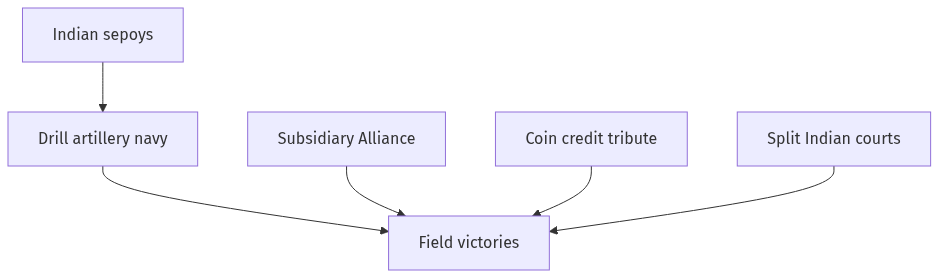
Conclusion
Company armies won because drill, artillery, naval supply, and a unified officer corps met Indian courts that were politically split and fiscally brittle. Indian sepoys made those victories possible; Indian disunity and Company finance made them repeatable.
Quick related
Students also ask
-
Why was there a sudden spurt in famines in colonial India since the mid-eighteenth century? Give reasons.
Next question on this syllabus topic (2022 · Q3). View answer →
-
Were Indian rulers’ armies always worse equipped?
No. Mysore rockets and Maratha cavalry were serious. The Company edge was combined arms, pay, and politics, not a monopoly of weapons.
-
Why did Indian soldiers fight for the Company?
Regular pay, honour of the regiment, and local recruitment. After 1857 many also fought from caste-military traditions the Raj cultivated.
Same topic · past papers
UPSC has asked this before
These previous-year questions sit on the same topic. Open one to practise the earlier ask.
-
2019 · Q19 · GS I · 15 marks
What are the continued challenges for women in India against time and space? -
2017 · Q10 · GS I · 10 marks
What are the two major legal initiatives by the State since Independence addressing discrimination against Scheduled Tribes(STs)? (250 words).
More from this topic
Q13 · UPSC Mains 2026 · GS I · 15 marks · Solution
The model of planned economy was adopted in India to address the regional imbalances left behind by colonial rule. Comment.
Modern Indian History
Post-independence India adopted state-led economic planning to counter deep-seated regional imbalances inherited
Q2 · UPSC Mains 2026 · GS I · 10 marks · Solution
Discuss the impact of Macaulay's Minute on colonial administration and education in India.
Modern Indian History
Macaulay's Minute of 1835 fundamentally altered India's trajectory by anchoring colonial administration to English-language proficiency and Western legal codes. In education, it shifted state patronage from Oriental learning to English education, creating a clerical class to serve British interests. While it modernised administration and introduced Western sciences, it alienated the masses and devalued indigenous knowledge systems. The downward filtration theory ultimately created a socio-cultural divide. This structural shift laid the foundation for modern administrative uniformity alongside long-term cultural alienation.
Q3 · UPSC Mains 2022 · GS I · 10 marks · Solution
Why was there a sudden spurt in famines in colonial India since the mid-eighteenth century? Give reasons.
Modern Indian History
Company rule after the mid-eighteenth century raised cash revenue just as drought hit Bengal in 1770. Settlements and cash crops left peasants paying rupees after a failed harvest. Older tax remission and local stores weakened, while grain followed price to the port. Nineteenth-century famines and Bengal 1943 showed policy and entitlement failure, not climate alone. Railways moved grain; they did not create a right to eat.