
Revision summary
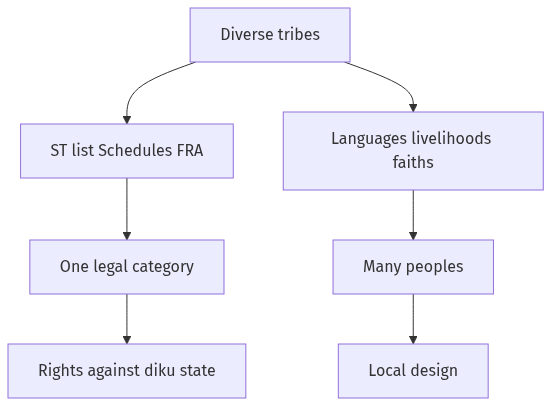
Tribes differ in tongue, faith, and farming across India. They are one category in the ST list, Schedules, reservations, and forest-displacement law. The shared fact is a relation to land, custom, and the settler-contractor state. Culture and livelihood need specific names, not a single folklore. Hold the legal umbrella and the ethnographic many together.
Model answer
Copper italics in this answer — like this — are the key facts. Each one is unpacked in the Facts & figures rail.
Introduction
Indian tribes differ in language, faith, farming, and kingship, from the north-east to the Andaman. They should be treated as one category only where the Constitution, the forest, and the settler state place them in the same relation of vulnerability.
Body
Contexts for a single category
- The Scheduled Tribe list, reservations, and the National Commission for Scheduled Tribes treat diverse groups as one legal class for political representation and jobs.
- Fifth and Sixth Schedule areas, governors’ powers, and autonomous councils address a shared problem of land, custom, and non-tribal settlement, even when Naga and Bhil histories differ.
- Forest rights, displacement by dams and mines, and the Forest Rights Act, 2006, meet a common pattern of state property versus community use.
- Census, tribal sub-plan finance, and anti-atrocities protection need a workable administrative umbrella, or the smallest groups vanish from the file.
- In opposition to the diku trader, contractor, and policeman, many communities already speak of a shared adivasi condition.
Where the single category fails
- Language families, shifting versus plough agriculture, and world religions among tribes make one culture claim false.
- North-eastern treaty politics, island Particularly Vulnerable Tribal Groups, and central-Indian peasant tribes do not share one demand list.
- Elite capture inside a pan-tribal party can hide gender and jati-like rank among some groups.
How to use both truths
- Use the single category for rights against dispossession and for affirmative action; use specific names for language, health, and local government design.
Flow diagram
Conclusion
Tribes are one category in law, forest, and anti-dispossession politics because the modern state met them as a single frontier. They are many peoples in culture and livelihood, and policy must hold both facts at once.
Quick related
Students also ask
-
Examine the uniqueness of tribal knowledge system when compared with mainstream knowledge and cultural systems.
Next question on this syllabus topic (2021 · Q9). View answer →
-
Is ‘Adivasi’ the same as Scheduled Tribe?
Adivasi is a political-cultural claim. ST is a legal list. They overlap but are not identical for every community.
-
Should every welfare scheme be pan-tribal?
Rights against eviction can be. Health, script, and shifting cultivation need group-specific design.
Same topic · past papers
UPSC has asked this before
These previous-year questions sit on the same topic. Open one to practise the earlier ask.
More from this topic
Q19 · UPSC Mains 2026 · GS I · 15 marks · Solution
Critically examine the challenges of demographic transition in contemporary India.
Indian Society and Diversity
India's demographic transition presents a complex picture of falling fertility rates and a rising working-age population, yet regional divergences undermine uniform gains. While southern and western states face rapid population ageing, northern and central states grapple with youth bulges that risk becoming liabilities without robust human capital investments. Critical bottlenecks include persistent gender imbalances, under-employment, and inadequate skilling infrastructure. Harnessing the demographic dividend requires targeted policy interventions in health, education, and employment generation rather than relying on population numbers alone. Ultimately, sustainable growth depends on transforming quantity into quality through inclusive regional development.
Q9 · UPSC Mains 2026 · GS I · 10 marks · Solution
How do you understand disability? Substantiate the need for inclusive policy framework in India in this regard.
Indian Society and Diversity
• Shifts understanding of disability from an individual medical deficit to a social construct caused by environmental and attitudinal barriers. • Adopts a rights-based paradigm that views persons with disabilities as active citizens entitled to dignity and equality rather than charity. • Fulfils constitutional mandates, notably Article 41, which directs the State to secure rights to work, education, and public assistance. • Addresses the demographic reality of over 2.68 crore disabled individuals in India as per Census 2011 through targeted resource allocation. • Overcomes multisectoral physical, educational, and employment barriers by enforcing the Rights of Persons with Disabilities Act, 2016. • Promotes universal design principles to ensure substantive equality, eliminate social exclusion, and drive inclusive national growth.
Q20 · UPSC Mains 2025 · GS I · 15 marks · Solution
Does tribal development in India centre around two axes, those of displacement and of rehabilitation? Give your opinion.
Indian Society and Diversity
Dams, mines and some conservation projects have made displacement a central tribal experience. Rehabilitation has often been a plot or cash that did not restore forest-based life. Those two axes therefore dominate the political meaning of tribal development. They are not sufficient: education, health, forest rights and PESA voice are development without a bulldozer. Opinion: treat displacement as a last resort with just rehab, and do not reduce all Adivasi policy to oustee management. Secure habitat plus citizenship is the fuller centre.