
Revision summary
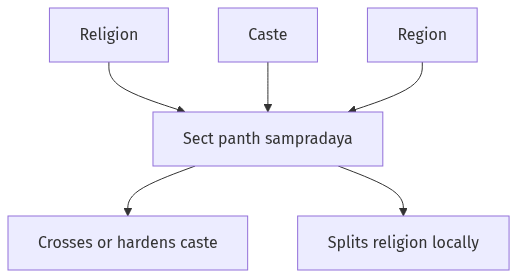
Sect means sampradaya or panth inside a larger religion. It can recruit across caste, yet it often becomes a new endogamous circle. It wears a regional language and shrine map. Religion, caste, and region remain the thicker grids of law, marriage, and state. Sect is the inner badge used when those three are too coarse or too crowded.
Model answer
Copper italics in this answer — like this — are the key facts. Each one is unpacked in the Facts & figures rail.
Introduction
- A sect in India is a bounded path inside a wider faith: a sampradaya, panth, or denomination with its own guru, book, and mark. It matters because it can split a religion, cross a caste, or sit inside a region without replacing any of the three.
Body
Sect and religion
- Religion names a large identity such as Hindu, Muslim, Sikh, Christian, or Jaina; sect names Vaishnava, Shaiva, Lingayat, Sunni, Shia, Ahl-i-Hadith, Khalsa, Nirankari, or Syrian and Pentecostal churches.
- Sect is therefore intra-religious salience: people fight conversion, shrine, and law inside one census religion.
- Bhakti and Sufi panths historically made religion livable as a local path rather than as a single church.
- Politics can freeze a sect as if it were the whole religion, which is why Shia–Sunni or Khalsa–other Sikh lines become public when votes and processions meet.
Sect and caste
- Many Hindu sampradayas claim a guru who takes disciples across jati, which is the sect’s promise of a religious public beyond birth.
- In practice Lingayat, Satnami, or certain Dalit panths also became new ranked communities, so sect can harden into a caste-like boundary.
- Endogamy often remains inside the sect’s inner circle even when the discourse is equality, which is why caste still organises marriage while sect organises the temple or dargah.
- Reservations and census categories sometimes meet sects that want ST, OBC, or minority status, which shows sect bargaining with the caste-state, not floating free of it.
Sect and region
- Sects are mapped: Chaitanya Vaishnavism in Bengal, Varkari in Maharashtra, Virashaiva in Karnataka, Kashmir’s older Shaiva and later Islamic lineages, Kerala’s Syrian Christians.
- Region supplies language, festival, and shrine circuits that make a sect feel like a homeland.
- Migration carries the sect into a new city, where it may become a caste-like association among strangers, as in urban jati-sampradaya sabhas.
Salience today
- Sect is most salient when a religious majority is too large to mobilise without a sharper badge, or when a minority needs an inner law and a guru against the outer census box.
- Caste remains the stronger grid of marriage and job; region remains the grid of language and state; religion remains the grid of festival and personal law.
- Sect is the flexible fourth: sometimes a bridge across caste, sometimes a knife inside religion, always wearing a regional face.
Flow diagram
Conclusion
Sect is salient in India as a path inside religion, a possible but incomplete escape from caste, and a regional style of worship. It never abolishes caste, region, or religion; it reorganises how those three are performed in shrine, marriage, and vote.
Quick related
Students also ask
-
Are tolerance, assimilation and pluralism the key elements in the making of an Indian form of secularism? Justify your answer.
Next question on this syllabus topic (2022 · Q19). View answer →
-
Is caste just a Hindu sect?
No. Caste is a birth-rank grid that also appears among some non-Hindus. Sect is a chosen or inherited religious path.
-
Can a sect replace region?
It can link regions through pilgrimage. Daily speech, food, and state politics remain regional.
Same topic · past papers
UPSC has asked this before
These previous-year questions sit on the same topic. Open one to practise the earlier ask.
-
2023 · Q11 · GS I · 15 marks
What are the main features of Vedic society and religion? Do you think some of the features are still prevailing in Indian society? -
2024 · Q10 · GS I · 10 marks
In dealing with socio-economic issues of development, what kind of collaboration between government, NGOs and private sector would be most productive? -
2024 · Q18 · GS I · 15 marks
Despite comprehensive policies for equity and social justice, underprivileged sections are not yet getting the full benefits of affirmative action envisaged by the Constitution. Comment.
More from this topic
Q10 · UPSC Mains 2026 · GS I · 10 marks · Solution
Do you think digital technology promotes social empowerment? Explain with examples.
Social Empowerment, Communalism and Secularism
Digital technology acts as a double-edged sword for social empowerment, bridging gaps in marginalized communities while simultaneously creating new forms of exclusion. On one hand, e-governance, financial inclusion via Jan Dhan, and digital literacy schemes enable grassroots mobility and amplify subaltern voices. On the other hand, the digital divide, algorithmic bias, and cyber-exclusion exacerbate existing socio-economic hierarchies. Therefore, structural interventions alongside technological deployment are necessary to ensure inclusive empowerment.
Q8 · UPSC Mains 2026 · GS I · 10 marks · Solution
Unity in diversity remains the defining feature of Indian society despite the challenges from communalism and regionalism. Comment.
Social Empowerment, Communalism and Secularism
India's civilizational ethos of unity in diversity persists despite structural pressures from communalism and regionalism. The answer analyses how historical syncretism and constitutional pluralism absorb societal friction. Communal polarization threatens the secular fabric through identity politics and majoritarianism. Regional aspirations, while occasionally manifesting as divisive sub-nationalism, often reflect genuine developmental imbalances. The conclusion highlights constitutionalism and inclusive governance as the anchors for reinforcing national cohesion.
Q9 · UPSC Mains 2024 · GS I · 10 marks · Solution
Intercaste marriages between castes which have socio-economic parity have increased, to some extent, but this is less true of interreligious marriages. Discuss.
Social Empowerment, Communalism and Secularism
Intercaste marriage has increased a little where education, income and urban life already match. The Hindu Marriage Act does not bar intercaste unions. The Special Marriage Act offers a civil path. The rise is selective and still a minority practice. Caste violence has not vanished. Interreligious marriage is rarer because personal law, conversion fears and honour politics raise the cost. Class can sometimes buy a caste exception. It rarely buys a religious exception in today’s climate. Constitutional choice of partner exists. Social enforcement is still family and community.