
Revision summary
Indian secularism grew from living with many faiths, not from a revolutionary church–state wall. Tolerance is the ethic of restraint; it was always imperfect. Constitutional pluralism in Articles 25–28 and minority rights is the legal core. Civic assimilation into one citizenship is needed; creedal assimilation is not. The Indian form is principled coexistence, still tested by communal politics.
Model answer
Copper italics in this answer — like this — are the key facts. Each one is unpacked in the Facts & figures rail.
Introduction
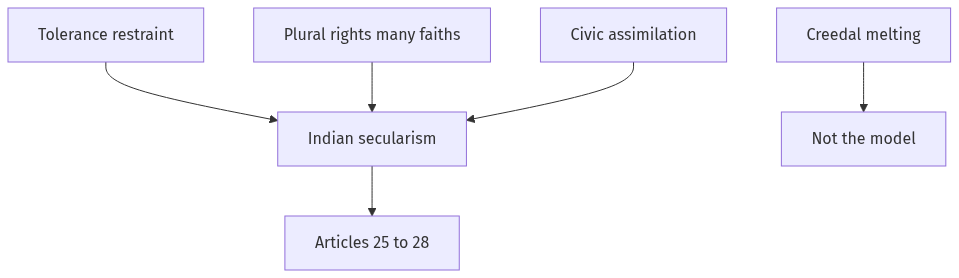
Indian secularism did not grow as a strict wall between church and state in the European revolutionary sense. It grew as a public ethic of living with many faiths, and tolerance, pluralism, and a limited assimilation are indeed its working parts, though not as equals.
Body
Tolerance as a historical base
- Ashokan dhamma, bhakti-sufi sharing of shrines, and Akbar’s sulh-i-kul taught that the ruler should not make one cult the only lawful path.
- Social tolerance was always uneven: it coexisted with hierarchy, conversion conflict, and riot. The inheritance is a norm, not a perfect past.
- The national movement’s claim to a composite people, and Gandhi’s equal respect, put tolerance into modern politics before 1950.
Pluralism in the Constitution
- Articles 25 to 28, minority educational rights, and personal-law plurality recognise that India is many religious publics, not one official church.
- The 42nd Amendment’s word ‘secular’ (1976) named a practice already in the text: the state may regulate religion for equality, yet it may also aid all faiths rather than starve them.
- Festivals, languages, and pilgrimage in the public calendar are pluralism as lived culture, which a French-style laïcité would thin out.
- Courts’ ‘essential practices’ doctrine is a clumsy tool, but it shows the Indian state walking into religion to keep a plural peace, not standing wholly outside.
Assimilation: use and danger
- Assimilation, as sharing a civic language, a vote, and a common criminal law, is a key element of one citizenship.
- Assimilation as melting all faiths into a majority custom is not Indian secularism; it is majoritarian absorption, which the Constitution’s minority rights reject.
- Tagore’s and Nehru’s ‘unity in diversity’ asked for a civilisational conversation, not for the erasure of the smaller voice.
- Therefore assimilation is a civic, not a creedal, element.
Justification of the ranking
- Yes: tolerance (daily restraint), pluralism (legal and cultural many-ness), and civic assimilation (one Republic) are the key elements of the Indian form.
- The distinctive Indian stress is principled distance plus pluralism, not the American wall and not Ottoman millet frozen in time.
- Communal violence and majoritarian campaigns show the form is incomplete; they do not prove that another model was the real Indian design.
Flow diagram
Conclusion
Indian secularism is made of tolerance, pluralism, and a civic assimilation into equal citizenship. Pluralism and restraint are the heart; faith-melting assimilation is not. The justification is constitutional text plus a long, uneven civilisational practice of many paths under one state.
Quick related
Students also ask
-
Has caste lost its relevance in understanding the multi- cultural Indian Society? Elaborate your answer with illustrations.
Next question on this syllabus topic (2020 · Q8). View answer →
-
Is Indian secularism the same as Western secularism?
No. It allows principled engagement with all religions and personal-law plurality, not only a wall of separation.
-
Does pluralism mean the state never touches religion?
No. Untouchability, reform of temples, and public order pull the Indian state into religion to protect equality.
Same topic · past papers
UPSC has asked this before
These previous-year questions sit on the same topic. Open one to practise the earlier ask.
-
2020 · Q18 · GS I · 15 marks
Is diversity and pluralism in India under threat due to globalisation? Justify your answer.
More from this topic
Q10 · UPSC Mains 2026 · GS I · 10 marks · Solution
Do you think digital technology promotes social empowerment? Explain with examples.
Social Empowerment, Communalism and Secularism
Digital technology acts as a double-edged sword for social empowerment, bridging gaps in marginalized communities while simultaneously creating new forms of exclusion. On one hand, e-governance, financial inclusion via Jan Dhan, and digital literacy schemes enable grassroots mobility and amplify subaltern voices. On the other hand, the digital divide, algorithmic bias, and cyber-exclusion exacerbate existing socio-economic hierarchies. Therefore, structural interventions alongside technological deployment are necessary to ensure inclusive empowerment.
Q8 · UPSC Mains 2026 · GS I · 10 marks · Solution
Unity in diversity remains the defining feature of Indian society despite the challenges from communalism and regionalism. Comment.
Social Empowerment, Communalism and Secularism
India's civilizational ethos of unity in diversity persists despite structural pressures from communalism and regionalism. The answer analyses how historical syncretism and constitutional pluralism absorb societal friction. Communal polarization threatens the secular fabric through identity politics and majoritarianism. Regional aspirations, while occasionally manifesting as divisive sub-nationalism, often reflect genuine developmental imbalances. The conclusion highlights constitutionalism and inclusive governance as the anchors for reinforcing national cohesion.
Q9 · UPSC Mains 2024 · GS I · 10 marks · Solution
Intercaste marriages between castes which have socio-economic parity have increased, to some extent, but this is less true of interreligious marriages. Discuss.
Social Empowerment, Communalism and Secularism
Intercaste marriage has increased a little where education, income and urban life already match. The Hindu Marriage Act does not bar intercaste unions. The Special Marriage Act offers a civil path. The rise is selective and still a minority practice. Caste violence has not vanished. Interreligious marriage is rarer because personal law, conversion fears and honour politics raise the cost. Class can sometimes buy a caste exception. It rarely buys a religious exception in today’s climate. Constitutional choice of partner exists. Social enforcement is still family and community.